Nov 28, 2026
Nov 28, 2026
and Favourite Pursuits
Introduction
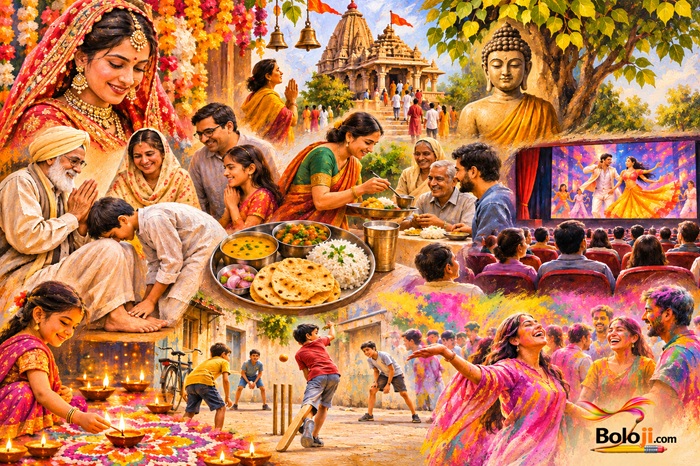
India stretches across a vast expanse of land, languages and memories, yet many people outside the subcontinent meet only a few scattered images of it through news reports, tourist brochures or popular stories. They might think first of crowded streets, ancient monuments, religious rituals or software engineers. They may not at once notice quieter habits that have taken shape over long periods of time and that influence how people in India eat, dress, pray, celebrate, argue, rest and imagine their futures. The pieces gathered in this essay bring together some of these habits and preferences. They do not speak for every part of the country or for every group, yet they sketch certain patterns that recur often enough to be worth patient attention.
One of the strongest threads concerns food. Vegetarian practices have deep roots in many regions and communities, although those practices do not exclude variety or pleasure. Another thread glitters in a far more literal sense. Gold jewellery carries historical, religious and emotional weight in India. It marks moments of transition, shores up a sense of security and feeds ideas about beauty and status. People who try to understand Indian life only through formal institutions miss the importance of these intimate habits of eating and ornament.
Visitors and writers have also long remarked on traits of behaviour that appear again and again when they speak with people in India. Accounts of warmth, hospitality and courtesy sit beside discussions of humility, self-doubt and the longing to be accepted by others. These qualities may stretch across religious and regional boundaries, and they colour domestic life, workplaces and encounters between strangers. At the same time, calendars filled with religious festivals and public holidays create a sense that life unfolds as a chain of occasions. There are fasts and feasts, processions and gatherings, official ceremonies and quiet rituals at home. The working year bends around these observances, which bring joy and rest to many people and also create real strain for those who worry about lost time and declining productivity.
Underneath these habits of everyday life lie older moral and spiritual ideas. The modern language of nonviolence in India draws on several currents at once. Ancient teachers from different traditions, later reformers and twentieth century leaders such as Mohandas Karamchand Gandhi turned earlier attitudes of forbearance into deliberate ethical and political programmes. Debates in present day India still circle around the strengths and weaknesses of these traditions of restraint and endurance. Hinduism, which remains the majority faith in India, developed over many centuries without a single founder or central authority, and this history has shaped its elasticity and its capacity to absorb new practices and figures into an already crowded sacred field.
Other aspects of Indian life at first appear more modern, yet they are no less revealing. Everyday codes of etiquette shape greetings, gift giving, table manners and the treatment of elders and guests. Mass entertainment has left its own imprint. Cricket grips people in cities, towns and villages, blurs regional tensions and offers heroes who carry the burden of public fantasy. Cinema feeds those fantasies further. Films that promise romance, adventure and triumph invite viewers to step for a few hours into another existence, while art house productions and regional industries attempt to confront harsher realities. Through all these domains runs a tension between dreams and limits, between what people long for and what they feel able to reach. The sections that follow explore these themes one by one and, taken together, reveal how certain patterns of belief, pleasure and conduct help to shape the many lived versions of Indian life.
Vegetarianism
There exist several misconceptions in the minds of people about vegetarianism in India. This article tries to dispel these misconceptions and also shows you how to live healthy as a vegetarian in India. Firstly, if you are a vegetarian and want to know more about this topic, you need to know that being a vegetarian in India does not denote strictness or only one fixed lifestyle. Rather, it refers to a lifestyle that respects the lives of animals and plant beings. Being a vegetarian does not restrict one to a certain diet or to consuming only limited amounts of food items.
In ancient times, many regions of India had strong vegetarian currents, especially among certain communities, although meat eating also existed. Over long periods the diets of large sections of people moved from animal to plant foods which led to an increase in the number of vegetarians in India. In this country, the western world has been trying to influence Indian culture, values and beliefs. There are several reasons for this. One explanation is that meat has been regarded as prestigious in some western cultures and another that there is a strong concern there about nutrition and modern food habits.
However, this has not stopped people from adopting vegetarianism in India. You will find that there is a wide variety of diets and recipes available for vegetarian food items in India. Apart from the standard legumes, you will also find that there are many other food items like pulses, grains, cereals, wheat and vegetables. The history of vegetarianism in India is there for all to see, though historical references are always subject to personal interpretations and, based on excavations and other proofs available, there are several versions of it. Rather than trying to analyse and discuss these various versions of it, focus instead on the basic essence of vegetarianism in India, which is that of a non-meat-eating culture for many communities.
Love for Gold and Jewellery
For centuries people in India have adored and valued gold and jewellery. Gold has always been seen as something of great value in the Indian context. It was often considered a symbol linked with Hindu gods. Gold also played an important role in many Indian wedding ceremonies, as it was considered auspicious for the bride to wear golden jewellery. The connotations of gold in Indian culture and tradition make it something that people treasure very deeply.
Indians have long spent very large amounts of money on gold jewellery. Many reasons account for this fact. People are passionate lovers of gold and they use it in many forms like necklaces, earrings, rings, pendants, brooches and other ornaments. Popular imagery in India often links gold jewellery with feminine beauty and status, and many families, across genders and generations, value gold both as ornament and as a store of wealth. This may stem from the long cultural history or from gender roles within families and communities. Gold jewellery and gold coins are symbols of security and beauty and many Indians are very passionate about them. They spend huge amounts of money on buying gold jewellery even at the cost of limiting comforts for themselves.
Indians have such passion for gold that many of them get involved in the trading of gold. The modern-day Indian population has inherited this love for gold and jewellery from earlier generations and they continue to carry on this old Indian tradition.
Friendliness and Humility
Many people in the West think that Indians are hard and cold people and that they must be very rude and always have a sense of bitterness and hatred towards everyone around them. This is not true, since there is more to the question than that. Any outsider who interacts with them wonders, how come Indians are so nice. Here are some of the answers to that question.
Many visitors comment on experiences of generosity and hospitality in India, although, as in any large society, habits of behaviour and attitudes vary widely. Even if you do not like someone, if you try to get into an argument or try to be mean to them, they often will not be angry with you and they may try to help you because they see you as a potential friend. Many Indians are very good at helping out and helping their friends.
Indians are also in many cases very humble, and they do not feel that they are better than anyone else. They only think that they deserve a good life and they work hard for it. Many commentators notice that this sense of modesty coexists with strong ambition and pride in personal achievement, which deepens the complexity of Indian social life. When you think about it you may realise that Indians are often the ones who long to be accepted.
Life as a Long Celebration – Festivals and Holidays
Why do Indians have so many festivals and holidays. This question needs an answer, because if we analyse this carefully there could be a correlation between festivals and holidays and also with time. Some observers link certain relaxed attitudes towards deadlines or long-term planning to religious ideas such as rebirth, although such explanations are debated and do not apply uniformly across India’s many religious and social groups. They also view life as a never-ending celebration and therefore they turn many events into a festival. Added to the religious festivals are the secular festivals such as Independence Day, Republic Day and the birthdays of various national figures. All these add up to a very large number of holidays that affect work. Occasionally several holidays fall close together, effectively turning part of a week into an extended break, especially when employees also take additional leave around major festivals.
Even though there are already many festivals and holidays, the adherents of various religions compete with each other and put pressure on the government to declare even more holidays on their respective minor religious occasions. In addition to these groups, the fierce followers of various national figures too pressurise the government to declare holidays on the birthdays of their leaders.
Some workers say that there is nothing wrong in having many holidays and festivals because it gives them more time to pray and obtain some enjoyment from their daily work routine. Others feel that they are not doing their job properly because of the existence of too many religious festivals and holidays. There are employees who do not show up for work on days preceding or succeeding these holidays. This is not only a waste of time and energy but this also badly affects the productivity of the employees and their efficiency. Whatever the case may be, it is important for all of us to understand that these things badly affect our productivity and that is why we should try to minimise their effect on our lives.
Non-violence and Peaceable Nature
Non-violence and the peaceable nature of Indians are traits that many observers associate with India in the modern world. The ideal of non-violence was articulated in different ways by ancient teachers such as the Buddha and, in more recent times, by Mahatma Gandhi. Apart from leading a mass movement for the independence of India, Gandhi urged his fellow citizens to adopt non-violence as a way of life so that India could contribute to a more peaceful world. One historical explanation sometimes offered for the spread of such attitudes points to the long experience of foreign rule in many parts of the subcontinent. When many communities faced powerful regimes that could be harsh or unpredictable, they developed habits of accommodation and psychological strategies centred on tolerance and endurance. These helped them to survive under difficult conditions without constant open conflict. In the twentieth century Gandhi transformed these habits of patience and forbearance into a conscious political method. He insisted on disciplined, organised non-violent resistance and in this manner he turned what had often been a survival strategy into a deliberate moral and political weapon that exposed the limits of colonial authority.
Non-violence and peaceableness in India are not confined to a single religious tradition but draw on a broader philosophical outlook that values restraint, compassion and the recognition of a common humanity. At the same time, this outlook has its ambiguities. The same tendency to avoid confrontation can sometimes lead to excessive tolerance of clearly harmful situations, including corruption, misgovernance, noise and environmental pollution and everyday forms of indiscipline that make life difficult for many people. Gandhi himself acknowledged that non-violence demands courage, organisation and a willingness to resist injustice, not mere passivity. Contemporary debates in India often focus on how to preserve the ethical core of non-violence while avoiding the kind of quiet acceptance that allows avoidable suffering and public disorder to continue unchecked.
Hinduism the Last Surviving Organically Evolved Major Religion
Hinduism, the predominant religion of India, is basically a way of life rather than a religion in the sense of the Abrahamic religions which have all been founded by prophets, often have only a single scripture and most definitely only one God. Hindu religion has many unique features. First, it is the last surviving organically evolved religion of the world, with roots that scholars usually trace back several millennia before the common era, though exact dates remain debated. Second, it still continues with the worship of innumerable gods and goddesses who represent mostly the forces of nature or fundamental human emotions, which is similar in some respects to the deities worshipped by the Greeks and Romans prior to the establishment of Christianity. Third, some writers argue that the worship of female deities alongside male deities can provide cultural models that support respect for women.
The fourth unique feature of Hinduism is spiritual democracy which manifests itself in the form of freedom of the worshippers to choose their gods or goddesses. It is not the other way round, that is, one unquestionable God does not demand absolute and unchanging devotion from the believers. If any worshipper is unhappy with his god, he is free to set aside the deity concerned and choose another god, much as citizens of a democratic country change their representatives.
The fifth special feature of Hinduism is that it does not place stress on proselytising. Part of the reason for it is that it is a naturally evolved religion and its principles have never been codified in a single scripture although there are many books which pass off as its holy books. It is more of a system of beliefs, practices, taboos, traditions and conventions that have evolved over a period of millennia in response to the exigencies of life from time to time. It resembles the unwritten constitution of the United Kingdom which is basically a system of conventions developed over centuries. However, these beliefs, practices, taboos, traditions and conventions are often confused with divinely sanctioned religious laws and principles and accorded the same importance.
The sixth notable thing about Hinduism is its elasticity meaning that it is formless, hard to define and amorphous. It can, and often did, absorb many faiths or belief systems, even when they appeared to contradict established practices, and deprive them of a separate identity. For example, many Hindu traditions incorporated the Buddha into their own pantheon through the avatar theory, which some historians see as one factor among many in the decline of Buddhism in much of India, even though Buddhism has remained a distinct religion. This incorporation led many Hindus to treat the Buddha as a Hindu deity, only one strand within a far wider Buddhist history that extends beyond the subcontinent.
Indian Etiquette
Indian etiquette is essentially the unique set of behavioural patterns, customs, traditions and beliefs associated with being Indian. Etiquette in Indian culture is practised by Indian men, women, elders and children almost as a matter of unwritten rules. Indian etiquette covers a host of activities like eating, drinking, visiting, travelling, working, playing, sitting and other socialising activities. The essence of Indian etiquette is treating others with respect, love and consideration.
Indian etiquette was described in early Sanskrit texts and later literature. The Rig Veda, a Sanskrit scripture, contains material that relates to rules and rituals associated with ancient Indian society. Readers who turn to this ancient text and to later works can gain insights into the mindset of earlier Indian communities. This helps one to understand and appreciate the roots of Indian culture better.
An important part of Indian etiquette is that the gifts that one gives to friends, family members, colleagues, servants and strangers should be of value and they should make a positive impression. One should always select gifts that can be used by the receiver in the future and enjoyed. Another important aspect of Indian etiquette is the unwavering respect accorded to elders. Everyone is expected to speak respectfully to the elders and not to insult them in any manner. In fact, some communities have been known to tolerate men with extremely bad manners, as long as they are aware that such men are elders by age, profession and status.
There is an important connection between Indian culture and good etiquette. In India, a guest is considered to be a demi-god. Thus, it is important for a host to treat the guest with utmost respect and avoid rude behaviour. The host is expected to feel blessed to be given an opportunity to play host. Indian etiquette thus tries to make sure that guests feel the warmth of hospitality extended by the host and his family and enjoy eating the delicious food offered. Hosts often try to make sure that a guest never feels that he has eaten enough. He is always served first. The host constantly urges him to eat more. Although it is sometimes a little inconvenient, it still makes sure that the guest enjoys the flavour and aroma of the food.
Indian etiquette relating to eating is as old and as well-known as its rules of respect. A guest is always welcome and always served first, and similar expectations of generosity apply at the table. A guest is never ignored at the table. When you order in India you can usually expect to be served with love, respect and consideration for your presence at the table. Indian etiquette on eating is also about serving only when you are truly hungry, that is, if you really want the food and you really want to have it.
Indian etiquette on eating does not mean that you will always wait for others to order and eat. Indian etiquette on eating holds that you will order when you are hungry and you will wait for the guests when they are ready. Indian etiquette on eating is also about the amount of food you will have, while in America and the West in general, it is often more about the number of guests than the kind or amount. But Indian etiquette on eating does not only involve the amount of food served at one table. It also includes the time.
Cricket Craze
Cricket is a national obsession in India, with cricket being played anywhere and everywhere by people of all ages. There are many who are crazy about cricket and the popularity of the game is increasing with time. There are several reasons that have given rise to the cricket craze in India. Cricket is not just a game for cricketers, it has also become a part of the life of most Indians. Almost every household in India has at least one cricket bat and many of them even have a set of balls that they keep with great care. The popularity of the game has brought it to new levels and now many youngsters as well as adults are taking to cricket with great enthusiasm. Although cricket is a legacy of the British Raj, Indians have learnt to detach the pain of colonial rule from the pleasure of playing cricket. They have unofficially given it the status of national sport.
There are many reasons for the popularity of cricket in India, one being that it is one of the major sports widely followed across South Asia, which helps to create a feeling of pride and identity among the people of India. If we carefully analyse the psyche of people of India, it emerges that cricket is not only a game that helps people in the form of mental and physical work but something that develops their leadership qualities. Further, it has proved to be a great unifier. It brings the entire nation together and inspires patriotism and makes people feel strong.
There are many other advantages of cricket for India. Cricket is a game that can be played at many times of the year and it does not matter whether one is playing in the hot sun, on a rainy day or in the cold winter. A person can play cricket almost anywhere, because it does not matter very much what the weather is like, one just needs to have some patience. No wonder then that cricket enjoys a huge following in the country. Cricket fans have always been on the lookout for a good competition to cheer for their favourite team and their favourite players such as Sunil Gavaskar, Kapil Dev, Mohammad Azharuddin, Sachin Tendulkar, M S Dhoni, Rahul Dravid, Virender Sehwag, Sourav Ganguly and others. Incidentally, in the list of all the Indian cricketers Tendulkar stands out head and shoulders above the rest. Tendulkar is one of the most popular Indian cricketers and his popularity has remained very strong since his debut as a test cricketer. Even his retirement does not seem to affect his image and popularity.
Films as an Inescapable Cultural Phenomenon
In India films are a cultural phenomenon, preferred pastime and even a national obsession. People enjoy watching films because they portray images of love and friendship that people seem to miss in real life. They also present the idea of living an exciting life that is full of happiness and adventure. They are more than entertainment because the subtle message they convey is often uncritically internalised by the film goers. Ideally films should give deep insight into the human mind and social life but many Indian films do not try to do that. People seem to obtain a indirect satisfaction from watching their favourite film heroes and heroines falling in love and living an adventurous life, things that are missing from real life. They seem to live their dreams through the celluloid images on the screen. The caste system and other social imperatives prevent people from freely mixing with each other and forming emotional bonds. They therefore identify themselves with the images on screen and live in an illusory or vicarious satisfaction.
The film industry of India is highly creative and has a lot of potential. It creates a huge platform for talented and skilled people to express their creativity. It also gives them an opportunity to learn, work and create something special in their lives. Critics argue that much mainstream commercial cinema favours escapist fantasy over realistic portrayal, potentially encouraging idealised or distorted expectations of life, although other strands of Indian cinema have explored social and psychological themes with considerable nuance.
Filmmakers are constantly on the lookout for stories that can hold the attention of the audience, whether the stories have any message or not. They then groom the story in such a way that it becomes a hit, by bringing in what are called masala elements, fights, songs, dances, emotionally charged scenes and similar attractions. It does not occur to them that the story and its depiction should be honest and true to life. Critics further contend that such films can thrust a particular image of life upon the audience and encourage them to believe in something overly simplified or illusory. Unsurprisingly, many people believe that life is like a film and that films shape life. In other words, life resembles a long movie that starts in one frame and ends in another. Indian cinema as a whole suggests this mindset. When these films make it to the international markets, people elsewhere in the world develop false notions about life in India on the basis of what they see on the screen. Those who verify it with other and independent sources such as scholarly accounts of life as it exists in India feel truly baffled by these films and the inaccurate picture of India they present.
Conclusion
The themes gathered in this essay form a loose circle around everyday existence in India rather than a neat theory. Food, ornament, manners, religious beliefs, games, holidays and films may look at first like separate subjects, yet they keep touching one another. Vegetarian habits shape what hosts place before guests, while rules of etiquette guide the sharing of that food. Gold jewellery glitters at weddings and religious ceremonies that themselves cluster around festival days. Non-violence and spiritual democracy influence how people think about public life and politics, but they also colour domestic disputes and family expectations. Hindu rituals and stories give content to many festivals and find their way into film plots and cricketing metaphors. Each element carries its own past and its own tensions, yet together they give a sense of how many Indians try to build meaning and comfort in the midst of pressure and change.
A quieter thread runs through all these aspects. At many points we meet a tension between generosity and strain, between openness and withdrawal. Hospitality towards strangers meets worries about time lost during long stretches of holidays. Traditions of non-violence and forbearance sometimes turn into excuses for inaction in the face of corruption or pollution. Cinema feeds dreams that lift people for a short while out of harsh routines, yet these dreams can also deepen frustration when real life refuses to match the screen. Love of gold offers a sense of safety and continuity, but that same desire can lead families into debt. Even cricket, which seems at times to heal divisions and kindle shared pride, can distract attention from other forms of public engagement that require patience and self-questioning.
Indian life, as seen through these examples, neither fits a single stereotype nor escapes contradiction. It contains habits of restraint beside displays of exuberance, deep respect for elders beside youthful impatience, spiritual ideals beside commercial pressures. Any honest account of the country must live with this mixture. The aspects discussed here do not exhaust the subject, yet they open a way towards more attentive observation. Anyone who listens closely to conversations in homes, watches the give and take at a festival, stands in a cinema queue or follows a cricket match begins to notice how inherited customs and new desires weave together. That interplay gives modern Indian life much of its particular flavour and leaves room for further change in the years to come.
28-Nov-2026
More by : Prof. Rajeshwar Mittapalli