Nov 28, 2026
Nov 28, 2026
The Poetry, Art, and Journey of Amitabh Mitra
in Trauma and Gender-Based Violence
Introduction
In the twenty-first century, medicine and the arts have moved from polite coexistence to active collaboration. Medical humanities, narrative medicine, graphic medicine, art therapy, and expressive-arts practice now inform how clinicians learn to observe, listen, reflect, and endure the emotional weight of care.
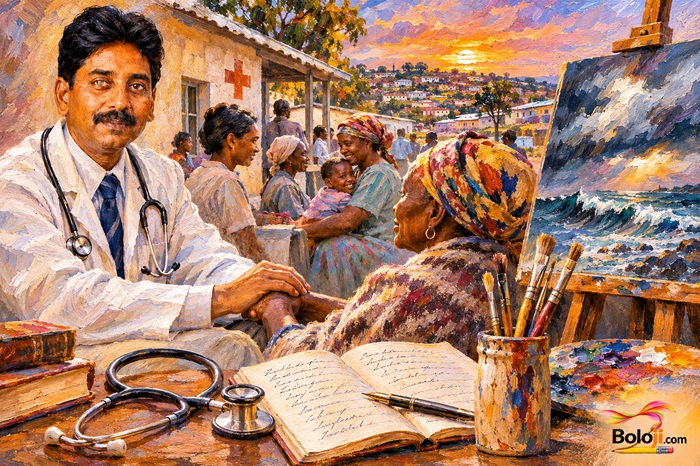
The work of Amitabh Mitra, an Indian-born South African physician, poet, and artist, offers a particularly revealing case. His career joins orthopaedic and trauma surgery, forensic examination in sexual-violence cases, poetry, painting, and community testimony. It therefore illuminates three questions at once: what art does for patients, what it does for clinicians, and what it does for a society confronting violence.
Medicine and the Arts: A Changing Field
The contemporary field is often described as medical and health humanities. Recent accounts argue that these disciplines challenge the separation of technical knowledge from lived experience and offer an antidote to highly technical, mechanistic training. Medical schools have increasingly incorporated literature, visual art, music, storytelling, and reflective writing to cultivate empathy, communication, observation, self-reflection, and professionalism. Over the past ten years, interest in integrating arts and humanities into medicine has grown specifically to increase learners’ empathy and resilience and improve well-being, communication, and observational skill.
Narrative medicine is central to this shift. Proposed by Rita Charon, it strengthens patient-centred care by helping clinicians recognise each person’s distinctive experience of illness. Narrative competence—the ability to recognise, absorb, interpret, and act upon stories—has been linked to empathy, trust, professional efficacy, and protection against burnout. In perioperative and other high-pressure settings, narrative workshops have been associated with improved professional efficacy and well-being, while reflective practice provides emotional catharsis, resilience, and meaning-making.
The evidential base extends beyond education. The World Health Organization’s 2019 scoping review mapped more than 900 publications, including 200 reviews covering more than 3,000 further studies, making it the most comprehensive arts-and-health review to that date. It examined arts activities for health promotion, illness prevention, and the management and treatment of physical and mental ill health. The report’s significance was not that art replaces clinical care, but that creative engagement can shape determinants of health, support recovery, and help people make meaning from experiences that resist purely biomedical description.
Graphic medicine, poetry, music, dance, and visual art also matter because illness and trauma are not only diagnosed; they are inhabited. A painting, poem, or comic can hold ambiguity, grief, anger, bodily memory, and hope simultaneously. In clinical education, close looking at art trains attention; in care, creative expression can offer a language when direct narration is too painful, too fragmented, or too dangerous.
Amitabh Mitra: Physician, Poet, Artist, Witness
Mitra is an Indian-born South African physician, poet, and artist known for work in trauma surgery and sexual violence as well as poetry. He studied medicine and pursued postgraduate orthopaedic surgery at Gajara Raja Medical College in Gwalior, India. His clinical geography is unusually wide: Bhutan, Arunachal Pradesh, Niger, Zimbabwe, Transkei, and Ciskei. His own site states that he served as an orthopaedic surgeon in high-altitude hospitals in Bhutan and Arunachal Pradesh, Niger, Zimbabwe, Transkei, and Ciskei, and later became Adjunct Professor of Emergency Medicine at the Datta Meghe Institute of Medical Sciences in Wardha, India.
In South Africa, he worked for more than thirty-five years in trauma and sexual violence in the Thuthuzela Rape Examination unit at Cecilia Makiwane Hospital in Mdantsane. He headed the Department of Accident and Emergency, Trauma, and the Thuthuzela Gender Violence Assistance Centre at that hospital. A 2026 tribute describes him as Professor and Head of Emergency Medicine and Head of the Thuthuzela Care Centre for the East London district, and credits expert testimony in High Court cases with contributing to 2,800 life and double-life sentences. That figure should be read as a tribute’s claim rather than an independently verified court statistic, but it captures the forensic gravity of his clinical role: examination, documentation, evidence, testimony, and the translation of bodily injury into a form the law can hear.
Mitra’s creative biography runs alongside, not after, medicine. His first book of poems, Ritual Silences, appeared in 1980. His publications of poems A Slow Train to Gwalior in 2009 and Mdantsane Breathing in 2010. His later Anarchy and the Sea brought together COVID-19 feelings, violence, and trauma encountered in emergency medicine with impasto seascapes of violent storms. His paintings are often described as dramatized stick figures, a visual language that is deliberately legible, urgent, and stripped of ornament.
In interviews, Mitra traces the fusion to childhood in Gwalior, sketching the fort at dusk and writing verses in textbook margins, then writing poems after long medical shifts. He describes the scalpel and pen as extensions of the same impulse: to understand suffering and transform it. Art, for him, teaches listening beyond noise and helps the clinician see the person rather than only the injury. Poetry, he says, allows him to hold pain without being consumed by it and gives shape to chaos.
Trauma, Gender-Based Violence, and the Work of Art
Mitra’s practice sits inside South Africa’s devastating gender-based violence crisis. The Human Sciences Research Council’s first national Gender-Based Violence and Femicide prevalence study found that approximately 7.3 million women aged eighteen and older had experienced physical violence in their lifetime, while more than 2.15 million had experienced sexual violence. More than 35 percent of South African women aged eighteen and older had experienced physical or sexual violence in their lifetime. So a recent news story by UK based Sky News caught Africa Check’s attention when it stated as fact: “It is estimated that a woman or girl is raped every 26 seconds in South Africa – and violence against women is an ‘almost accepted social phenomenon.
Thuthuzela Care Centres were designed as a systemic response. Their name comes from the isiXhosa word meaning “comfort.” They are one-stop facilities intended to reduce secondary victimisation and build a case ready for prosecution. Their pathway combines welcome and comfort, medical examination, consent, forensic evidence collection, counselling, treatment and medication for sexually transmitted infections and HIV, police reporting, court preparation, follow-up, transport, and referral to safety. The model is therefore already multidisciplinary: medicine, law, social work, nursing, and psychosocial care must meet in one place.
Art enters this landscape in several distinct ways. First, it offers survivors a non-linear route to expression. Expressive Arts Therapy integrates visual art, movement, storytelling, music, and ritual to support emotional regulation, identity exploration, and relational healing. In Toronto’s Hubs of Expressive Arts for Life project, a twelve-session expressive-arts intervention for fifty-two women across six cohorts began with co-creation rather than narration and allowed participants to engage at their own pace without pressure to disclose abuse. Evaluation documented improved emotional regulation, self-efficacy, confidence, rights awareness, reduced isolation, and stronger peer connection.
Second, art makes testimony public without requiring a survivor to become a legal exhibit. Mitra’s Mdantsane Breathing uses painting and poetry to record township life in watercolour, pastel, and verse. His own site describes the book as detailing Mdantsane in art and poetry and dedicating it to its brave people. A contemporary account says each page pairs painting or sketch with poetry distilling township life “breathing.” The township is therefore represented not only as a site of injury, but as a place of laughter, movement, dignity, and ordinary endurance.
Third, art sustains clinicians. Mitra’s core interests include burnt-out Accident and Emergency doctors and rejuvenating them through art. In a setting where practitioners repeatedly meet blood, panic, silence, and moral injury, creative practice can function as containment: a place to process what cannot be spoken in a ward round, to mourn patients who could not be saved, and to recover the capacity to attend to the next person.
Reading Mitra’s Journey: Exile, Witness, and Return
Mitra’s journey is shaped by migration. He arrived in South Africa in 1990, working first in the former Bantustan of Transkei, and later at Cecilia Makiwane Hospital in Mdantsane. He describes leaving India as entering a stranger’s exile and says an immigrant will always remain an immigrant. That consciousness informs Splinters of a Mirage Dawn, his anthology of migrant poetry from South Africa, and his insistence that poetry linked to visual art, dance, music, and cinema can reach audiences more fully than text alone.
His account of medicine is also a critique of medical culture. He calls parts of the medical establishment stuffy and resistant to creativity, yet notes changing institutions, including chairs and prizes for literature and medicine. His alternative is not undisciplined improvisation. He accepts that surgeons cannot invent procedures, but argues that clinicians can spend more time with patients before and after surgery and use creative attention to support faster healing.
The tension is productive. Clinical work demands protocol, evidence, and reproducibility. Art demands lateral thinking, ambiguity, and risk. Mitra’s practice holds both by assigning them different tasks: protocol governs the body; art governs attention, memory, mourning, and moral imagination.
Conclusion
Mitra’s significance is not that he proves art cures trauma. The evidence for arts-and-health interventions is promising but uneven, and creative practice cannot substitute for medical care, legal protection, housing, income security, or functioning Thuthuzela services. His significance lies in modelling a complete ecology of care: forensic precision in the examination room, narrative attention in the clinical encounter, poetry and painting as forms of clinician survival, and public art as community testimony. In a twenty-first-century medicine increasingly shaped by speed, data, and automation, his work insists that healing remains relational. The scalpel can repair tissue. Only attention, language, image, and witness can help a person, a clinician, or a township say what happened and continue living after it.
Arts and Medicine : A short film made on Dr Amitabh Mitra by the Department of Arts and Culture, Eastern Cape explaining Fusion of Arts with Medicine.
28-Nov-2026
More by : Braja K Sorkar
Top | Individuality | Home