Nov 28, 2026
Nov 28, 2026
Democracy does not mean merely casting a vote once every five years and handing politicians a licence to rule without accountability. It means questioning those in power, challenging arbitrary decisions, exposing corruption and resisting every attempt to undermine constitutional freedoms. Elections may bring governments to power, but they do not confer absolute authority. The moment rulers begin treating criticism as an offence, dissent as disloyalty and peaceful protest as a threat to national security, democracy begins to decay from within. A government that cannot tolerate questions has no moral claim to call itself democratic.
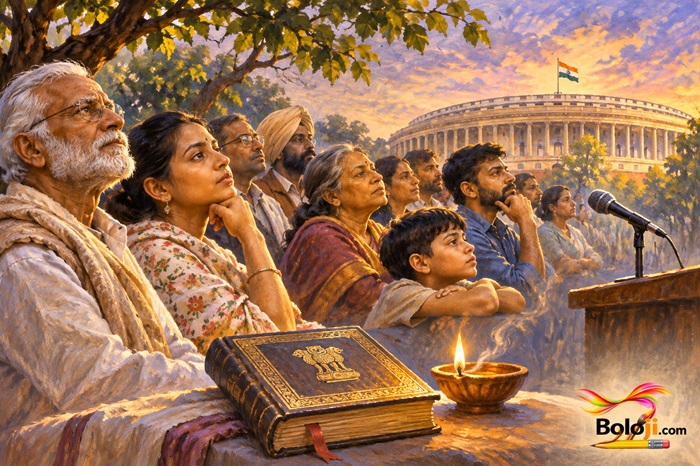
The real test of democracy is not how comfortably those in power govern, but how freely ordinary citizens can challenge them. When people demand drinking water, better roads, functioning public hospitals, affordable education and protection from exploitation, they are not disturbing public order. They are demanding accountability. When official complaints go unanswered, demonstrations and peaceful protests become legitimate instruments of democratic pressure. A government that expects obedience but refuses to listen has confused public mandate with political ownership.
Article 19 of the Indian Constitution guarantees freedom of speech and expression, as well as the right to assemble peacefully and without arms. These freedoms are subject to reasonable restrictions, but such restrictions cannot become convenient weapons for silencing inconvenient voices. The state cannot invoke public order to suppress public opinion. Nor can it selectively defend constitutional freedoms when protests favour its political interests while criminalising dissent when they challenge its authority. Violence and destruction have no place in democratic movements, but neither does the systematic intimidation of peaceful demonstrators.
Parliament, the supreme legislative forum of the people, is increasingly confronted with questions about the quality of democratic deliberation. Legislation should emerge from informed debate, scrutiny and consultation, not from numerical superiority and political arrogance. According to PRS Legislative Research, only 27 per cent of Bills introduced in the 18th Lok Sabha had been referred to parliamentary committees by the end of the 2025 Monsoon Session. When laws are pushed through without adequate scrutiny, Parliament risks becoming a rubber stamp rather than an institution of accountability. A parliamentary majority is a mandate to govern, not a licence to bypass democratic deliberation.
The credibility of constitutional institutions is equally fundamental. Questions surrounding the independence of investigative agencies, electoral transparency, media freedom and judicial accountability cannot simply be dismissed as opposition propaganda. Institutions created to protect democracy must not become instruments of political convenience. If investigative agencies appear selective, elections invite persistent doubts, and journalists face intimidation for exposing uncomfortable truths, public confidence inevitably erodes. Institutions derive their legitimacy not from government patronage but from their independence and impartiality.
The warning signs are difficult to ignore. Freedom House's 2025 report awarded India 51 out of 100 for internet freedom. Access Now recorded 84 internet shutdowns in India during 2024. Such restrictions do not merely inconvenience protesters. They disrupt students' education, cripple small businesses, interrupt digital transactions and affect ordinary citizens who depend on connectivity for their livelihoods. National security cannot become an all-purpose excuse for restricting citizens' access to information. Restrictions must be necessary, proportionate, transparent and subject to scrutiny.
The judiciary and the media, too, must recognise their constitutional responsibilities. Justice delayed is often justice denied, particularly for citizens who cannot afford prolonged litigation. The media must investigate those in power rather than act as their public relations machinery. Journalism that merely amplifies official propaganda while ignoring public suffering is not responsible journalism; it is an abdication of its democratic duty.
Street protests, however, cannot replace elections, legislatures, courts or independent institutions. They are an essential democratic safeguard when these institutions fail to respond adequately. Farmers' movements, workers' struggles and campaigns for civil liberties have repeatedly demonstrated how collective public action can force neglected issues into national debate. Peaceful resistance is not anarchy. It is the assertion of constitutional rights. But violence, intimidation, destruction of public property and coercion cannot be justified in its name.
Most importantly, defending democracy is not the exclusive responsibility of opposition parties or activists. Citizens who support the ruling party have an equal responsibility to question wrongdoing. Political loyalty must never become intellectual servitude. A citizen who excuses injustice because it is committed by a favoured leader is not defending democracy; that citizen is helping to dismantle it.
Democracy does not die overnight through a single dramatic coup. It is weakened gradually—when Parliament stops debating, institutions surrender their independence, journalists abandon scrutiny and citizens become too frightened or indifferent to speak. Silence is not neutrality when constitutional freedoms are under attack. Governments must understand one fundamental truth: citizens are not subjects, dissent is not a crime, and power is never above the Constitution."When the last voice of peaceful protest is silenced, what remains may still look like democracy, but its soul will already be dead."
28-Nov-2026
More by : Prof. Dr. K. Ram Kishore