Nov 28, 2026
Nov 28, 2026
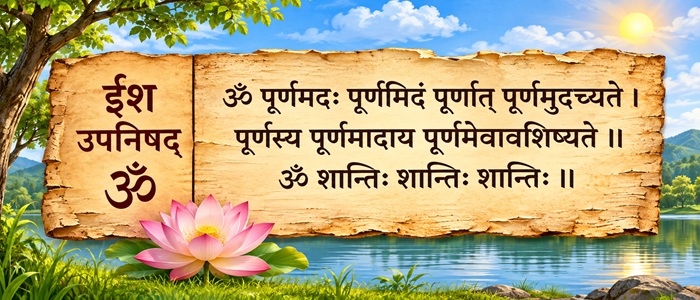
Om Poornamadah Poornamidam Poornaat Poornamudachyate.
Poornasya Poornamaadaaya Poornamevaavashishyate.
Om Shantih Shantih Shantih.
Hindi Translation
English Translation
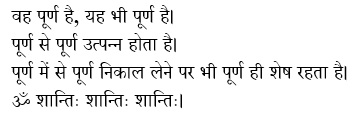
That is complete; this too is complete.
From completeness arises completeness.
Even when completeness is taken away from completeness,
still completeness remains.
Om Shanti, Shanti, Shanti.
My Understanding
The very word Isha invites contemplation. I perceive in it the inseparability of primordial Energy and Existence, governed by an inherent discipline.
Om, the opening expression of the invocation, signifies the primordial Energy perpetually manifesting as Existence. This understanding resonates with the opening declaration of Gurbani — Ik Onkar Satnam.
That — Energy — is complete.
This — Existence — is complete.
Existence is not separate from Energy. It is Energy in manifestation. Manifestation neither diminishes the source nor renders that which manifests incomplete.
Let us consider this in the context of our own being.
With advancing age, the body undergoes several changes. One may lose a limb, one's eyesight, hearing or other physical faculties. Yet these losses need not diminish one's identity with the Self. The body may no longer possess what it once possessed, but the Self remains complete.
Completeness is not determined by possession, nor is incompleteness necessarily a consequence of deprivation.
Likewise, if anything is taken out of Existence, where does it go? A tree decomposes, water evaporates, a star disintegrates. Forms undergo transformation, but nothing departs from Existence. There is no elsewhere beyond the totality of Existence.
Birth, life and death are expressions of this perpetual transformation. Neither birth augments the completeness of Existence nor death diminishes it. Thus, even when completeness is taken out of completeness, still completeness remains.
Completeness does not imply changelessness, and change does not imply incompleteness.
The invocation concludes with the threefold utterance of Shanti.
I perceive Shanti not merely as peace, but as discipline and equilibrium. Existence is in perpetual motion, and motion entails commotion, within and without. Even when we appear to be sitting motionless, innumerable activities continue within our body.
Shanti is not the absence of commotion but equilibrium amidst commotion.
The threefold utterance of Shanti may be perceived as an acknowledgment of the inherent discipline governing Janam, Jeevan and Maran — birth, life and death.
Traditionally, the three utterances are also associated with three kinds of affliction:
Adhyatmika — those arising from within oneself.
Adhibhautika — those arising from other beings and our physical surroundings.
Adhidaivika — those arising from forces beyond our control.
Rather than seeking exemption from these afflictions, the invocation, in my understanding, reminds us of the importance of maintaining equilibrium while encountering them. This does not imply resignation or indifference. It calls for awareness, responsible action and graceful acceptance of that which is beyond our control.
The recognition of Poornam thus finds its practical expression in Shanti. We are not outside the discipline of Existence. We are manifestations of it. To recognize this and live accordingly is to live in harmony with Existence. It is in this harmony that the teachings of the Isha Upanishad reflect the true spirit of Sanatana Dharma — the Eternal Order.
Om Shanti, Shanti, Shanti.
28-Nov-2026
More by : Rajender Krishan
Top | Spirituality | Home