Expansion of Legislatures, Reorganization of States, and Socio-Territorial Justice
Abstract
The expansion of legislative seats (delimitation), the reorganization of disproportionately large states, and the political empowerment of Backward Classes (BCs/OBCs) are critical imperatives for strengthening Indian democracy. The current stance of both ruling and opposition parties—failing to at least double legislative seats in proportion to population growth and neglecting statutory reservations for BCs and women in the expanded legislatures—poses a severe impediment to social justice. Synthesizing historical failures,
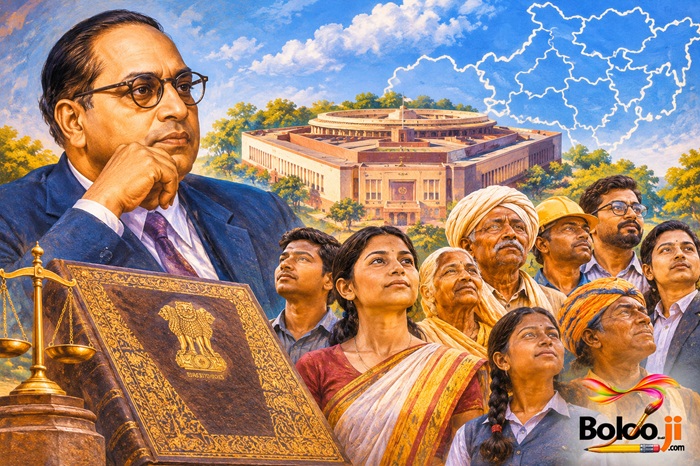
Dr. B.R. Ambedkar’s constitutional vision, and international standards of democratic representation, this seminar paper argues that true social transformation and balanced development can only be achieved by combining social reservations with statutory, constituency-wise territorial representation across all sectors of governance.
1. Introduction: The Congress Party’s Dual Stance and Historical Blunder
In any vibrant democracy, popular representation and social justice are two sides of the same coin. Expanding legislative seats in proportion to demographic growth (delimitation), reorganizing unwieldy states for administrative efficiency, and ensuring proportional representation in state power for Backward Classes (BCs) and women are foundational democratic principles. The current opposition by the Congress party to the expansion of legislative seats constitutes a grave historical blunder and a major setback to social justice. By obstructing the expansion of legislative representation and sidelining the political empowerment of BCs, the Congress has walked into a self-defeating trap, risking further erosion of its electoral base.
Until recently, Rahul Gandhi campaigned across the nation under the banner of "Jitni Abadi, Utna Haq" (rights proportional to population), prompting the Telangana Legislative Assembly to pass a resolution advocating 42 percent reservations for BCs. Yet, at this historic juncture of delimitation and seat expansion, failing to raise even a whisper regarding legislative reservations for OBCs exposes a glaring lack of political sincerity. One must never forget the historical truth that Dr. B.R. Ambedkar resigned from Jawaharlal Nehru’s cabinet specifically over the denial of gender equality (the Hindu Code Bill) and the failure to establish a commission for Backward Classes under Article 340. From Nehru to Rahul Gandhi, the Congress party has consistently perpetuated this legacy of institutional neglect toward the BCs.
2. Historical Background: Anti-BC Policies of Ruling Parties
Since independence, mainstream national political parties have systematically obstructed the Backward Classes from attaining their rightful share in state power and economic resources.
- Institutional Failures:
The electorate granted decisive mandates to the Congress party in 1976, 1980, 1984, 1989, 2004, and 2009. Despite holding power repeatedly, the party failed to enact political reservations for BCs in legislative bodies. Furthermore, whenever the Congress, the BJP, or the Janata Party held power at the Centre, they failed to allocate budgetary resources proportional to the BC population or even establish a dedicated Union Ministry for Backward Classes.
- The BJP’s Opposition and the Rath Yatra:
The Bharatiya Janata Party (BJP) has opposed BC reservations from its very inception. In 1990, immediately after the V.P. Singh government implemented the Mandal Commission recommendations granting 27 percent reservations to OBCs, the BJP withdrew its support and toppled the government. To derail the momentum of the social justice movement, the BJP launched the Rath Yatra, polarizing the polity along religious lines. Thus, both the Congress and the BJP have sustained an unbroken continuum of resistance against BC empowerment.
- Alienation from Power and Religious Polarization:
Deprived of a share in state power for decades, the Backward Classes grew deeply disillusioned with the Congress party, realizing that it offered no substantive path to their emancipation. This political vacuum pushed the majority working castes—who ought to have been the vanguard of social justice—toward religious emotionalism, devotionalism, and communal mobilization, inadvertently strengthening right-wing forces. The responsibility for this socio-political shift rests squarely on the anti-social justice policies of the Congress.
- Deception in the Women’s Reservation Bill:
The very hegemonic elements within the Congress that historically blocked constitutional amendments for both BC and women’s reservations later championed a Women’s Reservation Bill devoid of a sub-quota for OBC women. This ensured that the benefits would accrue disproportionately to upper-caste women while inflicting severe injustice upon BC women—a strategic misstep that ultimately yielded political dividends to the BJP.
3. Constitutional Perspective: Ambedkar’s Warnings, State Reorganization, and Seat Expansion
The Indian Constitution guarantees equal political rights to all citizens based on the foundational axiom of "One Person, One Vote, One Value." However, the retention of massive, unwieldy states and the prolonged freeze on legislative seats severely undermine this constitutional ethos.
- Dr. Ambedkar’s Prescient Warnings:
Dr. B.R. Ambedkar foresaw the grave dangers posed by demographic and geographical imbalances in the formation of Indian states. In his seminal 1947 treatise, States and Minorities, and later in Thoughts on Linguistic States (1955), Ambedkar articulated with absolute clarity how disproportionately large states subvert federal balance and marginalize smaller states and weaker sections.
- The Fazal Ali Commission and the 7th Constitutional Amendment:
During the deliberations of the States Reorganization Commission (Fazal Ali Commission, 1953) and the enactment of the 7th Constitutional Amendment in 1956, large states ought to have been divided based on administrative viability and demographic equilibrium. The Congress leadership of that era ignored Ambedkar’s warnings and abdicated its historical responsibility.
- The Imperative of Dividing Massive States:
Retaining Uttar Pradesh (UP)—whose population rivals that of the sixth-most populous nation among the world's 200 countries—as a single administrative unit has created a profound structural imbalance in Indian politics. In 2011, when the Mayawati-led BSP government passed an assembly resolution to divide UP into four smaller states and forwarded it to the Centre, the Congress-led UPA government consigned it to the dustbin. Dividing UP into three to five states, alongside reorganizing massive states like Bihar and Madhya Pradesh into smaller units, is essential to restore natural federal equilibrium.
- Doubling and Quadrupling Legislative Seats:
Restricting the Lok Sabha to a mere 850 seats is grossly inadequate. Given India’s current population, at least doubling the number of legislative seats across the country is an immediate necessity. Expanding seats fourfold to align with international democratic standards would fundamentally transform grassroots governance structures, such as Mandal Parishads, bringing elected representatives closer to the citizenry. A proportional, nationwide increase in seats neither harms nor unfairly advantages any single state; rather, it creates the necessary institutional space to grant proportional reservations to BCs and women.
4. International Comparison of Democratic Representation
When measured against global democratic benchmarks, India’s ratio of popular representation is among the poorest in the world. A comparative analysis of the lower houses (or unicameral legislatures) of ten major nations illustrates this stark disparity:
| S.No. |
Country |
Lower House /
Central
Legislature Seats |
Approximate Population |
Population
per Representative |
| 1 |
China |
2,980 |
1.405 Billion |
471,000 |
| 2 |
United Kingdom (UK) |
650 |
68.3 Million |
105,000 |
| 3 |
Germany |
630 |
84.4 Million |
134,000 |
| 4 |
France |
577 |
68.4 Million |
118,000 |
| 5 |
Brazil |
513 |
210.1 Million |
409,000 |
| 6 |
Japan |
465 |
124.0 Million |
266,000 |
| 7 |
Russia |
450 |
147.1 Million |
327,000 |
| 8 |
United States (USA) |
435 |
335.0 Million |
770,000 |
| 9 |
Italy |
400 |
59.0 Million |
147,000 |
| 10 |
Canada |
343 |
40.5 Million |
118,000 |
| — |
India |
543 |
1.435 Billion |
2,643,000
(26.43 Lakhs) |
- A Fourfold Expansion Required:
Based on the representative ratios of China, Russia, the United States, Europe, and Australia, India’s parliamentary and assembly seats should increase at least fourfold. Freezing seat allocations at the 1971 census levels despite exponential population growth is antithetical to representative democracy.
- Comprehensive Reservations and National Progress:
Had India implemented proportional reservations for BCs—who constitute over half the nation’s population—across legislatures, civil services, the military, and the judiciary, the intellectual and productive capacities of the majority working castes would have been fully integrated into nation-building. Such inclusive mobilization would have propelled India economically, scientifically, and technologically to heights unattainable by China, Japan, Canada, or Europe.
5. The Theory of Socio-Territorial Representation
Reservations based solely on social categories, while indispensable, cannot by themselves guarantee equitable development across all geographical regions. True social justice and balanced development require combining social reservations with statutory, constituency-wise territorial representation across all sectors of governance.
- Curbing Regional Centralization:
At present, key institutions—including the higher judiciary, top bureaucratic posts, military officer cadres, premier educational institutions, and budgetary allocations—are heavily concentrated in a few developed regions and urban centers. Backward rural and tribal constituencies remain virtually unrepresented in these spheres of power.
- The Dual Principle (Social + Territorial):
By treating every Parliamentary and Assembly constituency as a foundational administrative unit—and mandating statutory representation proportional to each constituency's population in public employment, judicial appointments, budgetary outlays, and executive offices—both socially marginalized castes and geographically neglected regions will advance simultaneously.
6. Contemporary Politics and Policy Recommendations
In the ongoing debate over delimitation, the Congress party’s opposition to seat expansion—under the pretext that southern states might lose relative seat share—reflects an anti-democratic posture. By focusing narrowly on southern demographic concerns while remaining completely silent on OBC reservations in the expanded legislatures, the Congress is repeating its historical mistakes.
Key Policy Recommendations for Democratic Renewal and Social Justice:
- Doubling and Expanding Legislative Seats:
Rather than capping parliamentary seats at 850, legislative seats across the nation must be at least doubled in proportion to current demographics. Over the long term, a fourfold expansion aligned with global standards is necessary to revitalize local self-government bodies like Mandal Parishads.
- Statutory OBC Reservations in Legislatures:
A constitutional amendment must be enacted concurrently with the current delimitation exercise to guarantee proportional political reservations (at least 42 to 50 percent) for OBCs in Parliament and State Legislative Assemblies.
- Reorganization of Large States:
In accordance with Dr. B.R. Ambedkar’s vision in States and Minorities, unwieldy states such as Uttar Pradesh, Bihar, and Madhya Pradesh must be reorganized into smaller, administratively viable states to ensure federal balance.
- Implementation of Socio-Territorial Equity and Dedicated Budgets:
Alongside securing an OBC sub-quota within the Women’s Reservation framework, statutory social reservations and constituency-wise territorial representation must be instituted across the judiciary, military, and civil administration. Establishing an independent Union Ministry for Backward Classes with a proportional budgetary allocation is a fundamental constitutional duty of the state.
7. Conclusion
Obstructing the expansion of popular representation is an act of political self-destruction for any democratic party. The Congress party must awaken to this reality, discard flawed strategic advice, and champion both the expansion of legislative seats and proportional OBC reservations during the ongoing delimitation process. Only through the institutionalization of socio-territorial justice can the balanced development and social transformation envisioned by Dr. B.R. Ambedkar be realized.