Oct 14, 2026
Oct 14, 2026
A Shift Toward a Multipolar World
BRICS (Brazil, Russia, India, China, and South Africa) has emerged as a significant force in the global economic and political landscape over the past two decades. It was initially formed in 2006 as BRIC (Brazil, Russia, India, China), and later became BRICS in 2010 with the inclusion of South Africa. In 2024, the group underwent a major expansion. Countries such as Egypt, Ethiopia, Iran, and the United Arab Emirates (UAE) joined as full members. Although Saudi Arabia’s status remains somewhat uncertain, by 2026 BRICS+ consists of ten full members and ten partner countries. India is set to host the summit in 2026. This expansion has transformed BRICS into a strong platform for developing nations.
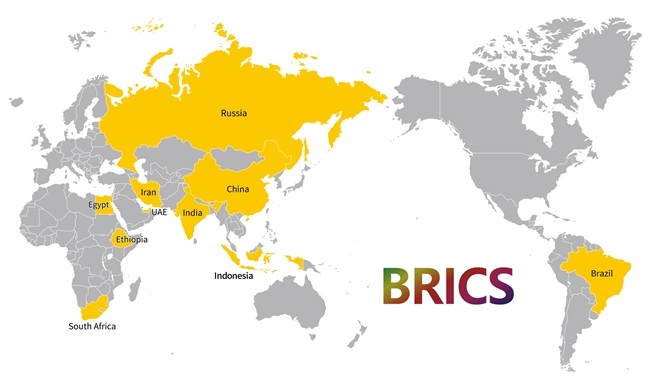
One of the most important aspects of BRICS’ rise is its economic strength. In terms of Purchasing Power Parity (PPP), BRICS has already surpassed the G7 (Group of Seven) countries. This shift became evident as early as 2018. By 2024, BRICS accounts for approximately 35 to 40 percent of global GDP (PPP), while the G7’s share has declined to around 28 to 30 percent. This gap is expected to widen further in 2025–26. Although the G7 still leads in nominal GDP, BRICS dominance in PPP is clearly visible. Rapid growth in China and India is a key driver of this trend.
Economic growth projections for 2026 further strengthen the position of BRICS. The group’s average growth rate is expected to be around 3.8 percent in 2025 and 3.7 percent in 2026. In contrast, the G7’s average growth is projected at only 1 percent in 2025 and 1.1 percent in 2026. Countries like India (6.2 percent), Indonesia (4.9 percent), Ethiopia (7.1 percent), UAE (5 percent), and China (4.2 percent) highlight the diverse strengths within BRICS. Factors such as population size, natural resources, manufacturing (China), digital services and youth power (India), and energy and minerals (Russia, Saudi Arabia, Iran) support this growth.
Another key factor in BRICS’ rise is de-dollarization (reducing dependence on the US dollar). After the Russia–Ukraine war in 2022, the freezing of dollar assets caused concern among many countries. As a result, BRICS nations have increased trade in local currencies. Trade between China and Russia in yuan and ruble has crossed 90 percent. India has been purchasing oil from Russia using rupee-ruble or yuan arrangements. Growing oil deals between China and Saudi Arabia in yuan have put pressure on the petrodollar system. Alternative payment systems like BRICS Pay and mBridge are being developed, enabling trade without relying on SWIFT (Society for Worldwide Interbank Financial Telecommunication). However, the dollar still remains the dominant global reserve currency, and any complete transition will be gradual.
Another important instrument for BRICS’ financial independence is the New Development Bank (NDB). Established in 2014 and headquartered in Shanghai, it serves as an alternative to the World Bank and the International Monetary Fund (IMF). By June 2025, the NDB had approved 123 projects worth about 39.7 billion dollars, with an active portfolio exceeding 34.9 billion dollars. It focuses on sectors such as transport infrastructure, food security, green energy, and water supply. In addition to standard loans, it also provides funding in local currencies, reducing dependence on the dollar. Its 2022–2026 strategy emphasizes sustainable infrastructure.
Despite its impressive growth, BRICS also faces challenges. There are internal differences among members. Border tensions between China and India, economic inequalities, and political differences test the group’s unity. G7 countries still dominate in technology, finance, foreign investment, and innovation. Since BRICS consists largely of developing nations, it must make further progress in areas such as stability, job creation, and technological advancement. Nevertheless, it is increasingly becoming a platform that gives a stronger voice to developing countries.
Countries like India must adopt a balanced approach within BRICS. By focusing on self-reliance, digital economy, and infrastructure development, India can safeguard its interests. Through BRICS, India can further strengthen its exports, technology partnerships, and infrastructure financing.
Overall, the rise of BRICS represents a historic shift. It reflects a transition from a unipolar world dominated by a single power to a multipolar global order. With proper reforms, internal unity, and coordination among members, BRICS has the potential to grow even stronger in the future. A redistribution of global economic power is underway, and this transformation should move toward providing equal opportunities for all nations.
Image (c) istock.com
