Sep 16, 2026
Sep 16, 2026
BASIC SCORING
Tennis matches consist of Games, Sets and Matches. To win a game, a player has to win four or more points with a minimum difference of two. To win a set, a player has to win six games with a difference of at least two. Matches are played based on Best-of-Three or Best-of-Five Sets. In any given set, if the score reaches six games all, Tiebreakers are introduced. A Tiebreaker is a game in which a player has to win at least seven points with a minimum difference of two. In the case of final sets, a Tiebreaker is won by scoring at least ten points with a minimum difference of two. In either case, the winner of the Tiebreaker wins the set at 7-6.
INTERCHANGE OF ENDS
To ensure a level playing field, the players change ends at periodic intervals. During the course of a set, the changes take place at the end of an odd number of total games. That is, the players change ends when the total number of games in the set reaches 1, 3, 5, etc. In Tiebreakers, the players change ends when the total number of points in that game reaches a multiple of six, that is, 6, 12, 18, and so on. The change of ends ensures that the players get an equal share of the advantage or disadvantage any specific end may be having.
The rule for change of ends within a set is well founded and stands scrutiny. However, the rule for change of ends within a Tiebreaker is not sound, as the number 6 is arbitrarily chosen. The purpose of this article is to focus on these points.
ASSESSMENT OF THE RULES GOVERNING CHANGE OF ENDS
We will consider a tennis match involving two equally well-talented players, P1 and P2. Let us also assume that the wind conditions give a distinct advantage to the player playing from a particular end. Let us call this end F, the favourable end. As P1 and P2 are equally well-talented, it is assumed that the player on the End F will always win the point and hence the game. Within a set, the games will proceed as indicated in the table below.
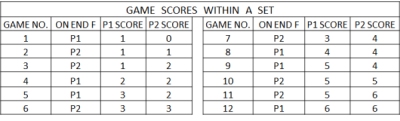
We see that the score at the end of twelve games is 6-all. At any stage, neither P1 nor P2 led by more than one game. More importantly, the scoreline would have been the same even if P2 played the first game from End F.
AT 6-all, the Tiebreaker comes into play. P1 will start playing from End F. He will play from End F for the first six points. The game will proceed as shown in the table below.
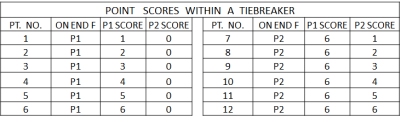
At 6-all, that is, after 12 games, the players will change ends. P1 will play the next six points from End F. But he will need only two of them to win the game at 8-6, and at 10-6 if it’s a 10-point Tiebreaker
The next set, Set 2, starts with P2 on End F. The story repeats, and P2 will win that set 8-6. Set 3 will be a repeat of Set 1, which goes to P1. Thus, P1 will win all odd games and the match. The implication is that the winner of the toss at the start of the match will be the ultimate winner. This is the unfair component of the Tiebreaker system.
SUGGESTION
A simple change is called for. During Tiebreakers, the players shall change ends when the total number of points is odd, instead of the arbitrary multiples of six. In other words, the two tables, as above, shall be identical.
