Oct 25, 2026
Oct 25, 2026
In the past, I published a few articles related to innovation. One of them focused on “change”. In that article, it is stated that Innovation and Change go hand in hand. There can be no innovation without change. In the present article, I wish to communicate that not all changes qualify to be called innovations. They must meet three important conditions. The three conditions are listed below.
1. The proposed change is desirable to the user.
2. It should be technologically feasible.
3. It should be economically viable.
A given change qualifies as an innovation only if it is a Triveni Sangam (three-way confluence) of D, F, and V as above. The concept is best understood through a graphic depiction known as a Venn diagram.
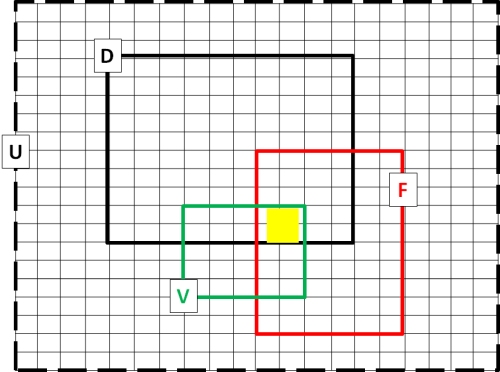
The diagram consists of many small squares or cells. Each cell represents a possible configuration or design. The cells are contained in an outer rectangle U. The rectangle U represents the “universal set”. There are three inner rectangles, which are subsets of U.
The rectangle D stands for DESIRABLE configurations. They come from user feedback and from internal brainstorming sessions. The rectangle F corresponds to “technologically feasible” configurations. Some are outside the subset D, and some are inside D. Only the cells of F that are inside D remain for further consideration. This is known as the “intersection of the subsets F and D”. Let us call it FD. Then, we have the third rectangle V that corresponds to “economically viable configurations". Only a subset of this is inside FD. This subset qualifies to be called innovation. In the diagram, this is shown in yellow.
The relative sizes of the rectangles in the diagram are typical of real-life situations. There are 100 desirable configurations. The number of feasible and viable configurations is 60 and 25, respectively. However, the number of configurations that meet all three conditions is just 4.
Innovations are needed for any organization to stay in business. This write-up conveys that the process of innovation is very dynamic and challenging.