Oct 26, 2026
Oct 26, 2026
In a democracy, the people’s verdict does more than determine who wields political power; it also shapes the future direction of a nation. The historic victory of left-wing leader Luiz Inácio Lula da Silva in Brazil’s presidential election brings this fundamental truth into sharp focus. In the second round of voting on October 25, 2026, Lula defeated far-right candidate Flávio Bolsonaro, securing public support for another term as President. This is not his fourth consecutive term. Having served two terms between 2003 and 2010, Lula returned to power in 2023 and has now secured another electoral victory.
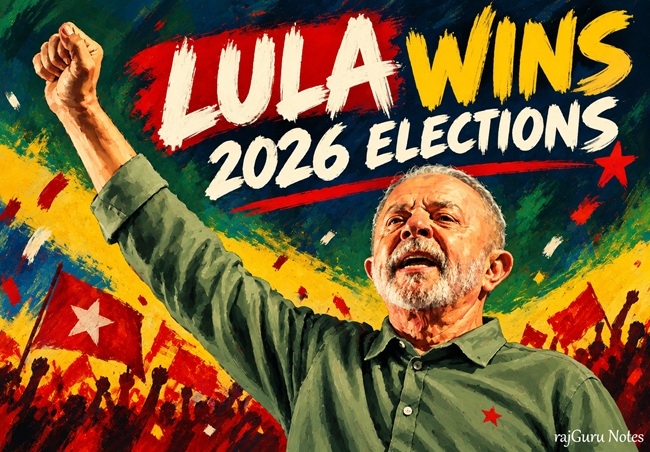
According to the final results announced by Brazil’s Superior Electoral Court, Lula secured 51.79 per cent of the vote, against 48.21 per cent for Flávio Bolsonaro. Lula received more than 64.2 million votes, while his rival polled approximately 59.8 million, giving the incumbent a margin of nearly 4.4 million votes. The first round, held on October 4, had placed Bolsonaro ahead with 47.03 per cent, compared with Lula’s 45.16 per cent. Lula’s ability to reverse that initial disadvantage in the decisive round demonstrates his political resilience and capacity to consolidate support across a divided electorate.
A crucial factor behind Lula’s victory was the mobilisation of progressive forces around the defence of democratic institutions. Jair Bolsonaro, the former President and father of Flávio, is serving a 27-year prison sentence in connection with a coup conspiracy following his defeat in the 2022 election. Flávio sought to consolidate conservative voters by presenting himself as the political heir to his father’s legacy. Lula, by contrast, emphasised poverty alleviation, welfare programmes, workers’ rights and social inclusion. Voter participation also improved, with abstention reportedly declining from 21.08 per cent in the first round to approximately 19.2 per cent in the second. This greater participation helped shape the final outcome.
Lula’s triumph, however, cannot be understood solely as a victory for welfare-oriented politics. At a time when right-wing movements have been gaining ground across parts of Latin America, Brazil has delivered a distinctly different message. Amid trade tensions and tariff disputes involving United States President Donald Trump, Lula’s insistence on safeguarding Brazil’s sovereignty without yielding to external pressure resonated with voters. His assertion that Brazil would not serve as another country’s backyard became a powerful expression of national dignity. Yet, preserving constructive relations with Washington while protecting Brazil’s economic interests will remain a formidable diplomatic challenge.
The role of social media in the election has also generated considerable debate. Lula’s campaign alleged that Meta, the parent company of Facebook, Instagram and WhatsApp, was operating in ways that favoured his opponent. Meta acknowledged that some political advertisements had been taken down because of technical errors, but rejected allegations of deliberate political bias. The controversy nevertheless raises fundamental questions about the influence of digital platforms on electoral behaviour, the transparency of political advertising and the accountability of technology companies. In contemporary democracies, electoral integrity requires not merely free voting but also safeguards against opaque digital manipulation.
Controversy also surrounded the decision to extend polling hours by two hours in response to concerns about transportation disruptions, heavy rainfall and difficulties faced by voters. Flávio Bolsonaro, meanwhile, indicated that he would seek the annulment of the election rather than accept the result. Such allegations must be assessed through verifiable evidence and lawful procedures, rather than allowed to undermine public confidence in democratic institutions without adequate justification.
Lula’s challenges remain formidable. The rising cost of living, crime, entrenched economic inequality and a deeply polarised society will test his leadership. His ability to govern will also be constrained by a Parliament in which conservative forces retain considerable influence. A victory at the ballot box cannot, by itself, resolve these structural problems. The promise to defend democracy will acquire lasting legitimacy only when accompanied by tangible improvements in ordinary citizens’ lives.
Brazil’s electoral verdict carries a message that extends well beyond its borders. Defeating extremism at the ballot box is an important democratic achievement, but it is only the beginning. The real test of political leadership lies in strengthening institutions, reducing inequality and translating electoral promises into meaningful social progress. In the final analysis, democracy is not vindicated merely when the far right is defeated, but when the aspirations of the people are fulfilled.
Image courtesy rajGuru Notes
