Oct 30, 2026
Oct 30, 2026
Social Realities, Legal Complexities, and the Blueprint for a Secular Way of Life
Abstract
Recently, judicial pronunciations and public petitions in India seeking the legal recognition of the right to register as having “No Caste, No Religion” have sparked a significant socio-political debate. While rooted in the constitutional guarantees of freedom of speech, conscience, and religion under Articles 19 and 25, this proposition demands a critical examination of its practical feasibility, existing social contradictions, systemic legal vacuums, and the necessity of a codified cultural alternative. Drawing upon empirical frameworks and theoretical paradigms, this paper analyzes why historic progressive movements desisted from the structural institutionalization of this right.
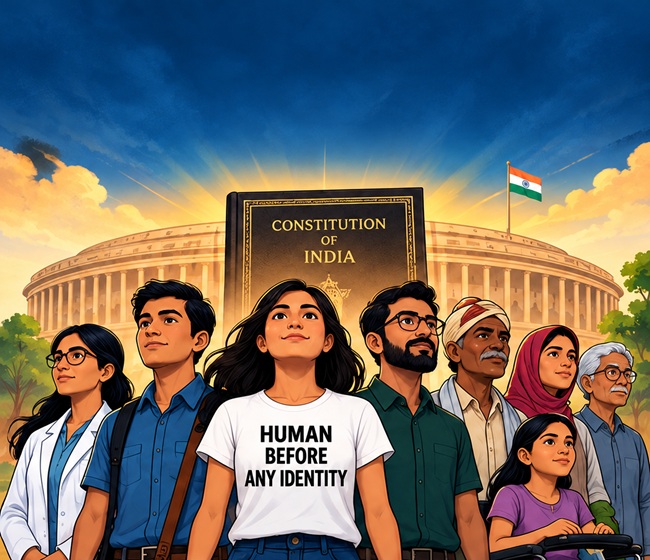
It evaluates the asymmetric accessibility of this option across social strata due to the constitutional framework of protective discrimination, highlights the civil legal void stemming from the absence of a Uniform Civil Code (UCC) or a distinct Secular Civil Code, integrates the critical sociological critique raised by Prof. Kancha Ilaiah Shepherd on the dynamics of “No Caste” declarations, and outlines a comprehensive behavioral and cultural code of conduct required for a genuinely caste-free, secular society.
The Communist Framework and a Century of Strategic Silence
Although communist and leftist movements in India are ideologically grounded in rationalism, historical materialism, and atheism, the demand for the formal deletion of caste and religion from state-issued identity documents never materialized as a core structural agitation during their century-long history.
Affirmative Action and the Asymmetry of Social Privilege
The progressive idealism of declaring a caste-free identity encounters a profound structural contradiction when evaluated against the constitutional mechanics of reservations.
The Kancha Ilaiah Paradox: Privilege Hiding in Plain Sight
The structural flaw of the “No Caste” movement becomes empirically evident when analyzed through the lens of recent socio-political transitions. As social thinker Prof. Kancha Ilaiah Shepherd observed during the historic Telangana caste census and subsequent expert analysis, the “No Caste” category often functions as a mechanism for “privilege hiding in plain sight”.
Data reveals that a massive concentration of individuals opting for the “No Caste” tag reside within affluent urban hubs like the Greater Hyderabad Municipal Corporation (GHMC) limits and rank among the least backward demographics. This highlights a severe sociological paradox: it is typically the highly privileged, secure in their generational social capital, who possess the structural luxury to disavow caste identity. For a Dalit-Bahujana individual whose day-to-day survival relies on identity-linked constitutional protection, a blank column provides no shelter against systemic prejudice. Therefore, as long as the state fails to provide an external, robust protective infrastructure, the unilateral renunciation of caste remains an asymmetric privilege rather than an egalitarian solution.
Institutional Limits on Rationalist Self-Identification
Current bureaucratic protocols allow citizens to opt out of major religions by selecting categories like “None” or “No Religion” in specific census or judicial declarations. However, the state infrastructure does not permit citizens to officially print explicit philosophical identities, such as “Atheist,” “Rationalist,” or “Humanist”, on foundational identity cards, educational degrees, or civil registers. Rationalist organizations continue to contest this limitation, demanding that the state recognize positive secular identities rather than treating non-belief as a mere administrative absence.
Codifying a Non-Religious Way of Life: A Secular Code of Conduct
When Dr. B.R. Ambedkar led the historic transition to Navayana Buddhism on October 14, 1956, he fundamentally understood that eradicating an old social order requires a structured, alternative behavioral paradigm. He achieved this by administering the 22 Vows, which explicitly dismantled the theological underpinnings of inequality.
Similarly, a society attempting to transition beyond caste and religion cannot exist in a cultural vacuum; it requires a robust, codified humanistic alternative for daily social existence, milestone celebrations, and communal relations. This secular alternative must govern the fundamental transitions of human life:
The Legal Vacuum: Civil Rights in the Absence of a Uniform Civil Code
The most critical operational barrier to the “No Caste, No Religion” paradigm is the prevailing structure of Indian jurisprudence, where personal laws remain deeply fragmented along communal lines. Because India has not implemented a comprehensive Uniform Civil Code (UCC) or a parallel, exhaustive Secular Civil Code, the renunciation of religious identity triggers an immediate legal vacuum in civil life:
Conclusion
The public petition demanding the constitutional right to declare a “No Caste, No Religion” status is a highly commendable progressive signal that challenges the ossified structures of state bureaucracy. It expands the legal frontiers of individual liberty and provides a statutory sanctuary for rationalists, humanists, and iconoclasts.
However, judicial validation of this right is merely a preliminary step. For this declaration to transition from an elite luxury into a transformative social reality, it must be accompanied by comprehensive legislative reforms. The state must bridge the existing legal vacuum by enacting a parallel, fully comprehensive Secular Civil Code or a robustly structured Uniform Civil Code that insulates inheritance, adoption, and marital rights from religious frameworks. Furthermore, civil society must actively popularize a codified, rational, and scientific way of life. True emancipation will not be achieved merely by leaving official columns blank, but by systematically replacing archaic theological dogmas with a vibrant, lived culture of constitutional humanism.
