Oct 31, 2026
Oct 31, 2026
Flavio Bolsonaro’s reported departure from Brazil for the United States has triggered fresh debate about political accountability, judicial independence and the resilience of democratic institutions. The episode raises questions that extend beyond the fortunes of one political family. Can elected leaders accept defeat gracefully? Should political influence or foreign support enable them to evade legal scrutiny? And what happens when electoral outcomes are challenged without credible evidence?
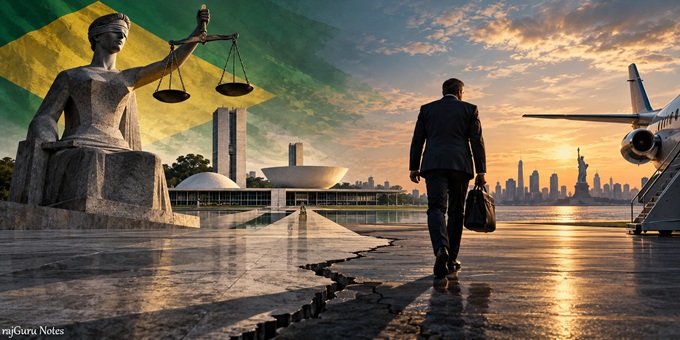
Flavio Bolsonaro, son of former Brazilian President Jair Bolsonaro, has faced scrutiny over allegations of financial misconduct. His departure reportedly followed a court order requiring him to surrender his passports within 24 hours as part of an investigation into alleged money laundering. According to international media reports, he travelled with his family through Argentina and Ecuador before reaching Miami. These developments have intensified speculation about his willingness to cooperate with the Brazilian authorities.
An important distinction must, however, be maintained. An individual facing allegations is not automatically guilty, and every accused person is entitled to a fair trial. Flavio has the right to contest the allegations through established legal procedures. Yet, that right comes with a responsibility to respect lawful judicial orders. Leaving the country amid an investigation does not establish guilt, but it inevitably raises questions about political accountability and confidence in the justice system.
The controversy also revives memories of Jair Bolsonaro’s turbulent presidency. Following his defeat by Luiz Inacio Lula da Silva in the 2022 presidential election, Jair Bolsonaro questioned the electoral process, while his supporters subsequently stormed government buildings in Brasilia on January 8, 2023. The attacks on the presidential palace, Congress and Supreme Court echoed the assault on the United States Capitol on January 6, 2021. The comparison underscores a disturbing international trend: political movements increasingly portray electoral defeat as evidence of fraud, weakening public confidence in democratic institutions.
The role of United States President Donald Trump adds another dimension to the controversy. Trump has expressed support for the Bolsonaro camp and questioned the legitimacy of Brazil’s electoral process without presenting convincing evidence of widespread fraud. Washington’s willingness to accommodate members of the Bolsonaro family could complicate relations between the two countries. When foreign governments appear to favour political figures challenging domestic democratic institutions, the distinction between diplomatic engagement and interference becomes difficult to sustain.
Lula’s response has emphasised that Flavio should remain in Brazil and defend himself against the allegations rather than leave the country. His remarks reflect a broader argument that political leaders must demonstrate confidence in the institutions they seek to influence. Meanwhile, Argentine President Javier Milei’s ideological affinity with right-wing movements illustrates the growing political polarisation across Latin America. Such alignments risk turning legal controversies into international ideological confrontations.
International media have also highlighted the contradictions in Flavio’s political messaging and the uncertainty surrounding the future of the Bolsonaro movement. His departure should not, however, be interpreted as proof that the movement has collapsed. The family continues to command support among sections of Brazil’s electorate. Its political future will depend on whether it can move beyond confrontational rhetoric and demonstrate a commitment to constitutional norms.
The larger lesson is that democracy requires more than periodic elections. It depends on the willingness of political leaders to accept the people’s verdict, the independence of courts and the impartial enforcement of law. Allegations of electoral malpractice must be investigated through credible evidence and transparent procedures, not amplified merely to delegitimise an unfavourable result. Equally, judicial authorities must act fairly and avoid any appearance of political bias.
Brazil’s challenge is therefore twofold: to safeguard due process for those facing allegations and to ensure that no individual is placed above the law. Political privilege, financial resources and international connections must not become instruments for escaping accountability.
Flavio Bolsonaro’s reported journey to the United States may prove to be a temporary episode in a continuing political struggle. Its wider significance, however, lies in the questions it poses about democratic responsibility. Political office is temporary, but the institutions that sustain democracy must endure. Respect for electoral outcomes, judicial independence and equality before the law remain indispensable to that endeavour.
Image courtesy rajGuru Notes
