Nov 05, 2026
Nov 05, 2026
When religion moves from being a spiritual practice
to a medium of display, propaganda and fundraising,
society should introspect.
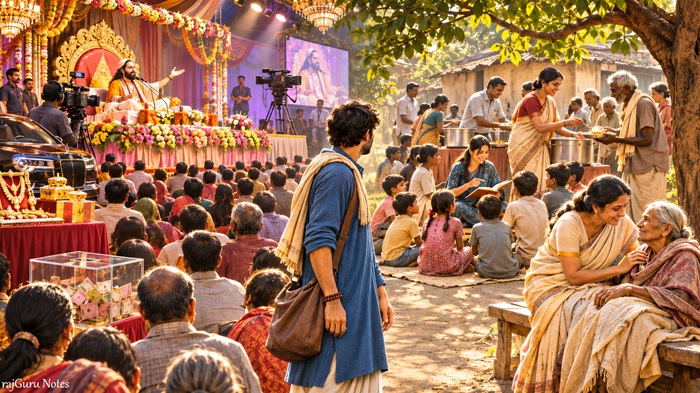
For centuries, India has been recognized as a land of spirituality, religious tolerance, and moral values. Here, religion means not only worship, rituals, and temple visits, but also the embodiment of truth, compassion, service, sacrifice, and humanity. Saints, sages, and wise men have used religion as a means to awaken the inner consciousness of humanity. The stories of the Ramayana, Mahabharata, Shrimad Bhagavad Gita, and the Puranas have taught generations the art of living. But today, amid the growing splendor of religious events and stories, a serious question arises: Is religion truly a means of public welfare or is it gradually transforming into a massive commercial enterprise?
Today, a vast world of storytelling has emerged in various parts of the country. Large pandals, grand stages, impressive decorations, expensive sound equipment, special guests, publicity vehicles, and extensive publicity on social media are becoming hallmarks of religious events. The popularity of storytellers is now measured not only by their knowledge and ideas, but also by the number of their followers, the grandeur of the events, and their fame. The crowds that gather at some storytellers' events resemble a major entertainment event. Along with religious discourse, fame, publicity, and displays of financial strength are also becoming visible.
Storytelling is a respectable and important tradition in itself. Storytellers explain the essence of religious texts to society, impart moral teachings, and connect people to their cultural roots. Many saints and scholars have been working for years to spread spiritual awareness in society without any pretense. The problem lies not in the tradition of storytelling, but in its commercialization. When the cost of the storyteller becomes more important than the quality of the story, when the number of devotees and the amount of offerings become the measure of an event's success, and when economic power begins to be displayed in the name of religion, introspection becomes necessary.
Today, many religious events involve huge expenditures on the arrival of storytellers, stage arrangements, accommodation, security, and other amenities. A competition for prestige is also evident among organizers and devotees. Discussions about who can organize the largest event, who drew the largest crowd, and which prominent figure graced which storyteller's stage begin to overshadow the core message of the story. In some places, financial transactions and expensive arrangements are even publicly discussed in the name of storytelling. While it is not appropriate to view all storytellers or events with the same prism, it is society's responsibility to question this changing trend.
The most worrying situation arises when religious sentiments are used as a means of financial gain. Devotees donate out of their faith. Some dedicate a portion of their earnings, while others contribute their life savings to religious events. This is their personal devotion and should be respected. However, transparency in donations, their use, and the accountability of religious institutions are equally important. If funds collected in the name of religion are used for personal luxury and publicity rather than public service, the faith weakens.
Ironically, while offerings of gold and silver jewelry and precious items to temples are increasing, many children in society are still forced to sleep hungry. Many families, due to financial constraints, are unable to provide for their children's education, treatment, and food. Poor patients wait for help in hospitals, while schools remain resource-poor. In such a situation, it naturally begs the question: should the primary purpose of religious faith be lavish offerings and grand celebrations? Shouldn't the prosperity of temples also enrich the lives of the poor in the surrounding areas?
The true beauty of religion is revealed only when it wipes the tears of the oppressed, feeds the hungry, educates the uneducated, and offers hope to the hopeless. Lord Rama's ideals embody dignity and public welfare; Shri Krishna's message emphasizes action and duty; and Buddha's teachings embody compassion and nonviolence. Simply reciting these great traditions from the pulpit is not enough. Putting them into practice is true righteousness.
Social media also plays a significant role in the popularity of storytellers. Sermons of a few minutes, attractive costumes, emotional presentations, and impressive dialogue spread rapidly. This has led to the spread of religious ideas, but it has also increased the competition for showmanship and popularity. Serious religious topics are often presented in an entertaining manner. There is also a tendency to influence devotees through emotional statements and claims of miracles. In such situations, listeners should exercise discretion. A person's popularity is not automatically a proof of their knowledge, character, or morality.
Society must also understand that not every storyteller is a businessman, and not every large-scale event is inappropriate. Expenses for organizing religious events are natural. Many storytellers serve selflessly and bring positive change to people's lives through their sermons. Therefore, criticism should not be directed at individuals, but at trends that link religion to wealth, prestige, and personal gain.
The government and social organizations also have a responsibility to encourage financial transparency in religious institutions. Devotees should be informed about the use of donations. Religious platforms should not be used to spread superstition, discrimination, and social animosity. Along with Katha events, programs such as blood donation, health camps, education for underprivileged children, cow service, and assistance to the needy should also be prioritized.
The need today is not to discontinue the Katha, but to revive its original purpose. Katha narrators should use their popularity to promote morality, harmony, and a spirit of service in society. Devotees should also understand the true message of the Katha, rather than being influenced only by miracles and sentimentality. Religion is not the property of any individual, but the common heritage of humanity.
Ultimately, the question isn't how big the Katha became, how grand the pandal was, or how much offerings were collected. The real question is how many people felt compassion after listening to the Katha, how many people received help from the needy, and how many people adopted morality in their behavior. The day the success of religious events is measured by service, education, compassion, and human welfare, that day religion will be revealed in its true form. Protecting faith from becoming a commodity is not just the responsibility of storytellers, but of every devotee and the entire society.
Religion became earning, the whole era changed.
Protect your faith, wake up devotees.
Image courtesy rajGuru Notes
