Nov 07, 2026
Nov 07, 2026
Introduction
Technology is transforming the way we live, work, and travel. One of the most exciting innovations in the automotive industry is the self-driving car. These vehicles use advanced technology to understand their surroundings and assist with driving or, in some cases, perform the entire driving task within specific conditions. Self-driving cars have the potential to change transportation, improve mobility, and create new opportunities for engineers. But an important question remains:
Are we truly ready for this future?
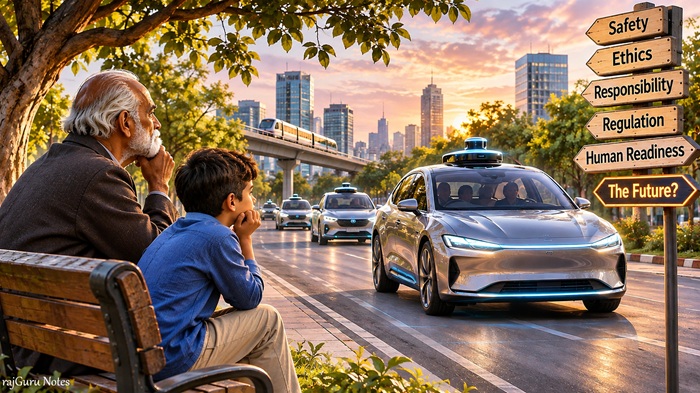
Imagine sitting inside a car, entering your destination, and relaxing while the vehicle drives itself to your location. Sounds like something from a science-fiction movie, right? Today, this idea is becoming a reality through the development of self-driving car technology. Self-driving cars use advanced technologies such as Artificial Intelligence (AI), cameras, sensors, radar, LiDAR, and computer systems to observe their surroundings and assist with driving. These technologies help vehicles identify traffic signals, recognize pedestrians, detect obstacles, and understand road conditions.
What Are Self-Driving Cars?
Self-driving cars, also called autonomous vehicles, are vehicles designed to perform driving tasks using sensors, software, computers, and artificial intelligence. They can be classified into different
automation levels, from basic driver assistance to highly automated driving. Not every car advertised as smart or autonomous is fully self-driving. Automatic Navigation, These cars can follow planned routes using digital maps and navigation systems. Obstacle Detection Sensors and cameras help identify pedestrians, vehicles, and objects around the car. Traffic Signal Recognition Advanced systems can recognize traffic lights and road signs. Automatic parking some vehicles can park themselves with limited driver involvement. Smart Decision-Making AI systems process information and help the vehicle respond to different road situations. Driver Assistance Some automated features help maintain speed, distance, and lane position. Self-driving cars are not just ordinary vehicles with advanced features; they represent a combination of mechanical engineering,
electronics, computer science, and artificial intelligence.
How Do Self-Driving Cars Work?
Self-driving technology combines several important systems. Cameras Help identify road signs, lanes, vehicles, and pedestrians. Radar Helps detect objects and estimate their distance and
movement. LIDAR Uses laser pulses to measure surroundings in vehicles equipped with it. Artificial Intelligence, Helps interpret sensor information and recognize road situations. Computers and
Software, Process information and support driving decisions. Control Systems, Manage steering, acceleration, and braking when the system is designed and authorized to do so. These systems work together to help the vehicle understand the road and respond to changing conditions. Self-driving car approaching a traffic signal. Its cameras recognize the signal, while its sensors monitor nearby vehicles and pedestrians. The computer processes this information and helps the vehicle respond appropriately. In this way, different technologies work together to make autonomous driving possible. Self-driving cars follow a cycle of sensing, understanding, deciding, and acting to navigate their surroundings.
Benefits of Self-Driving Cars
Self-driving cars offer several potential benefits that could transform the future of transportation. By combining artificial intelligence, sensors, and automation, these vehicles aim to make travelling more convenient, efficient, and accessible. Self-driving technology can monitor surroundings continuously and help identify potential dangers. It may reduce accidents caused by certain human errors, such as distraction or delayed reactions. Intelligent driving systems may help vehicles maintain appropriate distances and coordinate their movements, potentially improving traffic flow. Passengers may be able to use travel time for reading, relaxing, or other activities when the vehicle is operating autonomously within its permitted conditions.
Autonomous vehicles may provide additional transportation options for elderly people and individuals with disabilities who face difficulties driving conventional vehicles. Smart driving systems can help maintain smoother acceleration and braking. This may reduce unnecessary energy consumption in both electric and conventional vehicles. Human mistakes such as distraction, fatigue, and poor judgement contribute to road accidents. Automated systems may help reduce some of these risks. Self-driving technology could support future taxi services, public transportation, and delivery systems, making transportation more convenient. Automated driving may allow passengers to use their travel time more productively instead of concentrating entirely on driving. The development of autonomous vehicles encourages innovation in artificial intelligence, robotics, mechanical engineering, electronics, and computer science.
Are We Ready for the Future?
We are making progress, but complete readiness has not yet been achieved everywhere. Self-driving technology must be tested under real-world conditions, supported by suitable laws and infrastructure, and evaluated for safety, reliability, and accessibility. A responsible future should introduce automation gradually, with proper supervision and clear safety standards. I believe self-driving cars will play an important role in the future of transportation. However, we should not
depend completely on this technology until it becomes sufficiently safe, reliable, and affordable. As believe engineers have an important responsibility to develop innovative vehicles that make transportation safer, smarter, and more efficient. The future is not just about building cars that drive themselves; it is about building technology that people can trust.
Conclusion
Self-driving cars represent an exciting ste prp in the evolution of transportation. They offer opportunities for safer mobility, convenience, and engineering innovation, but they also bring
challenges related to safety, cost, cybersecurity, and public trust. The future of self-driving cars ionising, but technology must develop responsibly before we can fully depend on it. As a Mechanical Engineering student, I see autonomous vehicles as an inspiring field where creativity and engineering can shape the transportation of tomorrow.
Illustration courtesy rajGuru Notes