Nov 07, 2026
Nov 07, 2026
In a democracy, governments derive their authority from the people. That authority must be exercised to address public grievances, not to silence public voices. Governments may deploy police forces to suppress protests, arrest demonstrators and impose restrictions on public movement. Yet no amount of coercion can extinguish the economic discontent, social anger or aspirations for a better life that have accumulated among the people. This is the central message emerging from the waves of popular protests currently sweeping across several European countries.
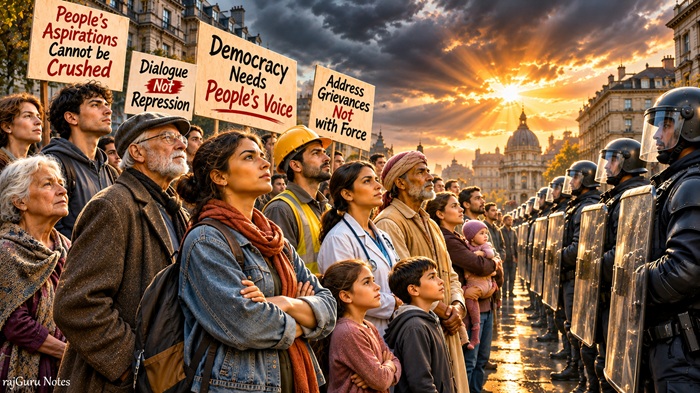
European nations, once regarded as pioneers of the welfare state, are today grappling with a multitude of social and economic challenges. Despite possessing advanced industries, sophisticated technologies, extensive trade networks and high per capita incomes, the lives of ordinary citizens are not improving to the extent expected. Students, workers, teachers, farmers, unemployed youth and pensioners are taking to the streets, each driven by a distinct set of grievances. The growing protests, strikes and demonstrations in countries such as France, Greece, Italy, Spain, Belgium and Portugal are far from isolated incidents. They reflect a deeper dissatisfaction with the unequal distribution of the benefits of economic development.
In France, protests that initially centred on problems in the education sector have gradually become intertwined with wider discontent over public services, the rising cost of living, wages and pensions. Teacher shortages, overcrowded classrooms and inadequate infrastructure in schools have caused considerable concern among students and educators. At the same time, rising prices have placed household budgets under severe strain. Trade unions have called strikes, while different sections of society have joined the demonstrations. These developments demonstrate that government assurances and promises alone cannot dispel deeply rooted public discontent.
Spain presents a somewhat different picture, although the underlying causes are similarly rooted in economic inequalities. While the expansion of tourism has generated substantial revenue for the country, rents in major cities have risen beyond the reach of ordinary people. The diversion of residential properties towards commercial tourism, housing shortages, temporary employment and low wages are depriving young people of financial independence. When people with jobs cannot afford to rent a home and live with dignity, the inevitable question arises: whom is economic development really serving?
The same contradiction is evident in Italy. As wages fail to keep pace with rising prices, people's purchasing power continues to erode. Healthcare, education and housing costs are increasing, while dissatisfaction with the quality of public services is growing. In Greece, the consequences of austerity measures imposed following the country's earlier debt crisis continue to haunt ordinary households. In Belgium, too, protests have focused on education costs, the rising cost of living and the quality of public services. Although the countries and the intensity of their problems differ, the demands of their people remain remarkably similar: fair wages for workers, secure employment for young people, affordable housing, quality education and healthcare, and financial security in old age.
The growing participation of young people in these movements deserves particular attention. Completing an education no longer guarantees stable employment. Even those who find jobs often struggle with inadequate incomes and unaffordable rents, forcing them to remain financially dependent on their families. This has seriously undermined their confidence in the future. According to Eurostat data, in 2025, approximately nine per cent of young people aged 15–29 in the European Union were spending more than 40 per cent of their household income on housing costs. The problem was particularly acute in countries such as Greece and Denmark. This demonstrates that the inability of young people to lead independent lives is no longer confined to poorer economies; it has become a disturbing feature of affluent societies as well.
Another significant factor behind this discontent is the contradiction in governments' spending priorities. While governments frequently cite financial constraints when it comes to public education, healthcare, housing and social security, they are simultaneously committing enormous resources to defence. According to 2025 figures released by the Stockholm International Peace Research Institute (SIPRI), total military expenditure by European countries reached $864 billion, representing an increase of 14 per cent over the previous year. The Russia–Ukraine war, security concerns and the defence commitments of member countries of the North Atlantic Treaty Organization (NATO) have contributed to this surge. There is no denying that defence expenditure is necessary for national security. However, governments must recognise that the economic security of their citizens is equally an integral part of national security. When military arsenals expand while families struggle with hunger, young people remain homeless and the poor are denied access to healthcare, the very model of development demands scrutiny.
Offering tax concessions and investment incentives to corporate entities may be part of economic policy. The fundamental question, however, is whether the wealth generated through these incentives eventually finds its way back into society. If production increases without generating employment, and corporate profits rise without a corresponding improvement in workers' wages, headline growth figures offer little comfort to ordinary citizens. The expansion of markets and the improvement of people's living standards are not necessarily synonymous. Creating wealth is important, but ensuring that people receive a fair share of that wealth is equally essential.
Public discontent is also finding expression in electoral politics. In Germany, dissatisfaction with traditional political parties, alongside concerns over immigration, economic security and nationalism, is reshaping the political landscape. In the 2025 parliamentary elections, the Alternative for Germany (AfD) secured 20.8 per cent of the vote, marking a substantial increase in its electoral strength compared with the previous election. In Britain, the Conservative Party suffered a crushing electoral defeat in 2024, paving the way for the Labour Party to assume office. In France, the snap elections of 2024 failed to give any political alliance a clear majority. These outcomes point to growing public disenchantment with established political parties.
However, this discontent is not translating exclusively into gains for left-wing movements. While left-wing forces advocating workers' rights and public welfare are gaining ground in some countries, right-wing and far-right political forces are expanding their influence elsewhere by foregrounding anti-immigration sentiment, nationalism and security concerns. In the 2024 European Parliament elections, the European People's Party emerged as the largest political group with 188 seats, while the Socialists and Democrats secured 136. Voter turnout across the European Union stood at 50.74 per cent. These results indicate that political discontent is not moving in a single direction. The future will depend on which political forces can win public confidence by offering credible and meaningful solutions to people's problems.
Governments must also recognise another serious danger. Diverting public anger away from genuine economic grievances and directing it towards immigrants, minorities or other social groups may yield short-term political dividends, but it does nothing to resolve the underlying problems. Blaming immigrants for unemployment without changing the policies responsible for joblessness, or holding them responsible for housing shortages without addressing the structural causes of the crisis, is merely an attempt by governments to evade accountability. Political systems that fail to address public grievances risk creating fertile ground for extremist tendencies.
Another crucial test of democracy lies in the manner in which governments respond to protests. The right to peaceful dissent is a fundamental democratic freedom. Opposing government policies, organising strikes and conducting peaceful rallies are not anti-democratic activities. They are, in fact, rights protected by modern constitutional systems. At the same time, acts of violence such as vandalising shops, setting public property on fire and attacking individuals cannot be justified under any circumstances. Those responsible for such acts must face stringent action in accordance with the law. However, using the violence committed by one or two individuals, or a handful of protesters, as a pretext to suppress an entire movement and portray all demonstrators as criminals is fundamentally contrary to democratic principles.
International news analyses of European protests published on October 19, 2026, also reported that peaceful demonstrations had been accompanied by violent incidents in certain areas. It is therefore essential to distinguish between the causes of the protests, the response of the police and the actions of individuals who resort to violence. If governments treat police deployment as their principal response instead of engaging in dialogue with the people, they will only aggravate the crisis.
The student-led protests in Serbia following the collapse of the roof of the Novi Sad railway station in November 2024, which claimed 16 lives, offer another important illustration. What began as a protest demanding accountability for a tragic infrastructure failure gradually developed into a wider movement questioning government corruption, public accountability and the functioning of democratic institutions. Such developments help us understand the broader character of popular movements. People do not always take to the streets merely to demand lower prices. They also demand a voice in decisions that affect their lives, accountable governance and action against those responsible for corruption.
There are several parallels between developments in Europe and the situation in India. Unemployment, rising prices, contractual employment, farmers' income difficulties, workers' rights, pensions and the growing privatisation of education and healthcare are causing widespread anxiety among ordinary people in India as well. In urban areas, rents and medical expenses have become a serious burden even for middle-class families. Higher education increasingly requires students to take on substantial debt. Farmers continue to struggle with rising input costs and inadequate remunerative prices for their produce. Meanwhile, the number of regular government jobs is declining, and the recruitment of soldiers into the Indian armed forces has also shifted towards a temporary employment model. This policy raises concerns about national security. Such developments reflect the growing prevalence of insecure employment in the country. Although India's problems are not identical to those confronting European nations, there are clear similarities in the underlying economic inequalities and the tendency of governments to retreat from their welfare responsibilities.
The approach of Indian governments towards public protests must also conform to democratic standards. Farmers' movements, workers' strikes, student agitations and demonstrations over public issues should not be dismissed merely as expressions of political opposition. It is the responsibility of governments to listen to people's grievances, engage with them and offer workable solutions. A strong government in a democracy is not one that relies on an overwhelming police presence or uses the military, whose primary responsibility is to defend the nation's borders, against its own citizens. Nor is it appropriate for the Union government to allow sections of the media and social media platforms aligned with its interests to portray young men and women protesting against government policies as anti-national or enemies of the country. Such propaganda is unbecoming of a government that claims to enjoy the people's confidence.
The recent movements across Europe also underline an important democratic principle: electoral victory may confer the authority to govern for five years, but it does not give governments the licence to ignore public grievances. If governments consider public opinion relevant only on election day and spend the remainder of their tenure prioritising corporate interests, public confidence in democratic institutions will steadily erode. Even when one political party replaces another, popular discontent will resurface if fundamental economic policies remain unchanged. Ultimately, what matters is not merely a change of political leadership, but a meaningful improvement in people's lives.
Governments must move beyond measuring development exclusively through growth in Gross Domestic Product (GDP), foreign investment, stock market indices and military strength. Can a young person complete an education and secure a job? Can that person afford to live independently on the income earned? Does a worker receive wages sufficient to meet the needs of the family? Can a farmer escape the burden of debt? Can an elderly person live with dignity? Can an ordinary household access quality education and healthcare? The answers to these questions must become the true benchmarks of development.
History offers little encouragement to governments that make the preservation of political power their overriding objective while disregarding the economic hardships of their people. Police forces may be deployed to suppress protests, and military assistance may be sought in exceptional circumstances. But attempting to sustain governance through coercion, without addressing people's aspirations, poses a grave danger to democracy. Police parades may silence the noise of dissent for a while, but they cannot extinguish the anger born of hunger, unemployment and economic inequality. Only by listening to the people, offering just and meaningful solutions to their problems and reshaping public policies in the larger interests of society can governments earn enduring public trust. The voices echoing through the streets of Europe today carry precisely this warning to governments across the world.
Illustration courtesy rajGuru Notes
