Nov 12, 2026
Nov 12, 2026
The importance of Practice.
Heaps of Stone: Practical Theory, Common Sense, and Humanist Culture
Introduction: The Autonomy of Practice Over Ideological Form
Countless theories have emerged throughout human history; just as many have vanished into the archives of time. However, the foundational strength of any theory never resides in the syntax of its sentences or the individual genius of its architect.
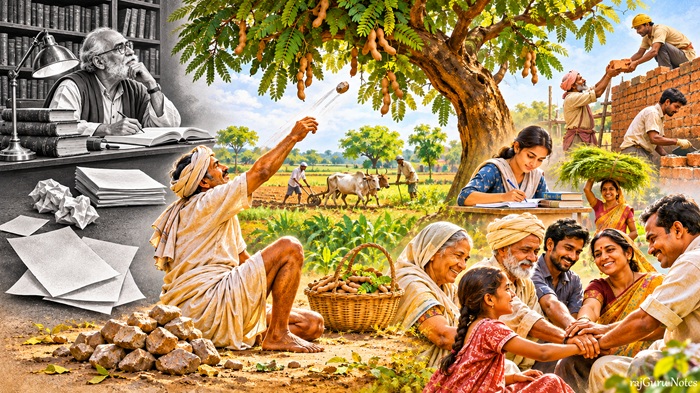
A theory, in its isolated state, is merely a lifeless scrap of paper. It is human practice, grassroots mobilization, and the raw sacrifices of the masses that breathe blood, flesh, and life into it. A theory detached from practice, no matter how profound, merely languishes in the forgotten corners of historical discourse. Action remains supreme over all conceptual designs.
To clarify this with a visceral, rustic analogy: sitting on a bed and chanting hymns will never bring tamarind pods down from the tree. It is only when someone stands beneath it and strikes the branches with a well-aimed stone that the fruit drops. The triumph does not belong to the stone; it belongs entirely to the labor and intent of the individual who aimed and threw it. All theories scattered across the intellectual landscape are merely heaps of stones. The name etched onto the stone by a theoretician is irrelevant; true victory belongs to the working-class hand that hurled the stone to fulfill a concrete material necessity.
I. The Political Hegemony of Conceptual Supremacy
The established intellectual elite often repeat a canonical maxim: "Practice without theory is blind." While this sounds conceptually sound, a massive apparatus of political hegemony is concealed within it. Sitting on an academic pedestal and dictate that "Only my specific theory is correct, and society must strictly conform to my blueprint" is the characteristic hallmark of authoritarian intellectuals. These rigid theoreticians systematically alienate the organic actions and existential sacrifices made by the masses to fulfill their immediate physical needs. They appropriate the collective victories achieved through the sweat and blood of the subaltern classes, transforming them into their own intellectual property and sweeping those sacrifices into the baskets of their conceptual frameworks.
In reality, society is driven not by textbook dogmas, but by natural instincts and organic common sense. Even if we accept the premise that unguided action is blind, a blind bull roaming into a fertile field will still graze chaotically and successfully fill its stomach. It requires no economic or dietary theories to survive. By what cinema or romantic literature do the beasts and birds of the earth learn to love one another? In which university did they study to nurture and protect their offspring? Nature has inherently endowed them with that foundational common sense.
In human society today, sapped of access to institutional learning and complex technical theories, the ordinary working masses utilize smartphones, operate televisions, and board airplanes through sheer empirical common sense. Utilizing a tool or navigating a modern system does not require parsing voluminous manuals of technical theory; a human being only needs basic social necessity and vernacular wisdom. What modern society requires is not extensive libraries of abstraction, but the practical common sense of mutual co-existence. Those who insist that "theory is paramount, and my design must dictate reality" are merely ideological hegemonists—academic technicians attempting to violently reshape organic society into their prescriptive molds.
II. Historical Transitions and the Vitality of Humanist Values
As society traverses its long historical trajectory, it undergoes a process of evolutionary advancement to reach its contemporary stage. In this protracted journey, the ultimate wealth secured by humanity is not a collection of ideological manifestos; rather, it is the deeply internalized humanist values, a living culture of mutual respect, liberty, social equality, and an innate disposition for altruism. These are paramount above all.
Whether it is Sanatana Dharma, Marxism, or any other paradigm, they are merely historical milestones emerging out of past social experiences. However, the contemporary evolution of society demands that we transcend these archaic frameworks. Every theoretician and every school of thought exists strictly to serve organic society, not to imprison human potential within their conceptual cages. A new history can only be forged on the foundations of mutual dignity, altruism, and the absolute equality of human values. No text of theory can ever claim supremacy over these core humanist values.
III. The Subaltern Re-activation of Dead Theory
This fundamental truth becomes evident when we analyze the major global ideologies that are credited with altering human history. The strength of Marxism did not reside in the pages of Karl Marx’s Das Kapital. Had practitioners like Georgy Plekhanov and Vladimir Lenin simply pursued the revolutionary path dictated by their immediate material realities without constantly invoking the name of Marx, the latter would have remained just another anonymous theoretician among hundreds in nineteenth-century Europe.
It was the absolute, uncalculated sacrifices and the spilled blood of the Russian peasantry and working class that pumped life into Marx’s dead texts. The collective desire for liberation and physical survival was the real locomotive of that revolution. Similarly, had Naxalite vanguards like Charu Majumdar or cultural forces chosen to wage their battles for social justice without referencing Marxist nomenclature, the subaltern classes would still have advanced toward historical assertion. Revolutions do not germinate within books; they erupt from the empty bellies of the oppressed and their collective common sense.
In contemporary society, the instructors who coach civil services aspirants have seldom cleared those elite examinations to become bureaucrats themselves. Yet the students who absorb their lectures and toil day and night through intense practice successfully become administrative officers. The triumph here belongs not to the pedagogical theory of the coaching center, but to the unremitting practice of the student.
Conversely, the total absence of practice reduces the most profound philosophies to historical stagnation. The Bhagavad Gita is chanted daily by millions across generations. But has this mass recitation transformed them into warriors of justice like Arjuna or architects of peace like Mahatma Gandhi? Absolutely not. Because the majority merely reduce the text to a ritualistic incantation, singing along to classical tunes for devotional escapism rather than translating it into structural practice. Ultimately, it has degenerated into a somber melody played over the deathbed during final funeral rites. Any communist dogma or philosophical system devoid of active, living practice is doomed to meet the same fate—becoming mere background music for an institutional funeral.
However, the historical trajectory of Buddhism offers a brilliant testament to the resurrecting power of subaltern practice. Born on Indian soil, the radical philosophy of Gautama Buddha was systematically decimated within the subcontinent by elite-caste counterrevolutions and a forced vacuum of practice. For centuries, it lay completely stagnant, a silent relic buried in neglected palm-leaves and stone sculptures.
Yet the moment Babasaheb Dr. B.R. Ambedkar reclaimed this Buddhist heritage and transformed it into a massive, practical emancipatory movement in 1956 alongside millions of marginalized people, Buddhism re-entered the living veins of society. As long as Buddha's philosophy remained confined to abstract academic debates, it was mute; the moment it received the electrifying touch of Ambedkar’s structural practice, it became a living weapon against historical oppression.
Conclusion: The Supremacy of Lived Experience
Therefore, what the world desperately requires today is not a network of theoretical archives, but honest human practice, social common sense, and lived humanist values. No matter how grand an idea appears, if it lacks the shoulders to bear it and the hearts to bleed for it, it remains nothing more than a paper flower. It is the practitioner alone who builds history; theory is merely a nominal label that history leaves behind.
Illustration courtesy rajGuru Notes
