Nov 12, 2026
Nov 12, 2026
Radio is far more than a medium of news and entertainment. It is an institution that shaped generations, nurtured cultural sensibilities and brought the wider world into the homes of ordinary people. Long before television became ubiquitous and the internet transformed communication, radio served as an intimate companion to millions. From villages to cities, from farmers to scholars, and from children to senior citizens, its voice reached every section of society. It informed, educated, entertained and, above all, gave expression to the cultural identity of the Telugu-speaking people.
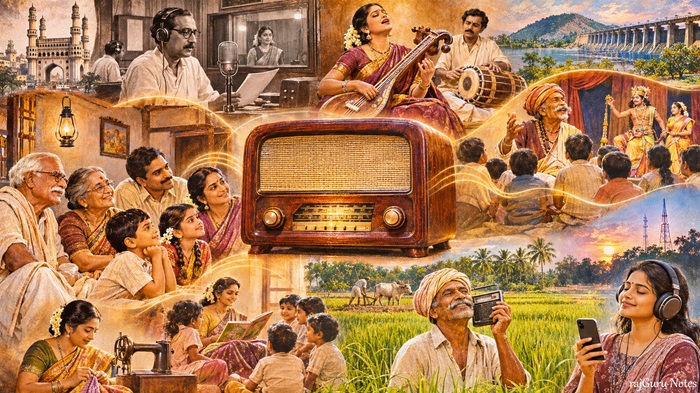
Through All India Radio (Akashvani), Vividh Bharati, regional broadcasting stations and, subsequently, FM channels, radio evolved into a powerful instrument of public communication. Behind this remarkable journey stood generations of broadcasters, writers, musicians, dramatists, newsreaders, programme producers and technical professionals whose contributions deserve enduring recognition.
1. The Birth of Akashvani and the Beginning of Telugu Broadcasting
Radio broadcasting in India began with the Bombay Radio Club in 1923. On June 8, 1936, the Indian State Broadcasting Service was formally renamed All India Radio (AIR). Telugu broadcasting commenced from the Madras station on June 1, 1938, marking an important milestone in the history of the Telugu language.
Mallampalli Uma Maheswara Rao, one of the earliest Telugu broadcasters, became affectionately known as 'Radio Thatha' (Radio Grandfather) for his popular children's programmes.
On June 18, 1938, the eminent linguist Gidugu Ramamurthy Pantulu delivered a landmark talk on 'Living Telugu', emphasising the importance of using a language rooted in everyday speech. Another significant milestone came on June 24, 1938, when Muddu Krishna's Anarkali was broadcast as one of the earliest Telugu radio plays. These pioneering efforts established a lasting relationship between Telugu literature and broadcasting.
2. Vijayawada Station: A Centre of Literary and Musical Excellence
The Vijayawada station of All India Radio, inaugurated on December 1, 1948, occupies a distinguished place in the cultural history of Telugu broadcasting. Particularly during the 1950s, 1960s and 1970s, it emerged as a vibrant platform for literature, music, drama and artistic experimentation.
Balantarapu Rajanikantha Rao, affectionately regarded as a doyen of broadcasting, made an extraordinary contribution to the development of Telugu musical programmes. A composer, lyricist, musicologist and programme designer, he brought the richness of Telugu musical traditions to a wider audience.
Banda Kanakalingeswara Rao, another towering personality, enriched the radio drama movement. After assuming responsibilities as a drama producer in 1956, he helped create numerous productions and took particular interest in recording and preserving traditional Yakshagana performances. His efforts gave renewed visibility to several performing arts that were gradually losing their traditional audiences.
Literary figures such as Pingali Lakshmikantam and G.V. Krishna Rao contributed to literary and intellectual broadcasts. Renowned musicians, including M. Balamuralikrishna, brought distinction to classical music programmes. Singers such as Srirangam Gopalaratnam, Vinjamuri Anasuya Devi and Vinjamuri Seetha further enriched the musical landscape of Telugu radio.
3. Hyderabad Akashvani: The Voice of Telangana's Cultural Identity
Hyderabad Akashvani played a significant role in preserving and popularising Telangana's language, dialects, folk traditions and literary heritage. It brought the everyday experiences of rural communities, agricultural concerns, local festivals and traditional cultural practices into the public domain.
Its broadcasts of Burrakatha, Oggukatha, Harikatha, folk songs and traditional dramatic performances provided an invaluable platform for rural artists. More importantly, they helped establish the legitimacy of Telangana's distinctive linguistic and cultural expressions in mainstream broadcasting.
Programme professionals such as Vinjamuri Varadaraja Iyengar and Manchala Jagannatha Rao contributed to the development of musical and devotional programming, including Bhaktiranjani. Sarada Srinivasan, who joined the Hyderabad station as a drama artist in 1959, was among those who enriched its dramatic and musical presentations.
The station thus became not merely a broadcasting facility but an important custodian of Telangana's collective cultural memory.
4. Vividh Bharati: The Enduring Magic of Indian Film Music
Launched on October 3, 1957, Vividh Bharati became one of the most popular services in Indian broadcasting. Its introduction was partly a response to the enormous popularity of Hindi film music broadcast by Radio Ceylon.
Programmes such as Hawa Mahal, Jaimala, Chhayageet, Bhule Bisre Geet, Sangeet Sarita, Inse Miliye and Pitara became household favourites. Jaimala, in particular, acquired a special emotional significance through its broadcasts for members of the armed forces. The participation of celebrated film personalities and musicians made the programme a cherished connection between soldiers and their homeland.
Vividh Bharati's appeal extended beyond film songs. It introduced listeners to different musical traditions, celebrated forgotten melodies and created a distinctive broadcasting culture through its presenters and programme producers. Its continued popularity demonstrates the enduring appeal of thoughtfully curated radio entertainment.
5. The News Division: A Tradition of Credibility and Public Trust
For several decades, radio news was the principal source of information for millions of Indians. From the freedom movement and Independence to wars, elections, parliamentary developments and natural disasters, All India Radio played an important role in keeping citizens informed.
The Telugu news division developed a reputation for clarity, linguistic precision and disciplined presentation. News editors, translators, correspondents and newsreaders worked together to communicate complex developments in accessible Telugu.
The distinctive pronunciation, measured delivery and professional composure of radio newsreaders became familiar to generations of listeners. Radio news traditionally placed greater emphasis on verification and accuracy than on sensationalism. At a time when misinformation spreads rapidly through social media, this tradition of editorial discipline deserves renewed appreciation.
6. Radio Drama and Literature: Giving Imagination a Voice
Radio made an exceptional contribution to Telugu theatre and literature. Unlike conventional stage productions, radio drama relied entirely on dialogue, voice modulation, music, silence and sound effects to create an imaginative world in the listener's mind.
Works by celebrated writers and literary personalities found a wider audience through radio adaptations, plays, discussions and serialised programmes. Writers such as Buchi Babu, Munimanikyam Narasimha Rao, Devulapalli Krishna Sastry and Nayani Subbarao were associated with the broader literary and broadcasting tradition. Stage personalities such as Sthanam Narasimha Rao and Banda Kanakalingeswara Rao helped enrich the dramatic dimension of radio.
The achievement of radio actors deserves particular recognition. Without facial expressions, costumes or stage movements, they had to convey the entire emotional spectrum of a character through voice alone. Their ability to communicate conflict, humour, sorrow and psychological complexity transformed radio drama into a distinctive art form.
7. Music and Devotional Programmes: Preserving India's Classical Heritage
All India Radio has made an invaluable contribution to the preservation and dissemination of Indian classical music. Carnatic and Hindustani traditions, light music, devotional compositions and folk melodies received space in its programming.
The music of M. Balamuralikrishna, Srirangam Gopalaratnam and the Vinjamuri sisters reached audiences far beyond concert halls through radio broadcasts. Programmes such as Bhaktiranjani became integral to the devotional listening habits of countless households.
The Akashvani Sangeet Sammelan and National Programme of Music provided prestigious platforms for established and emerging musicians. These initiatives helped regional talent reach national audiences and ensured that India's diverse musical traditions remained accessible to ordinary listeners.
8. Children's and Women's Programmes: Broadcasting for Social Transformation
Radio recognised early that broadcasting had an important educational and social responsibility. Children's programmes featuring stories, songs, poems, riddles, quizzes and science-related content helped nurture curiosity, creativity and linguistic abilities.
Mallampalli Uma Maheswara Rao and other gifted presenters developed a special rapport with young listeners. Their programmes were not merely entertaining; they encouraged children to develop an interest in language, literature and the world around them.
Special programmes for women addressed health, nutrition, education, family welfare, employment opportunities and women's rights. They also provided opportunities for women writers, singers, educators and specialists to share their knowledge and experiences. In an era when public platforms for women were limited, radio offered an important space for dialogue and awareness.
9. Agricultural Broadcasting: Connecting Science with the Farmer
Agricultural broadcasting remains one of radio's most valuable public-service contributions. Programmes covering seed selection, soil management, fertiliser application, pest control, irrigation, animal husbandry, market prices and weather conditions helped farmers make informed decisions.
By involving agricultural scientists, university experts, government officials and experienced cultivators, radio translated scientific knowledge into practical guidance. In rural areas where television, internet access and other communication facilities were limited, agricultural broadcasts functioned as an informal university for farmers.
They also strengthened the relationship between scientific institutions and rural communities, making agricultural knowledge more accessible and relevant.
10. FM Radio: A New Generation of Broadcasting
The introduction of Frequency Modulation (FM) broadcasting marked another important phase in the evolution of radio. Experimental FM transmissions began in Madras on July 23, 1977. All India Radio subsequently launched FM Rainbow on February 1, 1993, followed by FM Gold on September 1, 2001.
The emergence of radio jockeys (RJs) brought a new style of presentation and attracted younger audiences. Informal conversations, listener interactions, music requests, traffic updates, cinema discussions and contemporary affairs gave FM radio a distinctive identity.
FM broadcasting expanded in cities such as Hyderabad, Vijayawada and Visakhapatnam. Alongside public broadcasting, private FM stations introduced greater competition, innovative formats and new opportunities for presenters and creative professionals.
This transition demonstrated that radio was not an obsolete medium confined to older generations. It could adapt to changing tastes and remain relevant in an increasingly competitive entertainment market.
11. Akashvani in the Digital Age
Technological changes have transformed the way people access radio. Transistor sets have increasingly given way to smartphones, internet streaming and digital platforms. Listening to radio no longer requires a conventional receiver, and online services have enabled broadcasters to reach audiences across geographical boundaries.
Prasar Bharati continues to operate an extensive broadcasting network through All India Radio, with regional-language services, news, music, agricultural information and educational programming forming an important part of its public-service mandate.
Digital archives and online streaming also offer opportunities to preserve historic recordings and make them accessible to younger generations. However, modernisation must not come at the expense of radio's essential character: credibility, linguistic diversity, accessibility and public service.
Conclusion: A Salute to the Voices That Shaped Generations
The history of Telugu radio is not merely a chronicle of technological progress. It is the story of a cultural movement that brought language, literature, music, knowledge and social awareness into the everyday lives of ordinary people.
From Gidugu Ramamurthy and Balantarapu Rajanikantha Rao to Banda Kanakalingeswara Rao and M. Balamuralikrishna, from Mallampalli Uma Maheswara Rao to the contemporary generation of radio jockeys, numerous personalities have enriched this remarkable institution through their talent and dedication.
Many worked behind the scenes. Some never acquired public recognition. Yet their voices, compositions, writings and creative contributions became part of the collective memory of millions. Families that began their mornings with Akashvani news, farmers who listened to agricultural programmes and listeners who spent their evenings enjoying radio dramas developed an emotional relationship with the medium that cannot easily be replicated.
Radio's greatest contribution was not entertainment alone. It cultivated an appreciation of language, music and literature while strengthening public awareness and cultural consciousness. No matter how sophisticated digital platforms become, the warmth and intimacy of a human voice travelling through the airwaves will retain a special place in people's lives.
The contributions of Akashvani, Vividh Bharati, regional broadcasting stations and FM services, together with the countless celebrated and unsung professionals who sustained them, deserve our deepest appreciation.
A medium that gave Telugu culture a voice has also given generations of listeners memories that will never fade. Its legacy is not simply heard; it is remembered, cherished and celebrated.
Illustration courtesy rajGuru Notes
