Nov 13, 2026
Nov 13, 2026
The need of the hour is not population control,
but human development and preparation for the future.
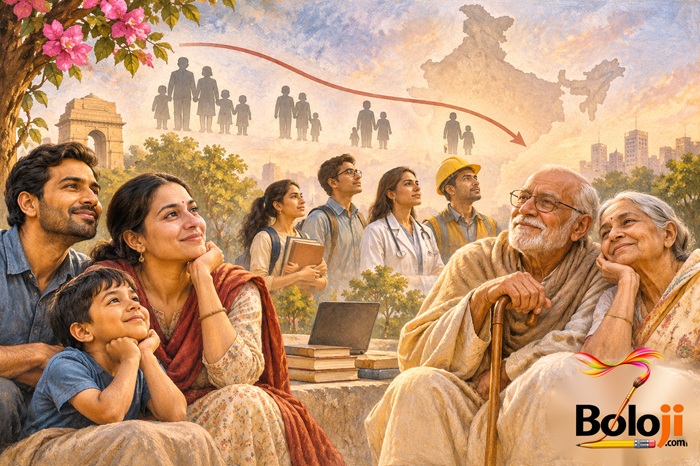
India's population has long been a major topic of public policy, political discourse, and economic planning. Calls for population control have periodically arisen, citing the growing population as a source of pressure on resources, unemployment, poverty, and environmental crises. However, today, India is undergoing a demographic transition, where, instead of a growing population, declining fertility rates, an aging population, and regional disparities are emerging as new challenges. Therefore, it is time to reconsider the need for population control laws.
India's total fertility rate (TFR) has reached approximately 1.9, which is below the stable population replacement level of 2.1. This means that on average, a woman is not giving birth to enough children in her lifetime to provide for natural replacement of the population in the next generation. Although India's total population is currently growing, this is driven by a large youth population and structural population dynamics. A continued decline in the fertility rate in the future could slow population growth and ultimately lead to a stabilization or decline in the population.
The decline in fertility rates is not a sudden phenomenon. Expansion of education, improved social status of women, availability of contraceptives, urbanization, rising marriageable age, and changing preferences regarding family size are the main reasons for this. Today, most families place greater importance on children's education, health, and quality of life rather than the number of children. Economic uncertainty, rising housing costs, and the expense of raising children are also reinforcing the trend toward smaller families.
Another significant change in India's population is the aging trend. The proportion of citizens aged 60 and above is expected to increase rapidly in the coming years. Various population studies estimate that the elderly population will reach approximately 15 percent by 2036. This change will have a profound impact on health services, pension systems, social security, and family care policies. In a society where a large youth population was once considered an economic force, ensuring the care and dignified lives of the elderly will become a significant public responsibility in the future.
Another important aspect of population change is regional disparities. Many states in South India have reached fertility rates well below replacement levels, while some states in North India experience relatively higher fertility rates. Differences in education, health services, women's employment participation, and socio-economic development are the main reasons for these variations. Therefore, implementing a uniform population policy for the entire country would be unreasonable. States with a larger youth population will have greater needs for employment, education, and skill development, while states with lower fertility rates will face challenges related to the welfare of the elderly and the future workforce.
In such circumstances, laws that limit the number of children to two, and measures that exclude individuals with more than two children from local body elections or government benefits, require serious reconsideration. Population policies must be consistent with citizens' rights, especially women's reproductive rights and personal liberty. Attempts to control family size through punitive laws, when families are naturally shrinking, may have consequences contrary to social justice and democratic values. This also risks placing disproportionate pressure on poor families, women, and disadvantaged communities.
The real challenge facing India is not population control, but rather the formulation of public policies in line with the changing demographic structure. A comprehensive pension system, affordable and accessible healthcare, geriatric care centers, and the expansion of social security for the elderly are essential. Furthermore, special attention must be paid to quality education, vocational training, skill development, and employment generation to make the working-age population productive. The demographic dividend can only be translated into real economic benefits when youth have access to employment and dignified life opportunities.
Women's economic participation is also central to this transformation. Providing women with access to education, employment, equal pay, maternity benefits, and freedom in reproductive decisions should be the cornerstone of any effective population policy. The aim of family planning should not be to control women, but to enable them to make informed and independent decisions. Similarly, denying political rights or public opportunities based on the number of children can undermine the broader objective of democratic representation.
India should move beyond the outdated concept of population control and adopt a comprehensive policy of population management and human development. This should prioritize planning based on regional demographic needs, expanding reproductive health services, elderly welfare, labor market preparation, and social security. Population policies should be evaluated not solely on birth rate figures, but on the basis of citizens' quality of life, health, education, and social equality.
Ultimately, a nation's population is not just a number, but a reflection of its human potential and social structure. India's declining fertility rate provides us with an opportunity to move from punitive control to rights-based, scientific, and sensitive policies. The India of the future will be empowered only when its youth are educated and employed, women are independent, and the elderly can live with dignity and security. The need now is not population control, but the development of human potential and nation-building in accordance with changing demographics.
