Nov 15, 2026
Nov 15, 2026
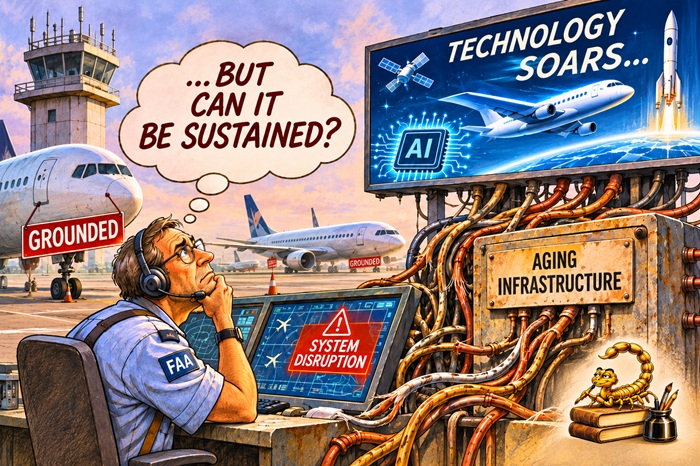
Technological Advancement, Infrastructure Vulnerability,
and the Question of Resilience
On Friday, November 13, 2026, the United States experienced an extraordinary aviation disruption. A nationwide ground stop halted departures for several hours, disrupting thousands of flights. Aircraft already airborne were brought safely to their destinations while passengers across the country waited for operations to resume. The problem was not with the aircraft but with the infrastructure coordinating their movements. And therein lies a troubling contradiction.
The Fragility Beneath Sophistication
Preliminary investigations pointed toward a telecommunications malfunction during the replacement of aging copper lines with fiber-optic technology. A router reportedly generated excessive connection attempts, disrupting communications and radar information across multiple air traffic control facilities. A routine modernization effort had exposed vulnerabilities extending far beyond the original malfunction.
How could a localized technical failure produce nationwide consequences?
Was the cause faulty equipment, inadequate testing, human error, or insufficient safeguards? The answers remain subject to investigation. But the incident raises a larger concern about the resilience of interconnected technological systems.
The Paradox of Progress
Humanity celebrates technological breakthroughs with understandable enthusiasm. Artificial intelligence promises unprecedented capabilities. Electric aircraft offer cleaner transportation possibilities. Space exploration continues to expand scientific frontiers. Yet sophisticated innovations often depend upon infrastructure that receives far less attention.
The issue is not simply aging equipment. New technology can also fail. The real challenge is designing systems capable of containing disruptions and maintaining essential operations.
Technological advancement measures what we can accomplish. Resilience measures what we can sustain.
Modern civilization depends upon interconnected networks supporting aviation, electricity, healthcare, finance, communications and commerce. Their integration delivers remarkable efficiency but also allows failures to spread across systems and geographical boundaries. The greater the interdependence, the greater the need for redundancy, isolation mechanisms and reliable recovery procedures. Efficiency without resilience can become vulnerability.
Accident or Technological Warfare?
The aviation disruption raises an uncomfortable question. If an accidental malfunction can cause such widespread disruption, what might a deliberate attempt to exploit similar vulnerabilities accomplish? Cyberattacks, electronic interference and technological sabotage are legitimate national-security concerns.
However, suspicion is not evidence.
Federal officials have indicated that the November 13 incident was not believed to involve a cyberattack. Its technical causes remain under investigation. There is no established basis for describing the disruption as concealed technological warfare. Nevertheless, the incident highlights a fundamental security consideration.
A nation may possess advanced military capabilities, yet its everyday functioning depends upon civilian infrastructure that must remain reliable under both accidental and deliberate threats. National security extends beyond military strength to the resilience of the systems sustaining society.
Accountability Beyond Blame
Investigations must establish what failed, whether existing safeguards were adequate, and whether the disruption could have been contained. Contractors, administrators and policymakers have legitimate responsibilities for maintenance, modernization and operational preparedness. But accountability should lead to systemic improvement rather than merely identifying someone to blame.
Equally deserving of recognition are the pilots and air traffic controllers whose judgment and established safety procedures helped bring airborne aircraft safely to their destinations. Their response underscores an enduring truth: technological sophistication does not eliminate the importance of human competence.
The Question That Remains
Flights resumed. Passengers continued their journeys. Normal operations gradually returned. But restoring operations does not necessarily resolve the vulnerabilities exposed.
Civilization has become extraordinarily capable of developing complex technologies. Has it become equally capable of safeguarding them?
Perhaps genuine progress should be measured not merely by the sophistication of our innovations, but by the resilience of the foundations supporting them.
For what good is the ability to soar higher if we neglect what keeps us safely airborne?
