Nov 17, 2026
Nov 17, 2026
Cyber Security and the Digital Economy
The digital revolution has given new impetus to India's economy, banking system, and civic life. Today, sending money, paying bills, making purchases, and accessing government services through mobile phones is easier than ever before. UPI, internet banking, and digital wallets have brought financial transactions within the reach of the common man. But with this convenience, a serious challenge has also rapidly emerged—cyber fraud.
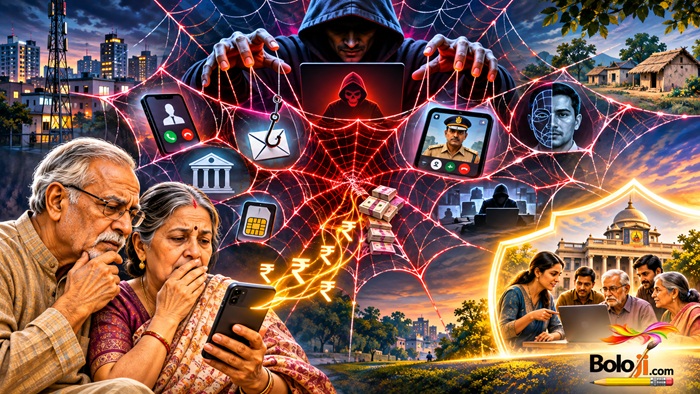
While technology has simplified economic activities, it has also provided criminals with new avenues to access people's hard-earned money. Today, cyber crime is not just a technical problem, but a serious question concerning economic security, social trust, and institutional accountability.
There are several interconnected reasons behind the increasing cases of cyber fraud in India. The most prominent reason is the rapid expansion of digital services and the lack of commensurate growth in digital literacy. While online banking and UPI have expanded access to small towns, villages, and remote areas, a large number of users are unfamiliar with basic digital security principles. They click on unknown links, share OTPs, or fall prey to fake customer service numbers. Criminals exploit this lack of knowledge to withdraw funds from bank accounts.
Phishing and identity fraud are dangerous forms of cybercrime. Criminals contact people posing as bank officials, government employees, police officers, or representatives of reputable institutions. They create fear and confusion by citing demands for KYC updates, bank account closures, receipt of contraband in parcels, or a government investigation. The most worrying example is fraudulent practices such as digital arrest. In this, criminals pose as officers from the police, CBI, ED, or other investigative agencies and hold people mentally hostage via video calls. They extort lakhs of rupees from them by threatening them with arrest, legal action, and social stigma.
The misuse of technology has exacerbated this challenge. Deepfake videos and fake voices, created with the help of artificial intelligence (AI), are now capable of impersonating a person's identity. Criminals can call in the voice of a relative, acquaintance, senior official, or trusted individual, asking for emergency financial assistance. While it used to be relatively easy to identify fraud through misspelled messages and suspicious emails, advanced technology has now made criminals' deceptions more convincing.
Another major problem is mule bank accounts. These are bank accounts used to transfer money obtained from cybercrime from one account to another. Unemployed youth and economically vulnerable individuals are often lured into using their bank accounts by offering commissions. In some cases, people hand over their accounts and ATM cards to others without complete information. By creating these chains, criminals attempt to conceal their true identities and source of funds. Furthermore, international cybercrime networks, fake SIM cards, fake identities, and cross-border digital transactions are increasing difficulties for investigating agencies.
Interestingly, cyber fraud is not solely the result of the cunning of criminals, but is often fueled by institutional weaknesses. The banking system's responsibility cannot be limited to providing digital services to customers. Banks must develop effective systems for identifying suspicious accounts, robust KYC procedures, and monitoring unusual transactions. If a large amount of money suddenly flows into or out of an account, or if there are multiple suspicious transactions in a short period of time, the bank's monitoring system should be activated immediately. Information sharing and coordination between banks is particularly essential for identifying mule accounts.
The role of the Reserve Bank of India is also crucial. As the regulatory body, the RBI should ensure stringent cybersecurity standards for banks and financial institutions. Clear guidelines, a timely grievance redressal system, and regular review of the security of digital payments are essential to protect customers from fraud. Banking institutions must understand that customer trust is their greatest asset. If confidence in the security of digital payment systems is weakened, the credibility of the digital economy is also affected.
Along with banks, telecom companies also have equal responsibility. Cybercriminals target people using fake SIM cards, spoofed calls, and fake mobile numbers. Telecom service providers should ensure the identification of suspicious SIM cards, the prevention of fraudulent connections, and prompt action upon receiving complaints. The government's Sanchar Sathi initiative is a useful step in this direction. Through this initiative, citizens can report suspicious mobile connections and mobile phone-related fraud. However, the benefits of such initiatives will only be widespread if the public is aware of their use.
The role of law enforcement agencies is also crucial. The nature of cybercrime allows criminals based in one state to target individuals in another and transfer funds to a bank account in a third state. Therefore, local action alone is insufficient. Better coordination between the Indian Cyber ​​Crime Coordination Centre (I4C), cybercrime police stations, and state police is essential. Once a complaint is filed, the process of preserving digital evidence, identifying suspicious accounts, and tracing the flow of funds must be expedited. Delays in taking action against cybercriminals can increase victims' financial losses.
Digital platforms and social media companies should also not shirk their responsibility. A large number of people fall victim to fraud through fake advertisements, fake investment schemes, accounts created in the name of government officials, and misleading links. Platform companies should actively monitor such advertisements and accounts. Effective systems should be in place to remove suspicious content upon receiving complaints and preserve digital evidence related to crimes.
The most important issue is providing relief to victims. In the current system, victims often continue to run around various institutions even after filing a complaint. However, in cyber fraud, the first few minutes are crucial. In India, the National Cyber ​​Crime Helpline 1930 and the National Cyber ​​Crime Reporting Portal are important channels for this purpose. Victims should report to 1930 without delay and also enter details on the portal, so that the relevant banks and agencies can take action to prevent further transfer of suspicious funds.
An important question here is institutional accountability. If a case reveals negligence, poor monitoring, or a violation of established security procedures, the victim should receive appropriate relief and compensation as per the rules. It would not be appropriate to automatically hold the bank responsible for every cyber fraud, but it is also unacceptable to dismiss institutional lapses as customer error. Accountability should be determined based on the facts, applicable regulations, and the investigation.
The use of AI-based surveillance systems could be crucial in future strategies. Technology should be developed to identify unusual transactions, suspicious logins, multiple accounts operating on the same network, and rapid money transfers. Banks, telecommunications companies, payment service providers, and investigative agencies should exchange information in real time. This technology should be effectively utilized not only by criminals but also by crime prevention agencies.
Digital literacy must also be made a national priority. Through schools, colleges, panchayats, banks, and public institutions, citizens should be informed that no real police officer or investigating agency holds a person hostage over video calls in the name of digital arrest, nor does it have the authority to deposit money into a private bank account in the name of investigation. OTPs, PINs, passwords, and confidential banking information should not be shared with anyone. Elders in families and new users of digital services need to be especially aware.
The battle against cybersecurity cannot be won solely with technical tools and legal provisions. Citizen trust, institutional activism, and government accountability are essential. The dream of a Digital India will only be realized when citizens can access digital services without fear. Victims must receive swift justice and financial relief, along with stringent action against cybercrime. The success of digital development should not be measured solely by the number of people who have adopted online transactions, but also by the safety of their hard-earned money. Technology should be a tool for convenience, not fear and exploitation—this should be the true identity of a secure Digital India.