Nov 20, 2026
Nov 20, 2026
The Indo-Pacific region has become a center of global politics, where maritime security, trade interests, strategic competition, and the global balance of power are intertwined. China's growing military activity, maritime disputes, trade dependence, and the race for control of critical technologies have made the region strategically sensitive. At this time, the Quad, a quadrilateral cooperation group comprising India, the United States, Japan, and Australia, has emerged as an important pillar of India's Indo-Pacific strategy. Its significance is not limited to mutual cooperation among the four countries, but also to the creation of a regional order that prioritizes freedom, respect for rules, economic security, and collective development.
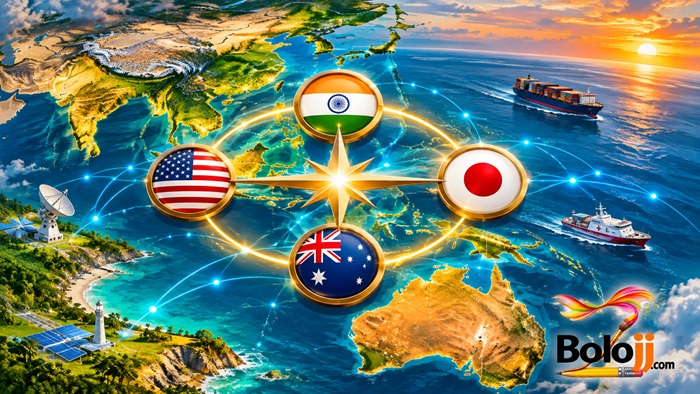
India's Indo-Pacific policy aims not to project power by becoming part of any military bloc, but to maintain balance, stability, and cooperation in the region. The Quad provides India with an opportunity to strengthen its maritime, economic, and technological capabilities. The Indian Ocean is India's economic lifeline. The country's trade, energy supplies, and international connectivity depend on sea routes. The security of the Strait of Malacca, the Strait of Hormuz, and major trade routes in the Indian Ocean is directly linked to India's economic interests. Any tension, disruption, or maritime insecurity in these areas could impact the Indian economy. Through the Quad, cooperation can be enhanced in maritime surveillance, information sharing, anti-piracy prevention, and safe navigation.
Another important aspect of the Quad is regional power balance. Disputes in the South China Sea, tensions over maritime boundaries, and unilateral actions increase security concerns for smaller countries. India supports a system in which all countries are free to exercise their rights in accordance with international rules. The Quad provides a collective voice to this vision. Through it, India can advocate for regional peace, maritime freedom, and the peaceful resolution of disputes. This is also an opportunity to maintain balance amid China's growing influence, but India's policy should remain based on restraint and diplomacy rather than confrontation.
The Quad also plays a vital role in economic security. Global crises, wars, and pandemics have made it clear that supply chains overly dependent on a few countries can weaken economies. Diversifying the supply of pharmaceuticals, semiconductors, rare minerals, energy, and technological equipment is no longer an economic imperative, but a national security necessity. Quad cooperation can provide India with opportunities to expand its role in investment, manufacturing, new technologies, and global trade. This will help India develop not just as a market, but as a reliable hub of production and innovation.
Technological cooperation is a key pillar of the Quad's future strength. Joint efforts in areas such as artificial intelligence, cybersecurity, telecommunications, clean energy, and digital infrastructure can enhance India's capabilities. Today, cyberattacks, communications disruptions, and the security of undersea communications cables are also part of national security. If India develops its research capabilities, technological self-reliance, and domestic industry through cooperation in these areas, this partnership will benefit its long-term interests.
The humanitarian aspect of the Quad is no less important. The spirit of cooperation in disaster relief and humanitarian assistance following the 2004 Indian Ocean tsunami laid the foundation for this group. Today, climate change, cyclones, maritime accidents, pandemics, and natural disasters are common challenges facing the entire region. Cooperation among Quad countries in providing relief materials, medical assistance, rescue operations, and rapid coordination during disasters can save many lives. India, given its geographical location, experience, and humanitarian assistance capabilities, can play an effective role in this region. Furthermore, the Quad helps deepen India's ties with ASEAN countries by strengthening India's Look East Policy.
Yet, the Quad's path is not easy. The national interests and strategic priorities of the four countries do not always align. India places the highest importance on its independent foreign policy and strategic autonomy. It does not want to limit its decision-making to the influence of any single power. On the other hand, member countries' approaches to China also differ. Economic relations with China, regional trade, and diplomatic exigencies motivate many countries to adopt a balanced approach. This is why building a common consensus within the Quad and translating it into effective action can be challenging.
Another challenge is that the Quad is not a formal military alliance. Its decisions are not binding, and there are limited clear implementation mechanisms for cooperation. If meetings, declarations, and joint statements do not translate into concrete results, its credibility could be compromised. Furthermore, China's hostile response and the sensitivities of regional countries could limit the Quad's expansion and influence. Therefore, India must ensure that the Quad does not project the image of a confrontational grouping, but rather respects the development, security, and independent decision-making of regional countries.
The path forward for India is clear. The Quad should deliver results in practical areas such as maritime security, disaster management, technical cooperation, economic partnerships, and strengthening supply chains. While respecting the central role of ASEAN, the needs of smaller and developing countries should also be prioritized. The value of cooperation should be determined not by mere displays of power, but by the positive changes it brings to the lives of regional countries.
The Quad is both an opportunity and a diplomatic test for India. India must maintain an independent foreign policy while strengthening its maritime power, economic capabilities, and technological advancement. Its true success lies not in aligning with any bloc, but in establishing regional peace and balance while protecting its national interests. If the Quad becomes a vehicle for cooperation, trust, and shared development, it can become the foundation of stability in the Indo-Pacific region. India's role should be that of a country maintaining this balance, not merely a participant in any competition. This will be the hallmark of India's strategic maturity and global leadership.
