Nov 22, 2026
Nov 22, 2026
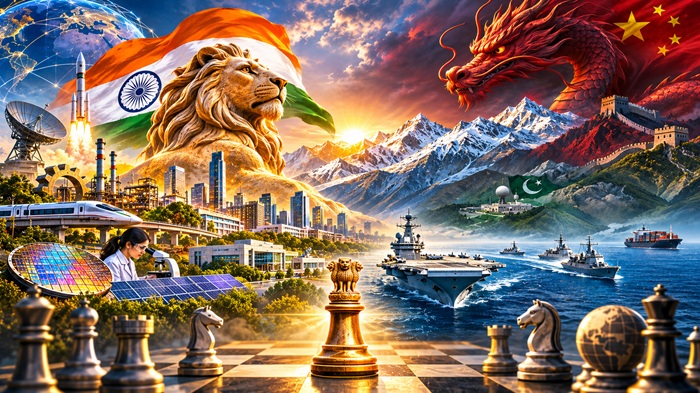
India’s growing economic and military prowess is reshaping the geopolitical landscape, particularly in Asia, where the contest for regional influence is becoming increasingly pronounced. For China, which seeks to preserve its pre-eminent position in the region, India’s emergence as a formidable power is an unwelcome development. A report by the US-China Economic and Security Review Commission, submitted to the US Congress, observes that Beijing views India not merely as a neighbouring country but as a potential challenger to its regional dominance. The findings have brought renewed attention to China’s strategic calculations towards India and the evolving security environment in South Asia. These developments, however, must be examined not simply through the prism of bilateral tensions but against the wider backdrop of global power rivalry.
One of the report’s significant observations concerns China’s military and technological assistance to Pakistan during Operation Sindoor, launched by India in May 2025. Although China did not directly participate in the military confrontation, the report highlights its support in strengthening Pakistan’s military capabilities. Beijing’s willingness to bolster Islamabad during its military tensions with New Delhi reinforces the perception that it seeks to safeguard its strategic interests by keeping India under pressure. Its supply of weapons, military equipment and advanced technology to Pakistan cannot, therefore, be viewed merely as a commercial enterprise; it also serves a larger geopolitical purpose of constraining India's strategic space.
The unresolved boundary dispute remains another major source of concern. Although India and China reached an understanding in October 2024 to reduce tensions along the Line of Actual Control (LAC), normalcy has yet to be fully restored. China's continuing construction of military installations, roads and other infrastructure in border areas poses a persistent challenge to India's security. Its repeated claims over Arunachal Pradesh further expose its reluctance to respect India's territorial sovereignty. While Beijing speaks of peace and cooperation at diplomatic forums, its continued military infrastructure expansion on the ground reveals a troubling contradiction between its rhetoric and actions.
China's expanding naval presence in the Indian Ocean is equally significant. Its ambition to secure influence over vital maritime routes, which carry a substantial share of global trade, could have serious implications for India's maritime security. Beijing's close strategic partnership with Pakistan, its involvement in developing regional ports and its growing naval activities underline the need for New Delhi to continually reassess and strengthen its maritime defence capabilities.
India's economic advancement is another factor contributing to China's unease. India's growing attractiveness to international investors, expanding manufacturing base and progress in technology and indigenous defence production have the potential to alter Asia's existing balance of power. The deepening defence and technological partnership between India and the United States is an additional source of concern for Beijing. More worrying, however, is China's ability to exploit India's continuing dependence on its industrial supply chains. Excessive reliance on Chinese imports for critical components, electronics and rare earth minerals exposes vulnerabilities that could undermine India's economic and strategic security.
Nevertheless, the US commission's assessment should not be accepted uncritically as an entirely dispassionate evaluation of regional security. Countering China's influence in Asia remains a central objective of American foreign policy. Strengthening strategic ties with India consequently serves Washington's own geopolitical interests. India must, therefore, examine the report's warnings carefully and formulate its responses strictly in accordance with its national interests.
Depending excessively on American support to counter China would be as unwise as disregarding the strategic challenges posed by Beijing. India must accelerate indigenous defence production, strengthen border infrastructure and reduce dependence on external suppliers in critical industrial sectors. Simultaneously, diplomatic engagement with China must remain open, while relations with neighbouring countries need to be nurtured through mutual trust and cooperation. National security is not merely a question of military hardware; it also rests on economic resilience, technological self-reliance and diplomatic maturity. The most convincing response to China's apprehensions about India's rise will not come through rhetoric or reliance on American patronage, but through the creation of a strong, self-reliant and economically vibrant India, firmly anchored in democratic values.
