Nov 26, 2026
Nov 26, 2026
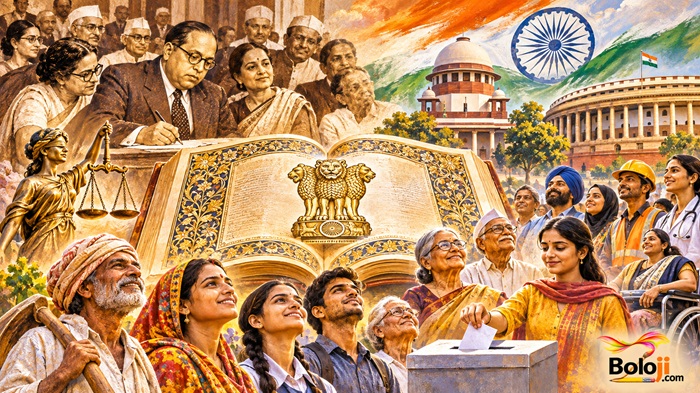
and the Road to True Social Justice
November 26, 1949, stands as a golden milestone in the annals of Indian democracy. Having broken the shackles of centuries of colonial rule, India adopted its foundational operating document—the Constitution of India. Chaired by Dr. B.R. Ambedkar, the Drafting Committee labored tirelessly for 2 years, 11 months, and 18 days to gift the nation the world’s longest written constitution. Notably, this monumental endeavor was not shaped by men alone; 15 visionary women members of the Constituent Assembly—including Durgabai Deshmukh and Hansa Mehta—played a pivotal role in championing gender equality and social justice.
Synthesizing the finest democratic principles from around the globe, the Constitution was custom-built to reflect India’s vast diversity. Its genius lies in its unique blend of flexibility to adapt to changing times and rigidity to protect its core values. Furthermore, establishing an independent Supreme Court to safeguard citizens' rights against legislative or executive overreach remains one of its crowning achievements.
From Colonial Subjecthood to Democratic Sovereignty
While the Constitution borrowed certain administrative frameworks from the British-enacted Government of India Act of 1935, the 1949 document represented a revolutionary leap forward. The 1935 Act kept India subservient to the British Parliament, offered no fundamental rights, and restricted voting rights to a mere 10–14 percent of the population based on property and education. In stark contrast, the 1949 Constitution vested absolute sovereignty in the Indian people, guaranteeing enforceable Fundamental Rights and Universal Adult Franchise (Article 326) to every adult citizen regardless of caste, creed, gender, or wealth. At a time when poverty and illiteracy were widespread, several members doubted whether universal suffrage would survive. Yet, leaders like Dr. Ambedkar and Jawaharlal Nehru placed unwavering faith in the wisdom of the common citizen, arguing that the ballot was the ultimate weapon to dismantle social hierarchies. While Western democracies like the US and the UK took decades of struggle to grant voting rights to women and the poor, India achieved this on day one, setting a global benchmark.
The Preamble, Basic Structure, and Federal Balance
The Preamble serves as the soul and identity card of the Constitution. Beginning with "We, the People of India...", it declares India a Sovereign, Socialist, Secular, Democratic Republic committed to securing justice, liberty, equality, and fraternity—values further reinforced by the 42nd Amendment in 1976.
Structurally, India follows a quasi-federal model, balancing state autonomy with a strong center to preserve national unity. In the landmark 1973 Kesavananda Bharati case, the Supreme Court ruled that while Parliament can amend any part of the Constitution under Article 368, it cannot alter its ‘Basic Structure’—such as democracy, secularism, judicial review, and federalism. This doctrine remains the ultimate shield against authoritarianism.
To ensure smooth governance, the Seventh Schedule divides powers into the Union, State, and Concurrent Lists. Subjects of national importance like defense and currency rest with the Union, while local matters like agriculture and public health belong to the States. On Concurrent List subjects—such as education, forests, and labor welfare—both can legislate, though Union law prevails in case of a conflict, ensuring uniform national standards.
Fundamental Rights, Schedules, and Nation-Building
Part III (Articles 12–35) equips citizens with vital Fundamental Rights, backed by Article 13 (judicial review) and Article 32—which Dr. Ambedkar called the "heart and soul" of the Constitution. From equality before the law and the abolition of untouchability (Articles 14–18) to freedom of speech and the right to life and privacy (Articles 19–22), as well as protections against forced labor and child exploitation (Articles 23–24), these provisions protect human dignity. Complementing them, the Directive Principles of State Policy (Part IV) guide governments toward building a welfare state. Supporting these articles are the 12 Schedules, which organize everything from state boundaries, official languages (8th Schedule), and land reform protections (9th Schedule) to anti-defection laws (10th Schedule) and local self-governance (11th and 12th Schedules).
Post-independence, integrating 565 princely states into the Indian Union was a herculean task accomplished through the statesmanship of Sardar Vallabhbhai Patel and V.P. Menon. Following linguistic movements and the Fazl Ali Commission’s recommendations, the States Reorganization Act of 1956 (7th Amendment) replaced the old A, B, C, and D state classifications with 14 states and 6 union territories. Subsequent socio-economic and regional aspirations led to the creation of new states, reaching 29 with the formation of Telangana in 2014 (currently 28 states and 8 union territories).
Key Amendments and the Quest for Social Justice
Over the decades, pivotal amendments have reshaped Indian society. The 1st Amendment (1951) introduced the 9th Schedule to protect land reforms and Article 15(4) to enable reservations for backward classes. The 42nd Amendment (1976) added Fundamental Duties (Article 51A), while the 44th Amendment (1978) removed the Right to Property from Fundamental Rights, making it a legal right under Article 300A to facilitate public development. Later, the 61st Amendment (1988) lowered the voting age from 21 to 18, the 73rd and 74th Amendments (1992) constitutionalized Panchayati Raj and Municipalities, and the 101st Amendment (2016) ushered in the Goods and Services Tax (GST).
In the march toward social justice, the 1953 Kaka Kalelkar Commission laid the crucial groundwork by identifying 2,399 backward castes. Though unimplemented at the time, its data inspired southern states to enact reservations and paved the way for the Mandal Commission, which eventually secured 27 percent OBC reservations.
Contemporary Challenges: EWS, Agrarian Security, and True Representation
Despite these strides, critical structural inequities demand urgent constitutional reflection—insights drawn directly from extensive empirical studies and public hearings I conducted as the First Chairman of the Telangana Backward Classes Commission, which were formally submitted to the Government and published as official Commission volumes in both English and Telugu:
1. Restoring Lost OBC Opportunities in the EWS Era:
The 103rd Amendment (2019), which introduced a 10 percent quota for Economically Weaker Sections (EWS), has inadvertently caused severe injustice to Other Backward Classes (OBCs), who constitute over half of India’s population. By carving this 10 percent out of the 50 percent open 'General Quota', the unreserved pool available to OBCs shrank from 50 percent to 40 percent. Children from OBC 'Creamy Layer' families face a double disadvantage: excluded from the 27 percent OBC quota due to income criteria and barred from the EWS quota reserved exclusively for general categories, they are forced to compete within a narrowed 40 percent pool. The only equitable solution is to abolish the OBC Creamy Layer and open the 10 percent EWS quota to poor families across all castes—or at least include BC/OBC communities—to restore their lost 10 percent opportunities.
2. Agrarian Security and Article 300A:
Agriculture—the backbone of India’s economy—must be recognized as a dignified, state-supported profession. By guaranteeing remunerative prices, modern technology, insurance, and comprehensive financial security, land-owning farming families will thrive independently without needing to compete for government jobs. This shift will unlock millions of new employment opportunities in public and private sectors for landless poor and unemployed youth. Amending Article 300A in the public interest to institutionalize a "One Family, One Livelihood" framework—agrarian security for the landed and employment security for the landless—will transform rural India.
3. Expanding Parliament to 3,200 Seats, Territorial Representation Across All Sectors, and Guarding Against Fascism:
Indian democracy remains incomplete without true proportional and territorial representation. Until at least 27 percent reservation for OBCs and full implementation of women’s reservations are realized in Parliament and State Legislatures, India remains a democracy lacking proportionate representation.
Furthermore, India suffers from an acute democratic deficit in terms of citizen-to-representative ratios. While major global nations maintain robust parliamentary representation relative to their populations, India’s 1.44 billion citizens are represented by just 788 Parliamentarians (543 Lok Sabha and 245 Rajya Sabha members)—meaning a single Lok Sabha MP represents over 2.5 million people! A comparative look at 10 major nations underscores this stark disparity:
| Country | Approx. Population | Total National Parliament Members (Lower + Upper House) | Avg. Citizens per Representative |
| China | ~1.41 Billion | 2,980 (National People's Congress) | ~4,73,000 |
| United Kingdom | ~68 Million | 1,430 (650 Commons + ~780 Lords) | ~47,500 |
| Italy | ~59 Million | 600 (400 Deputies + 200 Senate) | ~98,300 |
| France | ~68 Million | 925 (577 Assembly + 348 Senate) | ~73,500 |
| Germany | ~84 Million | 699 (630 Bundestag + 69 Bundesrat) | ~1,20,000 |
| Japan | ~124 Million | 710 (465 Representatives + 245 Councillors) | ~1,74,600 |
| Russia | ~147 Million | 628 (450 State Duma + 178 Federation Council) | ~2,34,000 |
| Brazil | ~216 Million | 594 (513 Deputies + 81 Senate) | ~3,63,600 |
| United States | ~335 Million | 535 (435 House + 100 Senate) | ~6,26,000 |
| Australia | ~27 Million | 227 (151 House + 76 Senate) | ~1,18,900 |
| India (Current) | ~1.44 Billion | 788 (543 Lok Sabha + 245 Rajya Sabha) | ~18,27,000 |
To match the democratic standards of Europe, the US, Australia, or China, India’s Parliament must expand to at least 3,200 seats (roughly one representative for every 4.5 lakh citizens). Crucially, territorial representation must not remain confined to electoral politics alone. Extending proportional and territorial representation for OBCs, women, and every region across **all sectors—including the bureaucracy, judiciary, military, and industrialization—**is essential for balanced, holistic national development. When power, administration, defense, and industrial wealth remain concentrated in the hands of a few dominant regions or social groups while the majority is excluded, democracy degenerates into fascist and authoritarian tendencies. Until genuine territorial and social representation is achieved across all institutions, democracy operates in only one-third of its three pillars—a fundamental root cause of persistent inequality and creeping fascism that we must never forget.
As we celebrate Constitution Day, let us remember that the Constitution is not merely a legal text, but a living instrument of liberation. Realizing its true spirit requires continuous reform, vigilance, and an unwavering commitment to equality for all.