Nov 27, 2026
Nov 27, 2026
Has Strategic Autonomy Been Achieved?
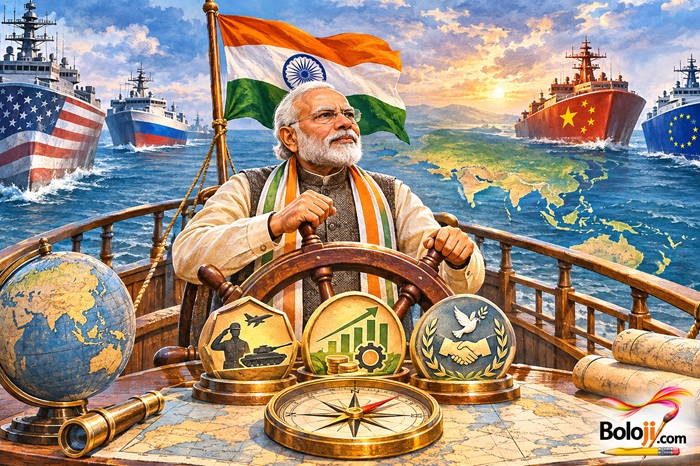
Since the Narendra Modi government assumed office in 2014, India's foreign policy has undergone significant changes. However, it would be inaccurate to describe these developments as an entirely new foreign policy. The fundamental objectives pursued since Independence — national sovereignty, territorial integrity, peaceful coexistence, non-alignment, international peace and an equitable global order — continue to remain part of India's official diplomatic vision. What has changed is the strategy adopted to achieve these objectives, the language of diplomacy, the nature of international partnerships and the emphasis placed on national defence.
The assessment of India's foreign policy must go beyond the question of whether the country's international standing has improved. The more important question is how effectively that standing has been translated into national security, economic development, border protection and international credibility. Providing leadership at global forums is undoubtedly an achievement. However, maintaining trustworthy relations with neighbouring countries, effectively countering China's expansionist ambitions and preserving independent decision-making while deepening partnerships with powerful countries such as the United States constitute much greater challenges.
It would be premature to suggest that the principles of Panchsheel have disappeared from India's foreign policy. Nevertheless, their practical application has increasingly given way to pragmatic realism. The traditional policy of non-alignment has evolved into a broader framework of multi-alignment. India's engagement with the United States, Japan and Australia through the Quadrilateral Security Dialogue (QUAD), its Act East Policy towards Southeast Asia, the India-Israel-United Arab Emirates-United States partnership (I2U2), and expanding technological and commercial relations with Europe reflect this transformation. Countering China's strategic influence, strengthening India's presence in the Indian Ocean and reducing dependence on China in global supply chains are among the principal objectives. Yet, as India moves closer to the American strategic orbit, concerns remain about the extent to which it can preserve its independent decision-making capacity.
This approach has opened up new opportunities in defence technology, intelligence-sharing, maritime security and semiconductor manufacturing. At the same time, India's participation in multiple strategic groupings sometimes makes it difficult for other countries to interpret its position consistently on international issues. Maintaining close relations with Washington while preserving longstanding ties with Moscow is both possible and necessary. But such a balance requires a clearly defined understanding of India's long-term national interests.
The Russia-Ukraine war has emerged as one of the most significant tests of this approach. At a time when Western countries were attempting to isolate Russia, India refused to join the Western sanctions regime and continued purchasing Russian oil. Energy security, competitive prices and decades-old defence ties with Moscow were important considerations behind this decision. At the same time, India called for an end to the war through peaceful negotiations. Prime Minister Narendra Modi's observation to Russian President Vladimir Putin in 2022 that this was not an era of war acquired considerable diplomatic significance.
While some foreign policy experts have praised India's position as an expression of strategic autonomy, others have criticised its reluctance to explicitly condemn Russian aggression at the United Nations, arguing that it reflects selective adherence to international law and the principle of sovereignty. A 2025 assessment by the Swedish Institute of International Affairs also examined the historical relationship with Russia, China's strategic challenge and India's growing partnerships with Western countries as important factors shaping this diplomatic balancing act.
Relations with China, however, have exposed some of the fundamental weaknesses in India's foreign policy. China's conduct has posed a serious challenge to the Panchsheel principles of mutual respect for sovereignty, non-aggression and peaceful coexistence. Twenty Indian soldiers lost their lives during the Galwan clash in 2020. The military standoff in eastern Ladakh continued for several years. The October 2024 agreement on patrolling arrangements in the Depsang and Demchok areas, followed by the announced completion of the disengagement process by December, represented positive developments. Nevertheless, it would be premature to conclude that the border dispute has been resolved or that mutual trust with China has been restored. As Carnegie Endowment for International Peace researcher Saheb Singh Chadha has argued, disengagement must be accompanied by troop de-escalation and the restoration of political confidence.
India's relations with its neighbouring countries have also witnessed both achievements and setbacks. Cooperation in transport, electricity, trade and development has expanded with Nepal, Bhutan, Bangladesh, Sri Lanka and the Maldives. India's financial and humanitarian assistance during Sri Lanka's economic crisis demonstrated its regional responsibilities. However, resentment over the 2015 border blockade in Nepal, the 'India Out' campaign in the Maldives and the uncertainty following political developments in Bangladesh have exposed shortcomings in India's neighbourhood policy. China has increasingly sought to exploit such regional discontent to advance its strategic interests. A 2025 assessment by the Observer Research Foundation (ORF) acknowledged India's development initiatives but identified delays in project implementation, local dissatisfaction and water-sharing disputes as important challenges in regional relations.
At the international level, India's presidency of the G20 in 2023 was a significant diplomatic achievement. India played an important role in securing permanent membership for the African Union in the G20. Bringing the concerns of the Global South into international discussions and highlighting issues such as food security, debt distress and climate justice were commendable initiatives. However, leadership at international summits cannot, by itself, be treated as a measure of diplomatic success. India must ensure that developing countries derive tangible benefits in trade, technology transfer and financial assistance.
The transformation of India's defence sector is another important dimension of the post-2014 period. The growing emphasis on domestic manufacturing has been a significant development. Initiatives such as Make in India and Atmanirbhar Bharat have expanded opportunities for public sector enterprises, private companies and micro, small and medium enterprises. The value of defence production increased from approximately ₹46,429 crore in 2014-15 to around ₹1.51 lakh crore in 2024-25. Defence exports rose from ₹686 crore in 2013-14 to ₹23,622 crore in 2024-25. These figures demonstrate the expansion of India's domestic defence manufacturing capacity.
However, an increase in production value should not be confused with complete self-reliance in advanced military technology. India continues to depend on foreign countries for critical technologies, including aircraft engines, sophisticated electronics, sensors and advanced aviation systems. Unless these technological gaps are addressed, the ambition of achieving genuine strategic self-reliance will remain incomplete.
Defence budget allocations have also attracted criticism. According to the analysis of the PRS Legislative Research, defence expenditure in 2024-25 was estimated at approximately 1.9 per cent of India's Gross Domestic Product (GDP). Despite earlier recommendations by the Parliamentary Standing Committee on Defence for allocations equivalent to three per cent of GDP, this target has not been achieved. A substantial proportion of defence expenditure is absorbed by salaries, pensions and maintenance costs, placing pressure on the funds available for modernisation, advanced weapon systems, research and technological development.
The Agnipath recruitment scheme has also generated sharply divided opinions among military experts and former service personnel. Reducing the average age of military personnel and containing the long-term pension burden are among its stated advantages. However, concerns persist over employment security for those leaving the armed forces after four years, the retention of trained personnel and the preservation of institutional experience and specialised military skills.
Ultimately, it would be simplistic to describe the Modi government's foreign policy as either an unqualified success or a complete failure. Greater international recognition, strategic partnerships, expanding defence production and engagement with the Global South constitute its strengths. Persistent tensions with China, declining trust in some neighbouring countries, dependence on foreign defence technology and selective positions on international law remain significant weaknesses. Foreign policy must serve the country's long-term national interests rather than becoming an instrument of an individual leader's political image.
The government must now undertake several essential measures. First, the principles of Panchsheel, non-alignment, international law and the sovereignty provisions of the United Nations Charter must be applied consistently, irrespective of the countries involved. Second, India must preserve its strategic autonomy by avoiding excessive dependence on any single power while maintaining constructive relations with the United States, Russia, China and Europe. Third, regional cooperation must be strengthened through mutual respect and equal partnerships, without creating the perception that India is interfering in the domestic political affairs of neighbouring countries.
Fourth, defence allocations must give greater priority to research and development, advanced technologies and military training. The Agnipath scheme should be reviewed by an independent committee of experts. Fifth, parliamentary scrutiny, expert consultations and democratic transparency must become integral to foreign policy decisions. Finally, India's commitment to peace, human rights, anti-colonialism and an equitable international order must be reflected not merely in diplomatic speeches but also in its actual conduct.
India cannot emerge as a major global power merely through military strength, economic size or the speeches of its leaders at international summits. Other countries must have confidence in India's word; neighbouring nations must feel secure in their relationship with New Delhi; and India's positions on international issues must command moral credibility.
"A strong military protects the country's borders. A strong economy provides the foundation for national development. But principled diplomacy earns a country lasting respect in the international community." India's foreign policy can be considered genuinely successful only when it achieves a sustainable balance among these three essential objectives.