Sep 23, 2026
Sep 23, 2026
Abstract
A recurring claim in modern Kabir scholarship is that Kabir maintained a deliberate distance from puranic Hindu gods, mythic geographies, and epic characters. This essay challenges that assumption. Through close reading of authentic Kabir-vani, and by situating Kabir within the Ramanandi Vaishnava milieu of his guru Ramanand, it demonstrates that Kabir did not reject the mythic universe of Hindu tradition. Instead, he engaged with it selectively, purposefully, and philosophically. His references to Ram, Ravan, Lanka, Krsna, Ayodhya, Kasi, and Vaishnava symbolism reveal not distance but critical intimacy.
1. Kabir’s Sectarian Location: The Ramanandi–Vaishnava Context
As the famous saying goes, “Kasi mein hum pragat bhaye hain Ramanand chetaye”
Kabir’s spiritual formation occurred under Ramanand, the eminent Vaishnava saint of the Ramanandi sampradaya. Ramanand’s tradition centered on Raghupati Ram, the recitation of the Ram-nama, and the ethical ideals of the Ramayana. Early hagiographies consistently describe Ramanand as Kabir’s guru, and Kabir’s own disciples identify him within the Vaishnava lineage.
Another doha maintains his shift from his idol-worshipping ‘bhakti-yoga’ tradition towards more of ‘jnana-yoga’:
“Hum bhi pahan pujate hote ban ke rojh
Satguru ki kripa bhai sir taim utaryya bojh”
This background is essential: Kabir’s world was not outside Hindu devotional culture; it was immersed in it. His references to Ram, Ravan, Lanka, and Ayodhya are therefore structurally coherent with his sectarian milieu.
2. Kabir’s Use of Puranic Names: Selective but Unambiguous
Kabir’s poetry is not mythological narration; it is spiritual critique. Yet he does invoke puranic figures when they serve his philosophical purpose. These references are authentic and appear in major Kabir‑vani compilations.
2.1. Ram Raghupati Ram
Contrary to the general impression that Kabir’s Ram is nirguna and nirakara, Kabir evidently uses “Ram” in two registers:
The latter appears in unmistakably puranic contexts:
a) “Ram gayo, Ravan gayo, ja ko bahu parivar
Kaha Kabir suno bhai sadho, sabaki lei khabar”

Here Ram and Ravan are clearly the epic protagonists, not metaphysical abstractions.
b) “Ek lakh put sawa lakh nati
Ta Ravan ghar diya na bati”
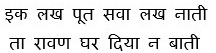
c) “Ravan ghar diya na bati, Ram na kinho bhoj
Kaha Kabir suno bhai sadho, sabaki lei soch”

This is a moral comparison rooted in the Ramayana narrative.
d) “Lanka so koá¹ samundar so ghera
Kaha Kabir taisi Ram ki dera”
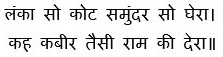
The imagery is directly drawn from the epic geography of Lanka and Ayodhya.
e) “Kabir kuta Ram ka, mutiya mera nau
Galai Ram ki jevari, jit khanche tit jau”

This is devotional language addressed to saguna Ram, consistent with Ramanandi Vaishnavism.
f ) “Dasharath sut tihum lok bakhana
Ram nam ka maram hai ana”
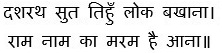
Though this doha is often quoted as an example of Kabir’s Ram being different from that of Dasharath’s Ram, there is no contrast in this doha. Kabir simply says that the essence lies in the name ‘Ram’, who is known in this world as Dasharath’s son. The contrast is a later scholarly projection, not present in Kabir’s words in this doha. Other poet-saints of that era including Tulsidas, Surdas, and Mirabai all have verses expressing the same idea as Kabir’s doha — that the essence lies in the divine name Ram-nama / Hari-nama, even more than in the avataric form. Tulsidas provides the closest conceptual parallel.
g) “Kahai Kabir Ram mam bahuguni
Hari bhagati binam dukh phun-phuni”
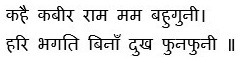
In these lines, not only Kabir isn’t talking about nirguna, but contrarily, he mentions, bahuguna. His Ram is in line with the Ramanandi Vaishnava tradition where Ram exists within a framework that accepts Brahma, Visnu, and Mahesa as different forms of the same divine reality:
“Pati Brahma puhape Visnu, phool phal Mahadev
Tini devau ek murati karai kisi ki sev
Ek na bhula doi na bhula sab samsara
Ek na bhula das Kabira, jakaim Ram adhara”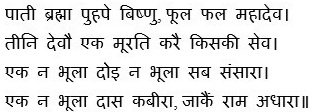
2.2. Ravan and Lanka
Kabir invokes Ravan repeatedly, always in the context of the Ramayana:
a) Ram gayo, Ravan gayo quoted above
b) Ravan ghar diya na bati quoted above
c) “Ravan mari gaya Lanka chhuá¹i, Ramchandra ki sena
Kaha Kabir suno bhai sadho, yah jag rahyo na bena”

This is a direct reference to the war narrative of the epic.
2.3. Govind / Krsna / Giridhar / Gopal
Kabir’s use of Govind is often interpreted as a generic name for God. Yet in several contexts, “Govind” retains its Vaishnava resonance as Krsna, the cowherd-lord of Braj. The most famous instance, “Guru Govind dou khare”, clearly talks about God standing in human form, on feet, just next to the human guru:
“Guru Govind dou khare, kake lagu paye
Balihariya guru apane, Govind diyo batay”
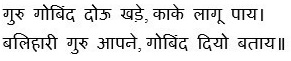
Here “Govind” is not an abstract Brahma; it is a personal deity whose “paye” feet Kabir can fall upon — saguna-sakara form consistent with Vaishnava theology.
A few authentic references from numerous others include:
“Govind gahai to chhutai nahim, chhutai to jag jae
Kaha Kabir hari bhaj man re, hari bhaj man re bhai”
“Govind ke gun gayiye, man mem rakho dhir
Kaha Kabir suno bhai sadho, Hari hi hai gunvir”
“Meri jibhya Bisnu nain Narayana, hirdai japaum Govinda
Jab duvar jab lekh mangya, tab ka kahisi Mukanda”
“Bahut bhagati bhausagara, nana vidhi nana bhav
Jihi hirdai Srihari, bhetiya, so bhed kahum thamv”
“Bahu pap parbat chhedanam, bhau tap duriti nivaranam
Kahai Kabir Govind bhaji, paramanand bandit karanam”
“Guru Govind tau ek hai, duja yah akar
Apa met jivat marai, to pavai karatar”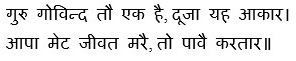
“Kabir dariya prajalya, dazhai jal thal jhol
Bas nahim Gopal sau, binsai ratan amol”
“Giridhar ke ghar jaum re, man laga mere Giridhar sang”
“Giridhar Gopal, das tera Kabir” 
- Kabir Padavali — Nirguni Parampara
“Giridhar se lagan lagai, man nahim manat aur”
- Padavali — Bhavatmak Bhakti Pad
“Giridhar ko dhari le, aur na kahu thaur” 
- Kabir Sakhi-Sangrah — Banarasi Parampara
“Giridhar sam bali koi nahim, dhari leta sab bhar” 
- Bijak - Ramaini, Lok-prachalit Path; Vidvanon dvara Manya
“Banamali janai ban ki adi, Ram nam bina janam badi
Phool ju phule ruti basant, jamaim mohim rahe sab jiv jant
Phoolni maim jaise rahai bas, yum ghaá¹i ghaá¹i Govind hai nivas
Kahai Kabir mani bhaya anand, jagjivan miliyau paramanand”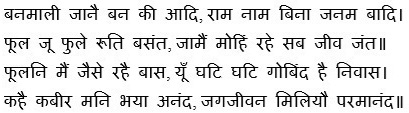
“Tu karau dar kyum na kare guhari, tum bin panchanani Sri Murari
Tan bhitari basai madan chor, tikin sarbas linau chhor mor
Mangai dei na binai mann, taki marai rida maim kamm bann
Maim kihi guharaum ap lagi, tu kari dar bare bare gaye hai bhagi
Brahma Visnu aru sur mayank, kihi kihi nahim lava kalank
Jap tap samjam sumni dhyana, bandi pare sab sahita gyann
Kahi Kabir ubare dve tin, ja pari Govind kirpa kinh”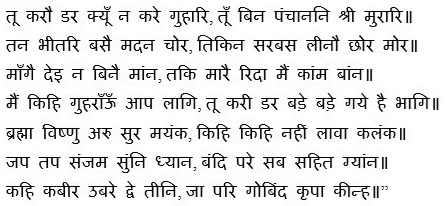
These usages align with Vaishnava vocabulary, where “Govind”, “Gopal”, or “Murari” are common epithets of Lord Krsna.
3. Sacred Geography: Ayodhya, Kasi, Braj
Kabir’s poetry is deeply rooted in the sacred geography of North India.
3.1. Kasi Varanasi
Kabir lived in Kasi, and references to it appear in multiple sakhis:
“Kasi karai kuka, Avadh karai ah
Kaha Kabir suno bhai sadho, dou jagah parvah”
And
“Kasi kuta mari kuta, kuta jagat samaj
Kaha Kabir suno bhai sadho, kuta bhitar kaj”
These lines critique ritualism but affirm Kabir’s embeddedness in the city’s Hindu religious life.
3.2. Ayodhya
Kabir uses Ayodhya symbolically as Ram’s sacred city:
“Ayodhya nagari Ram ki, taham karai sab kaj
Kaha Kabir suno bhai sadho, Ram bina sab saj”
Even when used metaphorically, Ayodhya is invoked as Ram’s sacred geography.
3.3. Braj / Gokul / Mathura
While Kabir does not frequently mention Braj by name, his use of Govind, Hari, and Murari reflects the Braj‑centric devotional vocabulary of his milieu.
4. Kabir’s Puranic Engagement: Not Rejection, but Reinterpretation
Kabir’s engagement with Hindu mythic figures is not devotional in the conventional sense. It is philosophical, ethical, and critical. Yet it is also intimate, unembarrassed, and unapologetic. There are numerous references to Brahma, Visnu, Mahesa, Yamaraja, and other Vedic-puranic figures in his poetry. Two examples:
“Kabir suta kya karai, gun Govind ke gai
Tere sir pari jam khara, kharach kade ka khai”
“Asa karai baimkunth ki, durmati tinau kal
Sukra kahi bali na karim, tate gayo patal”
“Kabir gaphil kyyom phirai kya sota ghanaghor
Tere sirane jam khara, jyum andhiyare chor”
“Kabir suta kya karai, suta hoi akaj
Brahma ka asan khisya, sunat kal ko gaj”
“Sab jag darpai kal som, Brahma Visnu Mahes
Sur nar muni au lok sab, sat rasatal ses”
Kabir does not reject Hindu gods; he rejects empty ritualism. He does not reject the Ramayana; he rejects ego, pride, and violence. He does not reject Krsna; he rejects sectarian exclusivism.
Kabir’s references show:
He stands within the Indic tradition, not outside it.
5. Conclusion: Kabir’s Mythic Vocabulary as Cultural Belonging
The claim that Kabir “kept distance” from Hindu gods is a modern projection. The textual evidence shows:
Kabir’s world is not myth-free; it is myth-literate. Not ritualistic; but deeply rooted. Not sectarian; but culturally integrated.

|
This is a beautiful blog on Kabir. Thanks for sharing something truly original and heart touching. |
