Sep 27, 2026
Sep 27, 2026
Introduction
 By 1849 at the end of Anglo-Sikh wars in the defeat of Sikhs, the East India Company (EIC) became the new rulers of Khalsa Raj. Earlier there was open clash between Rani Jindan and EIC, which made it evident that they would not tolerate the overbearing regent Rani for long. After assuming power, the thrust was to eliminate any source of potential rebellion against the EIC’s Raj. Thus, the first casualty was Rani Jindan herself, who was first stripped of her royal powers and imprisoned in Sheikhupura, Punjab then later transferred to Chunar Fort, near Varanasi in 1846-47. Rani Jindan escaped from the Chunar Fort to Nepal in 1849. With her out of picture the next perceived threat was Maharaja Duleep Singh, who was exiled to England in 1854. In 1857 Sepoy Mutiny had just ended and EIC were extremely concerned about any real or perceived threat to their Raj. The Indigenous education system established by Maharaja Ranjit Singh with high literacy rate was its next target. Punjab was the most educated place, there was not a Gurdwara, mosque, a temple, which had not a school attached to it. The literacy rates were approaching 100% which was perceived as a threat to the empire.
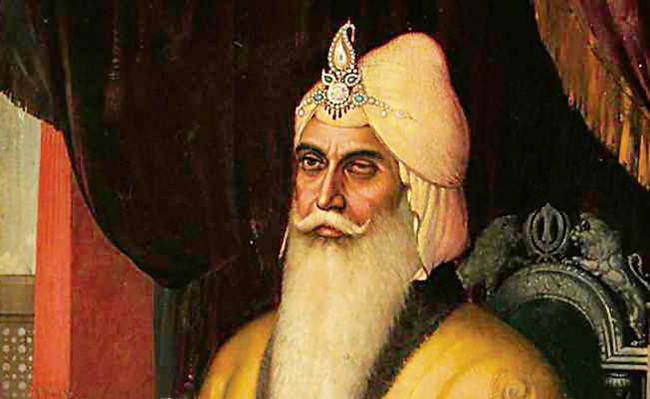
Maharaja Ranjit Singh’s Education System
Maharaja Ranjit Singh had been fighting with other rulers to consolidate his hold over the region. It was in 1820s; he was accepted by his adversaries and also by EIC as the undisputed ruler of the Punjab. In 1832 he turned his attention to education by introducing a Qaida system for his subjects. Though he himself was not so educated as had received little formal education, yet he was a great visionary, and wanted his subjects educated. He wanted all his subjects to be able to write to him directly.
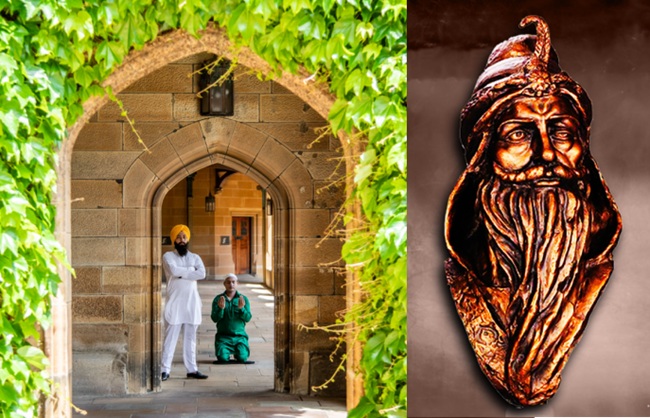
To fulfill that objective Qaida-E-Noor were introduced in three languages. Qaida means an elementary book and Noor means light (Roshni). A massive movement was launched in 1837 to educate masses through the book Qaida-E-Noor.
According to Leitner, Ranjit Singh appointed his well-read empire’s Foreign Minister Fakir Aziz ud-Din’s younger brother, to design a course for this purpose. Fakir Nur-ud-Din prepared a Qaida that helped one to learn the basic alphabets and elementary writing in the key languages of Gurmukhi, Shahmukhi, and Persian. The booklet also included a basic course in elementary and everyday mathematics.
Maharaja got prepared 5,000 books (Qaidas) to start his educational campaign with strict rules and ordered his “Lambardars” (Head of the Village) to implement and read the Qaida within three months. They were then required to manually print more copies of this Qaida to pass it on to 5 other people of the village whose names were to be registered with the state. The instructions were to continue this chain further down within the estate and report the final number back to the Maharaja. This top-down approach changed the educational landscape within few years.
In a few years 87% of the people of the Lahore area and 78% of the neighboring areas became educated. Qaida was made compulsory for women, thus ahead of its times the women in Ranjit Singh’s empire were fully educated. In the Lahore District report of 1860, we see that it had 576 formal schools where 4,225 scholars taught.
EIC documents state from intelligence reports that “over 61 per cent of the females of the Punjab could read and write, far more than those in England”. The foreign generals of Maharaja had enforced adult literacy programs in their units, and very soon the fighting force was “second to none.” Lord Roberts commented to the Company: “The forces of the Maharaja can truly be said to be among the finest in Asia.” Still more than the excellent Punjabi Army, the Company was more scared of the population of Punjab. Unfortunately, during the EIC rule in India, this Qaida totally disappeared and was never seen again.
After a survey upon taking over the Raj, EIC operatives discovered that education in Lahore, and the Punjab, was far superior to the education the British had introduced all over ‘conquered India.’ In Lahore alone there were 18 formal schools for girls besides specialist schools for technical training, languages, mathematics and logic. In addition, there were specialized schools for the three major religions, these being Hinduism, Islam and Sikhism. There were craft schools specializing in miniature painting, sketching, drafting, architecture and calligraphy. Besides, there were Mahajani Schools where pupils learnt trading and economic activities, bookkeeping and land records that were crucial to traders and property record keepers.
Historian and journalist Majid Sheikh said that the Punjabi language preceded Sanskrit as the image language of the Indus civilization, including Harappa.
Uprooting the established Indigenous Education System
 Much of what we know of the Maharaja’s educational reforms comes from the work of British scholar and traveler, Gottlieb Wilhelm Leitner, author of History of Indigenous Education in the Punjab: Since Annexation And in 1882(See details in References).
The new masters EIC wanted to focus on a secular and modern western system of education and did not allow classic languages: Persian, Gurmukhi and Sanskrit to be taught in Punjab’s schools. These were replaced with Urdu and English as the medium of instruction. The new political dispensation also halted funding to traditional, religious schools. During the Khalsa Raj every operating religious center was required to have a school running, and now they were ostracized with their funding cutoff as well. EIC called their teachings unscientific and claimed they were spreading old and outdated ways of thinking. Grants-in-aid were henceforth given only to schools and colleges run alone by European management.
The new rulers wanted to remove all traces of Indigenous education. Anybody handing over a gun or sword to the Raj rulers was paid two annas while the one returning Punjabi Qaida was paid six annas. According to Majid Sheikh, “The colonial rulers collected Punjabi Qaidas from village to village and burnt them.” Today no one can find a single copy of Qiada.
After the 1857 Sepoy Mutiny, EIC wanted to promote Western education, especially in the Khalsa kingdom. They decided to establish a college of repute in Lahore, as an affiliate of the University of Calcutta. Leitner applied for the position and gladly accepted the offer to serve as the first principal of the Government College, Lahore in 1864. That is how he was recruited from London and brought to Lahore.
In his work, Leitner says there was no dearth of money to set up schools and other institutions of learning in Punjab. Leitner writes, “Punjab has this tradition whereby the most unscrupulous chief, the avaricious moneylender, and even the freebooter, vied with the small landowner in making peace with his conscience by founding schools and rewarding the learned. There is not a mosque, a temple, a dharmsala that had not a school attached to it.”
Leitner further describes that along with languages and religion, the study of grammar, literature, philosophy, rhetoric, astronomy, law, logic, philosophy, arithmetic and geometry, all of which could be termed as the secular education existed in the religious schools of the kingdom. However, he fails to provide the exact timeline of these developments.
In the 'Introduction' to his original 1882 publication, he starts off by stating: “… in spite of the best intentions, the most public-spirited officers, and a generous Government that had the benefit of the traditions of other provinces, the true education of the Punjab was crippled, checked and nearly destroyed … our system stands convicted of worse than official failure”. What amazes one the most is the fact that women were more educated than men, and this was observed by Dr. Leitner. This ensured that with every passing year, the literacy rate increased.
Leitner also mentioned, “Instead of identifying them with our interests, everything in their literature which appeared ridiculous to our hasty examination was held up to tacit scorn, - a course which was calculated to destroy a sense of reverence amongst their co-religionist.” Once this patronage stopped, literacy rates progressively declined.
Conclusion
Maharaja Ranjit Singh, also popularly known as the Sher-e-Punjab, was not just a foresighted military strategist alone, but also possessed great foresight. He gave his subjects what was perhaps the greatest gift of all – the gift of education to have a higher quality of life. Later that education system was deliberately stifled so that EIC Raj could flourish. The cascading effect is visible even today as in either side of divided Punjab, Urdu and Hindi being patronized at the expense of Punjabi. If this is the state in Punjab, then its fate in other states of Khalsa Raj is worse. Interested in a movie on the subject? Dave Sidhu, an Indo-Australian Director has made a short movie on it in 2021 which is available.
References:
Image of Rani Jindan courtesy Preet Munday
10-Jan-2026
More by : Bhupinder Singh