Oct 19, 2026
Oct 19, 2026
by Varala Anand
Cultural Autobiographies of South Indian Societies
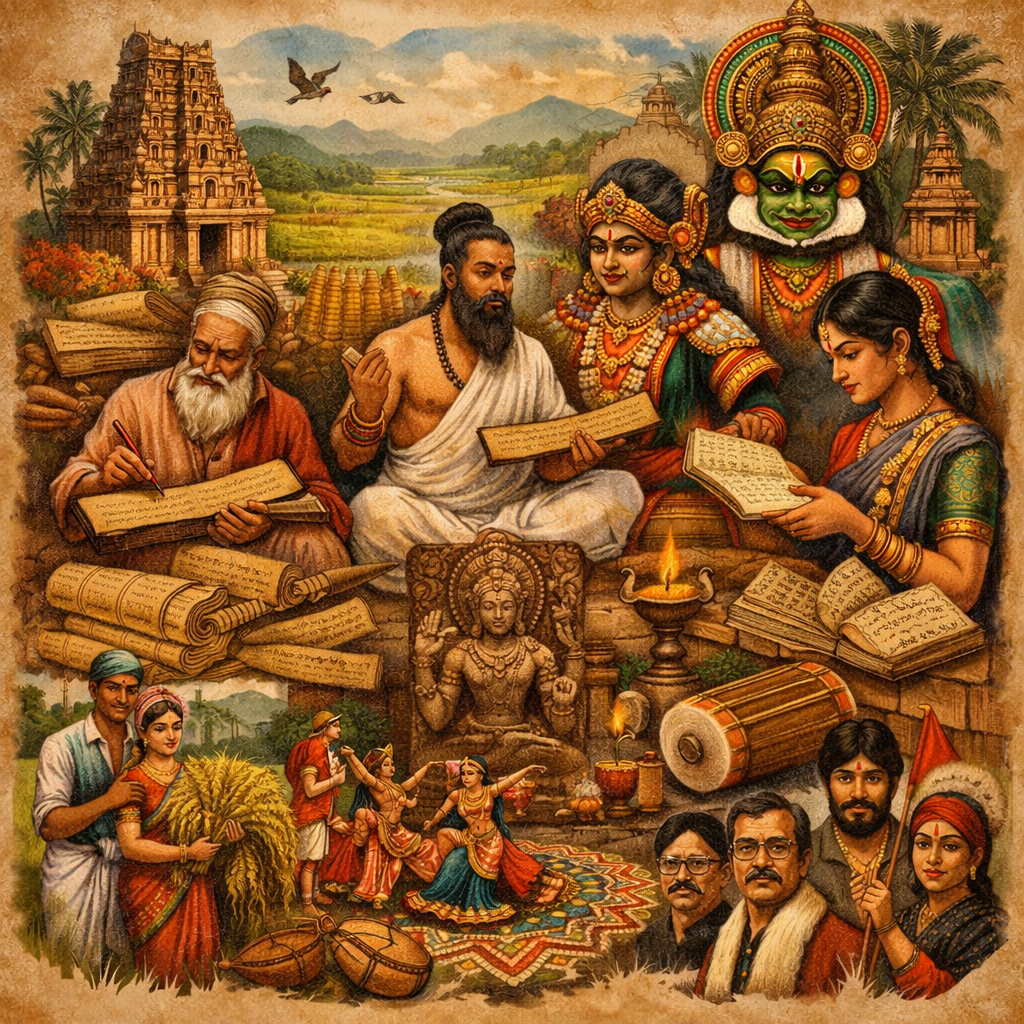
Dravidian literatures are not merely four distinct scripts. They are four ways of living. To view them comparatively is not to decide which is superior, but to recognize the vastness of human experience they embody. When we examine the Dravidian languages comparatively, what becomes clear is not only that they belong to a single linguistic family, but that they form a family of shared experiences. Despite their diverse styles, one finds within them a common, human-centred philosophy. That is why the unity of Dravidian literatures is not merely a political statement it is an intrinsic literary truth.
Yet, when Dravidian literatures are discussed, we often stop at the level of language itself Telugu, Tamil, Kannada, Malayalam their different scripts, sounds, and grammars. The discussion rarely moves beyond these distinctions. Literature may begin with language, but it does not end there. It continues through the land, the society, and the lived experiences of people in a given historical moment. Seen from this perspective, Dravidian literatures are not separate entities. They are different chapters of a single cultural consciousness.
When we examine their commonalities, we find that agriculture, the lives of peasants, labourers, and workers, and experiences shaped by rain, drought, and festivals form the foundational themes of Dravidian literature. Forests, hills, seas, and fields nature here is not merely a backdrop but a living presence, an active character within the literary world. Hence, village streets appear more often than royal courts, and everyday struggles of life resonate more powerfully than heroic epics.
Dravidian devotional literature does not enthrone God on a distant pedestal; it brings the divine closer to the human. Here, devotion is not fear. It is questioning, arguing, and at times even anger. This devotional tradition, in many ways, paved the path toward social equality. Dravidian literature persistently raised fundamental questions about caste, class, and power, addressing them with remarkable moral clarity.
Each Dravidian language carries its own vision. Alongside shared traits, there are clear differences. Tamil literature, from a very early period, developed systematic frameworks to understand love, war, and society, treating even emotion as a discipline. Telugu literature transformed storytelling into an art form; epic poetry, prabandha, and drama carried the language to wider audiences, making ornamentation and rhythm its natural qualities. Kannada literature, especially through the vachana tradition, brought literature out of royal courts into the public sphere, posing intense social questions in a simple, direct language. Malayalam literature, particularly in the modern period, turned inward to explore the human psyche loneliness, psychological conflict, and experiences of migration became its central concerns.
Amidst these many voices and distinctive features, one element binds Dravidian literatures together the human being.
Here, literature does not stand close to power. It stands beside the weak and the marginalized, speaking on their behalf. It relentlessly questions inequality. It does not merely glorify suffering, nor does it aestheticize pain. Instead, it records lived experience with uncompromising honesty. That is why Dravidian literatures have always moved with time, becoming sites of resistance and foundations for social change. They are not simply the stories of four languages they are the cultural autobiographies of South Indian societies.
They should not be viewed in isolation. What must be recognized is the continuous stream of collective experience that flows through them. Languages are never static; they change. Times change. But the fundamental tone of human experience does not. That unchanging note is the true unity that stands at the heart of Dravidian literatures.
A deeper examination reveals that Telangana literature expresses the political nature of Dravidian literatures with exceptional clarity. It has never privileged ornamentation, royal luxury, or the praise of authority. Instead, it has spoken of drought and hardship, questioned injustices in water distribution, and voiced caste and class humiliation with directness and force. The hardness, irony, and impatience found in the Telangana idiom are cultural responses to historical injustice. Oggukathas, Burrakathas, and folk songs are not merely forms of folklore; they are the people’s voices standing in opposition to power.
This sensibility aligns with the political consciousness of the Tamil Dravidian movements, the anti-caste voice of the Kannada vachana tradition, and the uncompromising realism of modern Malayalam literature. During the struggle for a separate state, Telangana literature transformed language not merely into a marker of identity but into a weapon of resistance. In doing so, it revealed the core philosophy of Dravidian literatures. That is why Telangana literature stands as a living continuation—an interpretation of the political soul of Dravidian literatures for our time.
Today, it is both necessary and desirable that discussions focus on the living presence and breathing movements of Dravidian language and literature.
08-Feb-2026
More by : Varala Anand
Top | Literary Shelf | Home