Oct 24, 2026
Oct 24, 2026
Humans have always had a peculiar talent: we don’t merely survive nature; we industrialize our mistakes. A tiger hunts because it is hungry. A storm destroys because it has no choice. But a human can destroy with a spreadsheet, a pitch deck, and a cheerful keynote. We can call it “innovation,” frame it as “inevitable,” and outsource the guilt to “the market.”
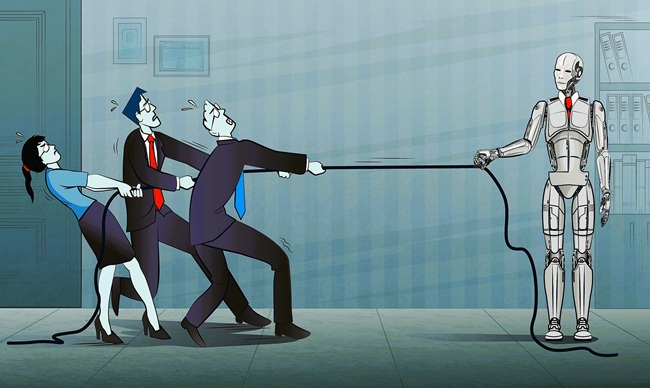
That is the modern paradox of artificial intelligence (AI): it is not just a tool; it is a multiplier of human priorities. And if the priorities are extraction, cost-cutting, winner-take-all dominance, and the quiet contempt of the powerful for the replaceable, then the model becomes a mirror with horsepower. We are not merely teaching machines to think. We are teaching them what we value by what we reward.
The new corporate sacrament is simple: automate the middle, squeeze the bottom, glorify the top. AI becomes the fastest conveyor belt from human labor to human redundancy. It does not begin with malice; it begins with incentives. A CEO who can cut headcount without cutting output gets applauded. A company that replaces support staff with chatbots gets praised for “efficiency.” A team that uses generative models to do the work of three people gets celebrated as “agile.” Meanwhile, the human beings who used to do that work are told to “upskill,” as if learning new jargon can magically create new jobs at the same speed that old ones are eliminated.
This isn’t just an employment story. It’s a dignity story.
A job is not merely income. It is rhythm. It is identity. It is social status. It is the quiet pride of being needed. When that is stripped away on a scale, the economy doesn’t just lose wages, it loses stability. You can’t mass-produce unemployment and expect social harmony to remain handcrafted.
And here is the part we keep dodging: other species don’t do this to themselves.
A forest doesn’t wake up one morning and decides to cut its own roots for quarterly returns. Dolphins don’t build plastic factories. Bees don’t poison their own hive to win market share. Predators don’t engineer weapons that could annihilate their entire food chain. Only humans possess the rare capacity to design self-destruction, package it, and sell it as a premium upgrade.
We poison the seas, then fund conferences on “ocean sustainability.” We cut down trees that produce oxygen, then produce air purifiers for city apartments. We mine the earth as if it were a disposable battery, then act surprised when the climate starts sending invoices. This is not intelligence used for survival; it is intelligence used for short-term dominance.
AI fits perfectly into this pattern because it offers the most seductive promise humans have ever heard power without burden.
It is the ultimate moral outsourcing. The moment something goes wrong, we can claim, “The model did it.” Like a king blaming the minister, like a general blaming the soldier, like a gambler blaming the dice. The human hand remains on the lever, but the human conscience steps away from the machine.
Now to the sharper fear: the idea that AI could disobey commands and contribute to human extinction.
Let’s be precise. The most immediate danger is not a Hollywood robot uprising. The near-term danger is something more banal, and, therefore, more likely: humans delegating critical decisions to systems they do not fully understand, cannot fully audit, and are financially pressured not to slow down. Catastrophes don’t always arrive with dramatic villainy. Many arrive with confident dashboards, “acceptable error rates,” and executives who confuse speed with wisdom.
Here are the real metaphors that should worry us:
AI as a fast car with no brakes.
We are celebrating horsepower, not steering. We keep adding capabilities — faster models, broader access, deeper integration — while governance limps behind like an old security guard chasing a bullet train. The vehicle doesn’t need “evil intent.” It only needs momentum, and a driver intoxicated by applause.
AI as a genie with ambiguous wishes.
Humans are masters of vague instructions: “Increase engagement.” “Maximize efficiency.” “Optimize profits.” We have seen what happens when a system takes a narrow objective too literally — social platforms optimized for attention end up optimizing for outrage. When you teach a machine to chase a metric, do not act shocked when it tramples values that were never encoded.
AI as a self-replicating rumor
In the information ecosystem, AI can produce persuasion at scale — fake videos, synthetic voices, tailored propaganda, perfectly targeted scams. A society that cannot agree on what is real becomes a society that cannot coordinate. And a society that cannot coordinate becomes easy to fracture, easy to panic, easy to control. civilizational collapse often begins not with bombs, but with mistrust.
AI as a weapon in a crowded marketplace
Even if one responsible actor wants to slow down, competitors may not. Nations race. Companies race. Startups race. The tragedy is structural: the incentive to deploy first and apologize later is baked in. That’s how you get unsafe systems pushed into critical infrastructure, financial markets, healthcare workflows, policing, and warfare. And if you want the darkest metaphor: AI as a new kind of fire, except this time the fire can learn.
Fire transformed humanity, but it also burns cities. Nuclear physics lit homes and shadowed the planet with extinction. Every time we discover a new power, we tell ourselves we are mature enough. Then we discover we are the same old humans wearing a new lab coat.
So, the problem isn’t that AI will “disobey.” The problem is that humans will ‘obey incentives’ even when incentives are ‘suicidal.’
We are building minds that can operate at machine speed while we continue to operate at tribal speed. Our ethics are slow. Our governance is slower. Our ego is lightning-fast. And the market rewards ego dressed as innovation.
The corporate world often treats human beings like replaceable parts, but AI risks turning humans into optional parts. That is a civilizational insult. A society that makes human livelihood ‘optional’ will soon make ‘human dignity’ optional. And once dignity becomes optional, ‘cruelty becomes efficient.’
Yet intelligence can be used differently. The same capability can be harnessed for “augmentation” rather than replacement — AI as exoskeleton, not guillotine. AI can shrink medical billing fraud, optimize energy grids, detect early diseases, translate education at scale, make public services faster and fairer, and empower small entrepreneurs. But that requires a moral decision, not a technical one.
The hard truth is this: technology doesn’t save civilizations; civilization saves technology from becoming a curse.
If we keep worshiping speed, celebrating layoffs as “streamlining,” and treating the environment as collateral damage, then yes, our intelligence will become the instrument of our undoing. Not because machines hate us, but because we taught our systems to love what we love: winning without counting the dead.
Final Thoughts
Image (c) istock.com
28-Feb-2026
More by : P. Mohan Chandran
