Sep 26, 2026
Sep 26, 2026
Introduction
If we look at the history of mankind, we find that wars have been fought all along. The thing that has changed is how wars were fought and types of weapons that were employed. When we look at the last century we saw advent of many new types of weapons, and along with that we saw coining of the term GI for army men in US army. Now in the twenty-first century we are seeing that advent of AI is transforming the way wars are being fought. The future of conflict resolution looks very scary not just in terms of human loss alone, but collateral property damage and infrastructure damage. Let us just look at the changes taking place and how they will influence the outcome of future wars.
GI
Originally the term GI was referred to for Galvanized Iron. Even today in the engineering world the term GI means Galvanized Iron. However, in military supply records systems it was used for items like trash cans and buckets etc. which were made of GI Then during World War I and II it came to signify items issued by the government. Thus, GI became an abbreviation for Government Issued. Later, in 1935, the term "G.I." became associated enlisted American soldiers.
When the comic strip GI Joe became popular in the Army weekly in 1942, it firmly established the relationship for the enlisted army men. This association was further deepened with the radio show called “They call me Joe” which started airing in 1944. So, by the end of World War Two the association was complete. That association was further deepened during the Korean war. Then the toys with GI Joe came into the market and became popular with the kids. The kids will play with those figures staging mock fights.
So today we have quite a few generations who have grown up playing with GI Joe toys and for them the association is inseparably complete. We even had a Hasbro Toys produced TV show called GI Joe from 1985 to 1986. Now in slang world and the popular literature the association of GI is for army men alone.
AI
AI is abbreviation for Artificial Intelligence. AI began as a theoretical pursuit in 1950s to automate human thoughts. However, the 21st-century computing power has fueled its recent explosive growth. It’s a transformational technology that can bring meaningful and positive changes to people and societies and the world. But it can be used also to cause harm, damage infrastructure, hack the computers running vital systems and maim the societies as well. Computing chip manufacturing has seen the explosive growth powered the demands for computer chips that they have developed using AI.
These technological advances have shifted the computer from a passive calculator to an active collaborator. It is already automating the high-frequency trades on the stock market, optimizing complex supply chains, transforming digital advertising. Today, AI systems have been used to rapidly identify and recommend bombing targets, sometimes leading to high civilian casualty risks. These tools have been used in the Gaza and Iran conflict, which have enabled faster, higher-volume strikes.
AI in the Russia-Ukraine war is revolutionizing warfare through autonomous drones, AI-powered targeting systems, and advanced surveillance, with drones accounting for 70-80% of battlefield casualties. Ukraine heavily utilizes AI for reconnaissance, facial recognition (Clearview AI), and autonomous drone strikes, while both sides use AI, to navigate electronic warfare (EW) and analyze battlefield data.
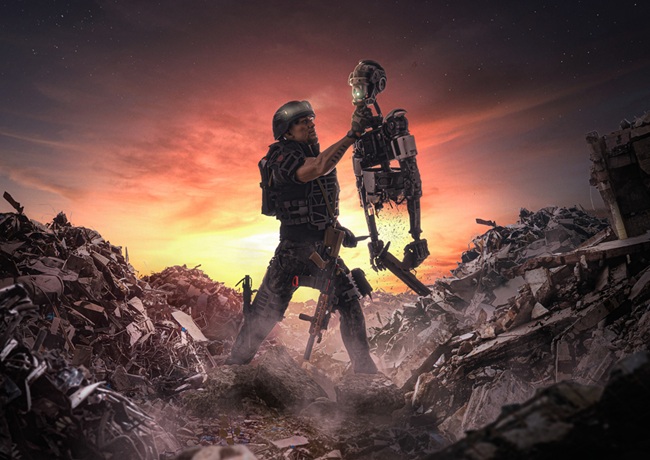
Now we can imagine how future wars will be fought. We will be seeing more AI dominance and less GI boots in the actual battlefield. The whole concept of wars is undergoing transformation. Just as Joe got associated with GI, soon we will find a first name that is associated with AI No one can predict what that name will be, but for today let us call it Leo.
The Future – AI Leo takes over GI Joe
Today, AI games are being used to simulate war time scenarios and train the personnel including GIs. Now imagine down the road if AI becomes powerful enough, that AI can replace the GI in the battlefield then the way the wars are fought will completely change. The battles will not be fought on the ground alone but will be fought by overtaking and disabling the functioning of the computers running the banking system, internet, transportation system, power generation, transmission and control of vast array of systems totally destabilizing and disrupting the normal functioning of systems in the enemy country. The situation is quite alarming and mind numbing.
Imagine the new world where AI Leo has taken over GI Joe. That doomsday scenario may be closer than what we can visualize. It is a scenario worth pondering over. How will the world look after the devastation caused by our AI Leo? The taste of future wars has been painted in these words by the Russian President Putin in a televised speech in September 2017. He said that the first country to develop true AI will rule the world. Thus, major countries have shown great interest in the military use of AI in recent years, and there has been a race to develop it.
The wars being waged now in Ukraine, Iran, Lebanon are becoming testing and proving grounds for AI use in warfare. Let us hope and pray that no such war gets started, but the consequences will be very devastating.
The most famous warning comes from renowned physicist Stephen Hawking: AI may bring about the end of humankind.
Image (c) istock.com
02-May-2026
More by : Bhupinder Singh

|
Bhupinder jee Totally impressed how you can write stuff on any topic. You definitely have acquired deep knowledge researching on these topics . We are benefiting reading for sure. Thanks for educating us on GI JOE |