Oct 25, 2026
Oct 25, 2026
Japan's Kawasaki Ec-2 & The Future of Ai-Driven Electronic Warfare
"The wars of the future may not begin with explosions. They may begin with silence — when radars go blind, communications disappear, satellites become unreliable, and commanders suddenly lose the ability to see the battlefield."
What happens when a fighter jet cannot detect an incoming missile?
What happens when an entire air-defense network suddenly becomes deaf?
What happens when drones lose contact with their operators?
And what happens when an enemy's billion-dollar weapons become useless without firing a single bullet?
These questions lie at the heart of modern warfare. The battlefield of the twenty-first century is no longer dominated merely by tanks, missiles, and fighter aircraft. Increasingly, it is dominated by the electromagnetic spectrum. In this invisible battlefield, Japan's new Kawasaki EC-2 Stand-off Electronic Warfare Aircraft represents one of the most sophisticated strategic weapons developed in recent years.
Unlike conventional bombers, the EC-2 is not designed to destroy cities. It is designed to destroy the enemy's ability to fight.
The Rise of Electronic Warfare
Military historians often divide warfare into different eras.
The First World War belonged to artillery.
The Second World War belonged to air power.
The Cold War belonged to nuclear deterrence.
Today's conflicts increasingly belong to electronic warfare (EW).
Electronic warfare revolves around controlling the electromagnetic spectrum by:
In military doctrine, whoever dominates the electromagnetic spectrum often gains a decisive operational advantage before the first missile is launched.
Why Japan Built the EC-2
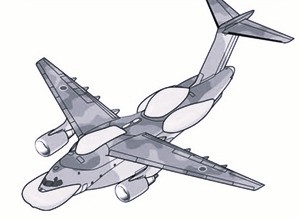 Japan faces an increasingly complex security environment in the Indo-Pacific, with growing regional investments in long-range missiles, integrated air-defense systems, and electronic warfare capabilities. In response, the Japan Air Self-Defense Force (JASDF) initiated development of a new stand-off electronic warfare aircraft based on the indigenous Kawasaki C-2 transport platform. The programme began around FY2020–2021, with the first aircraft expected to enter service in FY2027 after flight testing.
Instead of entering heavily defended airspace, the EC-2 is intended to operate from safer stand-off distances while using high-power electronic attack systems against hostile radars and communications.
Why Does the Aircraft Look So Strange?
At first glance, the EC-2 hardly resembles a conventional military aircraft.
Its unusually large nose, prominent dorsal humps, and multiple fuselage fairings are not aesthetic choices. They are designed to house antennas, receivers, transmitters, and electronic warfare systems. Analysts assess that these structures support radar jamming, electronic support measures, and other mission systems.
Unlike fighter aircraft that carry bombs, the EC-2 carries information, and the ability to deny information to an adversary.
Major Features of the EC-2
Some of its most significant capabilities include:
The large C-2 platform was selected because electronic warfare equipment requires significant payload capacity, electrical power, and onboard space — more than the earlier EC-1 platform could provide.
Why AI Makes the EC-2 More Dangerous
Artificial intelligence is transforming electronic warfare. Traditional jamming relied on pre-programmed techniques.
Modern AI-enabled systems can:
Rather than simply transmitting powerful interference, AI-assisted systems can help identify which signals matter most and support quicker adaptation to a changing electromagnetic environment. Public information about the EC-2 does not confirm the extent of AI integration, but AI is increasingly viewed as an enabling technology for modern electronic warfare systems.
How Electronic Warfare Can Neutralize Advanced Weapons
Many advanced military systems depend on:
If these supporting systems are disrupted, the effectiveness of many weapons can be significantly reduced.
Electronic warfare does not necessarily destroy the missile.
It may instead interfere with the missile's ability to find its intended target.
Lessons from Recent Conflicts
Recent conflicts have shown that electromagnetic superiority is increasingly important.
Operations in Ukraine, the Middle East, and elsewhere have highlighted extensive use of jamming, spoofing, drone interference, and electronic intelligence to influence battlefield outcomes.
Electronic warfare has become as strategically important as traditional firepower.
The Indo-Pacific Implications
The EC-2 is not merely another military aircraft.
It signals Japan's investment in electromagnetic operations alongside traditional air power.
Combined with assets such as the RC-2 intelligence aircraft, airborne early warning platforms, advanced fighters, satellites, and networked command systems, the EC-2 contributes to a broader emphasis on information superiority.
Beyond Firepower
Modern wars increasingly reward those who can make better decisions faster.
A nation that can detect first, understand first, disrupt first, and coordinate first may gain an advantage before kinetic weapons are employed.
The EC-2 reflects this shift from attrition to information dominance.
Final Thoughts
The battlefield is changing before our eyes.
Tomorrow's wars may be decided not only by the number of fighter aircraft a nation possesses, but by how effectively it can control the invisible electromagnetic spectrum.
Japan's Kawasaki EC-2 symbolizes this transformation. It is not a platform built primarily to destroy enemy aircraft directly. It is designed to complicate an adversary's ability to sense, communicate, and coordinate — functions that are increasingly central to modern military operations.
In an age shaped by AI, autonomous systems, drones, and network-centric warfare, the side that better manages information and electronic effects may gain a decisive operational advantage.
The old saying was, "Knowledge is power."
Modern military strategy may require an updated version: "Control the information, and you may control the battlefield."
Image showing a rendering of the EC-2 SOJ. Image credit: Japan MoD.
25-Jul-2026
More by : P. Mohan Chandran