Sep 15, 2026
Sep 15, 2026
What Krishna Really Meant by ‘Acting Without Owning the Outcome’
What does it mean to act without claiming the result? Is Krishna asking us to abandon ambition, ignore evidence and become indifferent to success? If outcomes do not matter, why should a farmer study the soil, a surgeon monitor survival rates, a scientist repeat an experiment or a government measure policy impact? Can any civilization progress if its people act without thinking about consequences? More provocatively, does the Bhagavad Gita contradict science?
At first glance, one of its most celebrated verses appears to do precisely that:
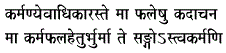
Karmanyevadhikaraste ma phaleshu kadachana;
Ma karmaphalaheturbhur ma te sango'stvakarmani.
— Bhagavad Gita, 2.47
The verse is commonly translated as: “You have a right to action, but not to its fruits.”
Read superficially, the statement seems scientifically untenable. Science rests upon causality. Change the temperature, and the reaction changes. Alter the dosage, and the physiological response changes. Modify the input, and the output is affected. Every experiment, equation and prediction depends upon a demonstrable relationship between cause and consequence.
But Krishna does not deny causality. He challenges something far more psychologically seductive: our assumption that because we contribute to an outcome, we therefore own it completely.
That distinction changes everything.
Cause is Not the Same As Control
An action may be a cause without being the only cause.
A farmer controls the choice of seed, the preparation of soil and the timing of cultivation. He does not control rainfall, pestilence, market prices or an unexpected flood.
A scientist controls the experimental design, instrumentation and method. She cannot control every hidden variable, measurement limitation or unknown property of nature.
A captain controls the vessel, the crew and the navigational decisions. He does not command the ocean.
A civil servant can design a sound policy, allocate resources and build an implementation mechanism. He cannot completely govern political interference, public behaviour, institutional inertia or a sudden crisis.
The Gita is not saying that action has no relationship with outcome. It is saying that the relationship is contributory, not sovereign.
In fact, the Gita itself offers a sophisticated model of causality. In Chapter 18, verses 13–14, Krishna speaks of five factors behind the accomplishment of an action: the field or context in which it occurs, the individual agent, the instruments employed, the various efforts made and daiva, the element beyond the actor’s immediate command.
The individual is one cause among several.
Modern management might describe this as a multivariable system. Behavioural science may call it the correction of the “illusion of control.” Philosophy may frame it as the boundary between agency and contingency. The Gita expresses it more radically: act with total responsibility, but without the delusion of total authorship.
What Does Adhikara Actually Mean?
The Sanskrit word adhikara is often translated as “right.” But it can also mean authority, jurisdiction, eligibility or sphere of responsibility.
Krishna is telling Arjuna: your jurisdiction extends to action. It does not extend to commanding the universe to deliver your preferred consequence.
This does not mean that Arjuna should ignore results. The entire dialogue occurs because the result of war matters enormously. Lives will be lost, dynasties destroyed and a civilization transformed. Krishna does not dismiss these consequences. Nor does he ask Arjuna to enter battle thoughtlessly.
He asks Arjuna to examine the situation, understand his duty, purify his intention and then act without allowing the anticipated result to paralyze his judgment.
The verse contains four distinct instructions:
The fourth instruction is frequently forgotten. Krishna does not permit fatalism. He explicitly warns Arjuna against using uncertainty as an excuse for withdrawal.
The teaching is not “Results do not matter.”
It is: “Results matter, but your psychological survival must not depend entirely upon them.”
The Gita is Not Anti-ambition; It Is Anti-enslavement
There is a crucial difference between having a goal and becoming imprisoned by it.
A goal provides direction. Attachment converts direction into desperation.
A leader guided by a goal asks, “What must be done to improve the probability of success?”
A leader enslaved by the result asks, “What must I manipulate, conceal or sacrifice to ensure that I appear successful?”
This is where outcome attachment becomes ethically dangerous. When the result becomes an obsession, data is distorted, dissent is silenced, shortcuts are rationalized and people become expendable.
Corporations inflate projections because leaders cannot tolerate missing a target. Governments suppress inconvenient evidence because political reputations have become inseparable from policy outcomes. Students cheat because marks have replaced learning. Athletes dope because victory has become more important than worthiness.
Krishna’s counsel is therefore not an argument against performance. It is an ethical safeguard against allowing performance to corrupt purpose.
Non-attachment does not reduce excellence. Properly understood, it protects excellence from anxiety, vanity and fraud.
This is why Krishna later declares, “Yoga is equanimity” (2.48) and “Yoga is skill in action” (2.50). Equanimity and competence are not opposites. A mind less terrified of failure can observe more clearly, decide more rationally and recover more quickly.
Krishna’s Diplomacy: Preparation Without Guaranteed Success
Before the Kurukshetra war, Krishna does not simply tell the Pandavas to accept destiny. He negotiates. He assesses power. He builds alliances. He travels to Hastinapura as a peace emissary and proposes a settlement so modest that the Pandavas would accept merely five villages.
Duryodhana refuses even that.
Was Krishna’s diplomatic mission therefore a failure?
Only if effort is judged solely by its immediate outcome.
The mission established the moral legitimacy of the Pandava position. It demonstrated that war had not been their first preference. It exposed Duryodhana’s intransigence and removed ambiguity from the conflict.
Krishna controlled the integrity and intelligence of the effort. He did not control Duryodhana’s response.
This is strategic non-attachment: exhaust every responsible option, but do not surrender your stability to another person’s decision.
Rama: When the Expected Future Collapses
On the eve of his coronation, Rama’s future appears secure. The arrangements have been made, Ayodhya is celebrating and the throne is within reach. Then, within hours, the promised kingdom becomes fourteen years of exile.
Rama grieves, but he does not disintegrate. He does not confuse the loss of a position with the loss of his identity.
This is not passivity. During the search for Sita, Rama gathers intelligence, forms an alliance with Sugriva, mobilizes the Vanara forces, sends search parties in different directions and eventually builds a bridge to Lanka. He remains profoundly result-oriented.
What he refuses to do is allow an uncontrollable outcome to destroy his capacity for purposeful action.
Rama’s life illustrates the distinction between acceptance and resignation. Resignation says, “Nothing can be done.” Acceptance says, “This has happened. What is the most responsible action available now?”
The former abandons agency. The latter restores it.
Hanuman: Devotion Expressed As Intelligent Improvisation
Hanuman’s journey to Lanka is not a story of effortless success. He faces physical barriers, psychological temptations, hostile forces and incomplete information. Even after entering Lanka, he does not immediately find Sita.
For a moment, he confronts despair. But he does not convert temporary failure into a final conclusion. He changes his search strategy, continues observing and eventually reaches the Ashoka Vatika.
Later, when Lakshmana lies critically wounded and Hanuman cannot identify the precise Sanjivani herb, he does not return empty-handed. He carries the mountain. This is not blind faith. It is adaptive agency.
Hanuman does not control every variable, but he expands the quality, speed and ingenuity of his response. His devotion does not make planning unnecessary; it makes surrender to helplessness unacceptable.
The Gita’s doctrine is visible here in action: when certainty is unavailable, commitment must become more creative.
The Churning of the Ocean: Unintended Consequences of Collective Action
The Samudra Manthana episode offers one of the most powerful civilizational metaphors for uncertainty.
The Devas and Asuras churn the cosmic ocean seeking amrita, the nectar of immortality. Their objective is clear, the effort colossal and the instruments carefully assembled. Yet the first major outcome is not nectar. It is halahala, a poison capable of devastating creation.
The story captures a truth that modern science, technology and public policy repeatedly confront consequential action produces unintended consequences.
Industrialization created prosperity and pollution. Digital connectivity democratized information and industrialized misinformation. Artificial intelligence (AI) expands human capability and creates profound ethical risks. Medicines heal and may cause adverse reactions.
The answer is not to stop churning the ocean. Nor is it to pretend that poison cannot emerge.
Shiva receives the poison and contains it. The myth therefore adds another dimension to responsible action: mature leadership must be prepared not only to pursue desirable outcomes but also to absorb, mitigate and manage unintended ones.
You initiate an action for nectar. Character is revealed by what you do when poison appears first.
Savitri: Accepting Uncertainty Without Surrendering Initiative
Savitri’s encounter with Yama in the Mahabharata dismantles the lazy interpretation that spiritual acceptance means passive submission.
She knows that Satyavan is destined to die. Yet when death arrives, she follows Yama. She neither denies reality nor collapses before it. Through composure, intelligence and carefully structured persuasion, she secures successive boons until Satyavan’s life must logically be restored.
Savitri cannot command fate. But she can determine the quality of her response to it.
Her conduct demonstrates that non-attachment is not the abandonment of desire. It is the refusal to let desire produce panic, incoherence or moral compromise.
She does not know whether she will succeed. She acts because the action is worthy.
Prahlada: When the Result Cannot Purchase Conviction
The Bhagavata Purana presents Prahlada as a child confronted by overwhelming coercive power. Hiranyakashipu controls the palace, commands the instruments of punishment and appears almost invulnerable.
Prahlada cannot guarantee survival. Yet he refuses to allow fear of the outcome to determine the integrity of his action.
His strength lies not in predicting victory but in making his conviction independent of victory.
This is the deeper meaning of freedom in the Gita. A person whose values survive both reward and punishment cannot easily be controlled. One may control his circumstances, but not his conscience.
Effort Does Not Guarantee Success, It Alters Probability
Does effort guarantee success? No.
Does this make effort meaningless? Absolutely not.
Effort changes probability. Better preparation improves the likelihood of a favorable result. Discipline reduces avoidable error. Competence expands available choices. Courage permits action where fear would otherwise produce paralysis.
But probability is not certainty.
An excellent company can fail because a technological disruption changes the market. A conscientious candidate can lose an election. A deserving student can underperform in one examination. A skilled doctor can lose a patient despite making every responsible decision. A well-planned mission can encounter an unforeseeable catastrophe.
The outcome emerges from a conversation between personal effort and a universe containing other people, competing intentions, hidden variables, inherited conditions and chance.
The Gita does not ask us to reduce our effort because success is uncertain. It asks us to intensify effort while loosening the ego’s claim over the final outcome.
We are accountable for the quality of our participation, not omnipotent over the final configuration of events.
The Psychology of Being Destroyed by Results
Why are human beings devastated by failure?
Often, it is because we do not merely seek a result; we convert it into a verdict on ourselves.
- The project failed; therefore, I am a failure.
- The relationship ended; therefore, I am unworthy of love.
- I lost the election; therefore, my public life is meaningless.
- My business collapsed; therefore, my intelligence was an illusion.
This is the psychological bondage Krishna confronts. The event becomes fused with identity.
Outcome attachment also creates anticipatory suffering. Before acting, we rehearse failure. During action, we divide attention between the task and anxiety about the result. After acting, we repeatedly reconstruct what might have happened. The mind is no longer performing the action. It is prosecuting itself.
Nishkama karma breaks this cycle. It allows a person to say: “I will prepare intelligently, act courageously and learn honestly. But I will not permit one result — favorable or unfavorable — to define the totality of who I am.”
This does not make loss painless. The Gita never demands emotional numbness.
Arjuna’s grief is taken seriously; it becomes the starting point of the dialogue.
The teaching is not that pain is optional. Pain is human.
The teaching is that ‘pain need not become psychological annihilation.’
What, Then, Truly Belongs to Us?
The effort belongs to us. The intention belongs to us. The discipline belongs to us. The courage to begin belongs to us. The willingness to adapt belongs to us. The honesty with which we evaluate failure belongs to us.
The outcome does not belong to us in the same exclusive manner because it was never produced by us alone.
This understanding creates neither laziness nor indifference. It creates humility in success and resilience in failure.
When the result is favorable, we do not become intoxicated by the fiction that we alone created it. When the result is unfavourable, we do not assume that our effort was worthless. We examine our mistakes, correct what is correctable and return to action.
Krishna was not merely teaching Arjuna how to win a war. He was teaching him how to act when victory was uncertain, how to remain ethical when the stakes were unbearable and how not to be internally destroyed even after external loss.
Perhaps that is the Gita’s most demanding lesson.
Can we pursue success without worshipping it? Can we plan for results without pretending to own them? Can we remain ambitious without becoming anxious, competitive without becoming corrupt and disappointed without becoming defeated? Can we accept that our effort is powerful but not omnipotent? And when the universe refuses to produce the outcome, we believe we deserve, will we abandon our dharma, or will we possess the courage to act again?
Read Also: Interpreting Influence
01-Aug-2026
More by : P. Mohan Chandran