Oct 20, 2026
Oct 20, 2026
Where Every Pothole Has a Plot Twist
A Humorous Field Report from the Republic of Craters
When exactly does a pothole stop being a pothole and qualify as a waterbody? At what depth should the municipal corporation install a “No Fishing” board? If a road disappears every monsoon and reappears every summer, should it still be called infrastructure—or seasonal entertainment? Why do we spend crores building roads and then wait for the rain to conduct the quality audit? And most importantly, why does Google Maps never warn us: “In 200 meters, turn left into a geological formation”?
The monsoon had arrived. So had the annual transformation of the Indian road. Yesterday, it was a road. Today, it was a wetland.
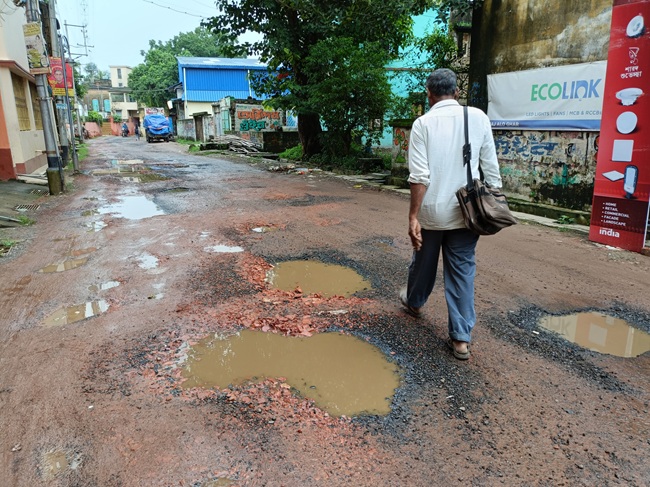
Inspired by the recent public fascination with no-nonsense inspections, I decided to conduct one of my own. Not of the refrigerator this time. I stepped outside to inspect the road in front of my house.
I took a notebook, a pen, an umbrella, and the optimism of a taxpayer.
I returned with wet trousers, muddy shoes, mild spinal realignment, and a completely new understanding of public infrastructure.
The Road That Became a ‘Geography Textbook’
The first irregularity appeared approximately twelve feet from the gate.
Technically, it was a pothole.
But calling it a pothole seemed disrespectful to its ambition.
This thing had depth, circumference, character, and possibly its own microclimate. A family of mosquitoes had already moved in. Two frogs appeared to be discussing property prices. A passing autorickshaw entered it with three passengers and emerged with what looked like four.
I stood at the edge and peered inside.
There are moments in life when a man confronts the abyss.
Nietzsche had one.
I had this pothole.
The road ahead looked less like a carriageway and more like a satellite photograph of the Moon after rainfall. Craters overlapped craters. Asphalt appeared occasionally between them, almost apologetically, like islands in the Pacific.
At one point, I found a perfectly smooth patch measuring roughly two feet by three feet.
I became suspicious.
Clearly, something had gone wrong.
India’s Annual ‘Amphibious Driving Test’
The Indian monsoon does not merely test drainage. It introduces a new category of vehicle: the amphibious hatchback.
Before the rains, your car requires a pollution certificate, insurance, registration, and fuel.
After the rains, it requires sonar.
Drivers no longer ask, “How deep is that pothole?”
They ask, “Has anyone returned from it?”
The most dangerous potholes are not the visible ones. Those at least possess the courtesy of declaring themselves. The real villains are the water-filled ones—brown, calm, reflective pools that look two inches deep and turn out to have strategic depth.
Approaching one is an act of faith.
You slow down.
The motorcyclist behind you honks.
The SUV beside you accelerates.
A pedestrian watches with the detached expression of a man who has seen civilizations rise and fall.
You enter.
THUD.
For half a second, every component of the vehicle renegotiates its relationship with every other component.
The suspension files for divorce.
The wheel alignment resigns.
The dashboard develops a new sound.
And somewhere, a mechanic smiles without knowing why.
Potholes: India’s ‘Unofficial Speed Breakers’
We complain that people drive too fast in India. Perhaps we have misunderstood the road-safety strategy.
Why install speed breakers when the road itself can become one continuous speed breaker?
A strategically distributed pothole can reduce a motorist from 60 km/h to 6 km/h faster than any traffic policeman.
It is behavioral economics through bitumen failure.
There is even a democratic elegance to it. A pothole does not discriminate between a Mercedes and a Maruti. It respects neither horsepower nor social status. The luxury SUV may have twelve airbags, adaptive suspension, lane assistance, and a panoramic sunroof, but when it encounters a crater concealed under monsoon water, it becomes equal before the Constitution.
For one glorious second, socialism is achieved.
The Municipal Theory of ‘Temporary Repair’
Then came the repair crew.
This is one of the great rituals of Indian civic life.
A truck arrives.
Three men inspect the crater.
Five men inspect the three men inspecting the crater.
Someone makes a phone call.
Someone drinks tea.
A small quantity of material is deposited into the hole.
It is pressed down with the confidence of a man tucking a bedsheet into a mattress.
Traffic is immediately released over it.
The repair survives long enough to develop emotional attachment to the road.
Then it rains.
By the next morning, the pothole is back — larger, wiser, and apparently strengthened by adversity.
Some potholes have more successful comeback careers than film stars.
You begin to suspect that the contractor and the pothole are in a long-term relationship. One creates employment for the other.
When the Joke ‘Stops Being Funny’
The humor, however, has a hard boundary. Bad roads are not merely inconvenient. They can be lethal.
The Ministry of Road Transport and Highways’ Road Accidents in India 2023 report records that, in India’s million-plus cities, potholes were associated with 1,318 reported accidents, 311 deaths, and 1,221 injuries in 2023. The same official dataset says potholes accounted for about 1.6% of road accidents and 1.8% of road-accident deaths in those cities. These figures cover reported accidents classified by road feature; they do not capture every fall, vehicle-damage incident, near miss, or unreported injury caused by deteriorated roads.
The broader road-safety picture is even more sobering. Government data for 2022 recorded 461,312 road accidents, 168,491 fatalities, and 443,366 injuries across India. The government has also cited a World Bank finding that India accounts for roughly 11% of global crash-related deaths despite having about 1% of the world’s vehicles.
So behind every joke about a crater is a serious governance question: why should rainfall—an entirely predictable annual event—be allowed to convert ordinary roads into preventable hazards?
The Great Monsoon ‘Quality-Control Laboratory’
In fairness, the monsoon is an excellent auditor. It accepts no PowerPoint presentation. It attends no review meeting. It is unimpressed by inauguration plaques. It does not care who cut the ribbon.
Rain simply arrives and asks one question: “Was this road actually built properly?” Within days, the answer becomes visible.
Weak drainage? Exposed.
Poor compaction? Exposed.
Bad patchwork? Exposed.
Blocked storm-water outlets? Exposed.
A road inaugurated with flowers, banners, speeches, coconut-breaking, drone photography, and twelve smiling dignitaries may survive all of that ceremony.
Then 90 millimeters of rain arrives without protocol. The road confesses everything.
The monsoon is, therefore, India’s most incorruptible infrastructure inspector. Unfortunately, it submits its report in the form of potholes.
Every Pothole Has an ‘Ecosystem’
After several days of rain, a mature pothole develops an ecosystem.
First comes water. Then mosquitoes. Then mud. Then plastic wrappers. Then an enterprising street dog uses it as a drinking bowl.
Soon someone places a brick inside it to warn motorists. The brick disappears underwater. A second brick is added. Then a stick. Then a plastic bag is tied to the stick.
Congratulations: India has invented a low-cost Internet of Things road-warning system without the Internet and without the Things.
Occasionally, residents become more creative. They plant saplings in potholes, put up sarcastic signs, stage photo opportunities, or upload videos to social media.
This is citizen participation in urban governance, although perhaps not the version envisioned in policy documents.
Google Maps Needs a ‘Monsoon Upgrade’
Navigation applications are also inadequately prepared for Indian monsoon reality.
“Take the fastest route,” Google Maps says. Fastest according to whom? A helicopter?
The app calculates distance, traffic, road closures, and estimated arrival time. What it does not calculate is Pothole Density Per Kilometer, Probability of Axle Survival, or Number of Uncharted Inland Seas.
We need a proper Indian monsoon mode.
“Continue straight for 500 meters. Then choose between the crater on the left and the trench on the right.”
“Recalculating route. Your vehicle has lost a wheel.”
“Flooded underpass ahead. Consider purchasing a boat.”
“Road unavailable. Democracy continues.”
The Indian Motorcyclist: A Master of ‘Applied Geometry’
No discussion of monsoon roads is complete without honoring the Indian motorcyclist.
Watch one navigate a badly damaged road and you are witnessing applied mathematics.
He calculates angles, depth, velocity, approaching buses, pedestrians, stray cattle, autos, puddles, loose gravel, and the probability that the apparently dry patch ahead is actually wet cement.
He zigzags with the precision of a fighter pilot.
Left.
Right.
Left again.
Sudden brake.
Accelerate.
Avoid crater.
Avoid cow.
Avoid man avoiding crater.
Avoid car avoiding man avoiding crater.
This is not commuting. This is a live-action entrance examination. Anyone who successfully rides through an Indian city during peak monsoon deserves honorary credits in fluid mechanics, risk management, and crisis leadership.
A Pothole Is Also a ‘Governance Metaphor’
There is a reason potholes irritate citizens disproportionately. They are visible.
A failed policy can hide inside a 300-page report. A delayed project can disappear inside bureaucratic correspondence. A procurement defect may require an audit to discover.
A pothole requires no RTI application. It sits in the middle of the road and introduces itself to your spine. That makes the pothole a wonderfully brutal metaphor for governance. It begins as a small crack that nobody fixes. Water enters. Traffic enlarges it. Everyone adjusts around it. Responsibility becomes unclear. Temporary repairs are made.
The underlying defect remains. Eventually, the abnormal becomes normal. This is how institutions deteriorate too.
The most dangerous stage is not when citizens complain about potholes. It is when they stop complaining and simply memorize them.
“Careful near Sharma Medical Store.”
“Keep right after the temple.”
“Slow down before the tea shop.”
“Don’t take the left lane after rain.”
At that point, citizens have become the road-maintenance database.
The ‘Inspection Report’
After forty-five minutes, I completed my inspection.
Findings:
I was ready to issue notices. I wanted to summon the contractor. I wanted to question the engineer. I wanted to seal the road.
Then a bus drove through the largest puddle. A wave of muddy water hit me from ankle to shoulder. The inspection was officially concluded.
Final Thoughts: The ‘Road to Accountability’ Should Not Have Potholes
Can a country aspiring to become a major economic power continue treating monsoon road failure as an annual surprise?
Why should taxpayers pay first to build a road, again to repair it, and then privately to repair the tires, rims, suspensions, and backs damaged by it?
Why are road contracts not judged more rigorously by how the asset performs after multiple monsoons rather than by how beautiful it looks on inauguration day?
Why should citizens have to become cartographers of craters?
And if the monsoon can expose poor workmanship every year with such ruthless efficiency, why can our accountability systems not do the same?
India does not need roads that look good when the ribbon is cut. It needs roads that remain roads when the clouds open. Because a pothole is funny only when it is a metaphor.
When it overturns a two-wheeler, injures a commuter, damages an ambulance, slows a fire engine, or takes a life, the joke is over.
Until then, the Indian monsoon commute continues.
Helmet on. Seat belt fastened. Google Maps open. Insurance valid. Prayers offered.
And if the road ahead suddenly resembles the Bay of Bengal — do not panic.
It may still be the road.
Image (c) istock.com
05-Sep-2026
More by : P. Mohan Chandran
