Sep 26, 2026
Sep 26, 2026
- Recipient of the Prestigious Dr Gadiyaram Venkata Sesha Sastry Award
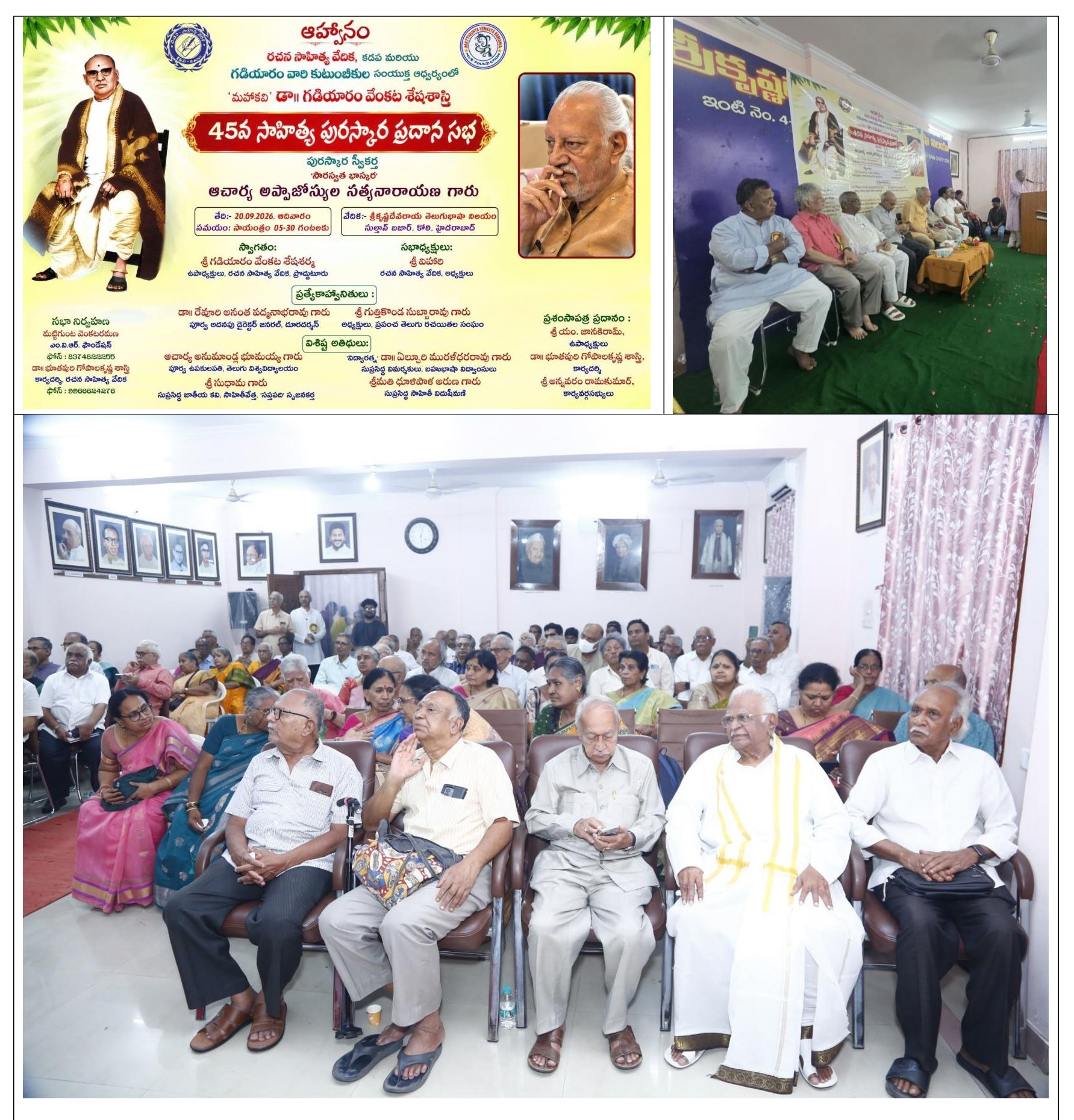
A memorable meeting it was wherein Dr Prof Appajosyula Satyanarayana was feted with the prestigious 45th literary award in memory of the celebrated poet Dr Gadiyaram Venkata Sesha Sastry, jointly organised by Rachana Sahitya Vedika & the Gadiyaram family. The name Dr Gadiyaram Venkata Sesha Sastry (1894 – 1980) is inseparably intertwined with his — “Sri Siva Bharatamu” — a Telugu patriotic poetic tome on the life of Chatrapati Shivaji which he penned in 1943 as a means to spread the fervour of Independence.
A PhD, Appajosyula Satyanarayana, served at many prestigious institutions in both India and the USA, and finally as Professor of Electrical Engineering & Computer Science at Stevens Institute of technology, New Jersey. Alongside, he is deeply soaked in the reading & writing of Telugu literature, and also promoting it through the AVK Foundation — “dedicated to the cause of Telugu language, literature, tradition and theatre” — by annually awarding the literary & artistic stalwarts, publishing valuable literature, and supporting the writers. AVK stands for Ajo-Vibho-Kandalam set up jointly by the Appajosyula, Vishnubhotla and Kandalam families in 1993.
A symbol of a rightful blend of the continuous flow of tradition & modernity, materialism & spiritualism, Dr Appajosyula Satyanarayana has mastered the art of the Telugu prosodic poetry, and come out with distinct poetic works, especially on the five fundamental elements—earth, water, fire, wind, and space—under the titles Vasundhara Vritta Taravali, Sujala Vritta Taravali, Sagara Vritta Taravali, Soura Vritta Taravali, Pavaka Vritta Taravali, Sameera Vritta Taravali, and Antariksha Vritta Taravali. Each of them consists of 28 (27+1) quatrains representing the 28 (27+1) constellations astronomically/astrologically associated with our lives. His other works are —Maha Devi Mattebha Taravali (on the Prime Goddess), Sugunadhya Satakam (on the imperative of human virtues), Aparoksha Anubhuti (Translation of Adi Sankara’s Sanskrit work of 140 shlokas on spiritual quest & enlightenment), and Mana Chatu Padya Sampada (The wealth of our anonymous poetry).
He is so intensely passionate about Telugu poetry that he can reel out hundreds of poems of legendary writers like ‘Jnan Pith’ recipient Viswanatha Satyanarayana without looking into their script either physical or virtual.
The uniqueness of the poetic creations of Dr Appajosyula Satyanarayana, a solar-sharp personage, with grateful reverence for Mother Nature, is—it not only provides a harmonious perspective of things but also stimulates us to learn the things of a higher level and broaden and deepen our cognizant levels. His poetry is hailed for its rich diction and germane collocation of words. The variety & richness of thoughts leads to a proportionate richness of expression by duly tapping on the ocean of words from the lexicons.
It is apt in this context to quote the observation of John Henry Newman:
“While the many use language as they find it, the man of genius uses it indeed, but subjects it withal to his own purposes, and moulds it according to his own peculiarities. The throng and succession of ideas, thoughts, feelings, imaginations, aspirations, which pass within him, the abstractions, the juxtapositions, the comparisons, the discriminations, the conceptions, which are so original in him, his views of external things, his judgments upon life, manners, and history, the exercises of his wit, of his humour, of his depth, of his sagacity, all these innumerable and incessant creations, the very pulsation and throbbing of his intellect, does he image forth, to all does he give utterance, in a corresponding language, which is as multiform as this inward mental action itself and analogous to it, the faithful expression of his intense personality, attending on his own inward world of thought as its very shadow… the style of a really gifted mind can belong to any but himself. It follows him about as a shadow. His thought and feeling are personal, and so his language is personal.”
As Chief Editor (and Contributing Editor, Telugu Literature) of the Muse Inda literary ezine, I am happy to recall that Appajosyula Satyanarayana was featured in the special feature ‘Bhakti Literature’ of Muse India (Issue 101: Jan-Feb 2022) by way of a review of his “Divakara Vritta Taravali” by Prof Veluvolu Naga Rajya Lakshmi whose Telugu original was translated by me (Atreya Sarma Uppaluri). Click Here
The event took place at Sri Krishna Devaraya Telugu Bhasha Nilayam, Hyderabad, on 20 September 2026, with a constellation of speakers and erudite audience making the venue a full house. Vihari garu, the evergreen mid-octogenarian with 75 books to his credit, presided and conducted the proceedings in a highly professional way, and with his photographic memory of persons and things. While the citation was resonantly read out by renowned Sudhama—an innovative writer; the speakers who analysed the poetic profundity of Dr Appajosyula Satyanarayana were Dr Revuri Ananta Padmanabha Rao, former Additional Director General of Doordarshan; Guttikonda Subba Rao, President, World Telugu Writers Association; Prof Anumandla Bhoomaiah, former Vice Chancellor, Telugu University; Dr Elchuri Muralidhara Rao, well-known literary critic & polyglot; and Smt. Dhulipala Aruna, renowned savant.
While Mattitgunta Venkata Ramana (MVR Foundation) was the man behind the logistics of the meeting, the others behind the success were the functionaries of Rachana Sahitya Vedika—M Janakiram (Vice President), Dr Bhutapuri Gopalakrishna Sastry (Secretary), and Annavaram Rama Kumar (Member, Executive Committee).
Despite my other activities—including that day’s Ganesh immersion ceremony within our gated community when I normally would do a dance in my sarvanga-asana (head-down, legs-up posture), I chose to attend this, thanks to the undeniable call from Vihari garu. Had I not been able to attend it, I would have missed an illumining milestone meeting.
The venue brough back to my mind the memories of a meeting that took place in 1965 (?) in the Sri Krishna Devaraya Andhra Bhasha Nilayam, as called during those days, on the ground floor of those times. The chief guest was Tenneti Viswanatham, a leading politician of human & cultural values. The speakers included Kasi Krishnacharya and “Chittiguduru” STG Varadacharyulu, and the topic was Sanskrit as a choice to be the official language of our country.
Going back to the current meeting, I was fortunate to be seated beside ‘Padma Shri’ Dr Prof Kolakaluri Enoch, former Vice Chancellor, Sri Venkateswara University, the 87-year-old versatile legend glowing with modesty & amiability. His presence geed me up to pen extempore a few poetic lines on him in Telugu, and I read them out to him on the sidelines. He exuded with affectionate happiness & asked me to share them with him. The next day, I honed it a little more and sent it to him along with an English acrostic as well. And he duly acknowledged them with his appreciation. Appended is my English Poem.
May the mission & vision — of Rachana Sahitya Vedika, Ajo-Vibho-Kandalam (AVK) Foundation, and MVR Foundation—as also the literary ardour of Dr Appajosyula Satyanarayana, Vihari garu, Sudhama, and the likes — go on and on, regenerating our Telugu & Bharatiya languages & culture with a view to realising universal fraternity & harmony!
***
An Ode to 'Padma Shri' Dr. Prof Kolakaluri Enoch
(In Acrostic Style)
(By: Atreya Sarma Uppaluri)
Knocked my socks off—the serendipitous meeting with
Obeisances mine to ‘Padma Shri’ Dr Prof Kolakaluri Enoch!
Laying by him, ex-Vice Chancellor of Sri Venkateswara University
As also a prolific and multi-talented literary personality with apt knack
Kept up my respectful thoughts about him, who empathically
Appreciated my physical fitness referring to my latest Half Marathon!
Language Telugu of Bangalore University came pronto to my mind
Ushering me to mention Dr Asha Jyothi, Professor at Jnana Bharathi.
Reared and nurtured she was by Kolakaluri Enoch, none but her father!
Immersed in the springs of Telugu literature across every genre,
Enoch the endearing and amiable soul clad in the traditional white attire
Narrated to me about his children foursome—all well-placed, and motivating!
On his literary and humanitarian trajectory, may the Kolakaluri savant
Carry forward the glory of our Telugu language, literature and culture to
Heights greater as also the uniqueness and universal ethos of our Bharat!
[The above lines are a product of the serendipitous sitting beside Dr Prof Kolakaluri Enoch (b. 01 July 1939), a prolific & versatile litterateur, and former Vice Chancellor, Sri Venkateswara University, and interacting with him on the sidelines of a meeting at Sri Krishna Devaraya Telugu Bhasha Nilayam, Sunday, 20 September 2026. He was very amiable & modest.
Also, I was fortunate enough to attend a meeting on 19 December 2018 on the Life & Work of Gurajada Apparao, jointly organised by the Gurajada Foundation (USA) and the Department of Telugu, Bangalore University, the Chairperson being Prof K Asha Jyothi — daughter of Dr. Prof Kolakaluri Enoch, as mentioned in the poem.
26-Sep-2026
More by : U Atreya Sarma
Top | Literary Shelf | Home
