Oct 24, 2026
Oct 24, 2026
Cultural and Literary Parallels between Kashmir and Turkiye
Kashmir and Turkey both are beautiful lands belonging to two different geographical regions of the world having a long distance yet they have several noticeable similarities. They have distinctive similarities in terms of landscape, cuisine, handicraft, art & architecture, historical influences and most importantly culture. Both Kashmir and Turkiye have visual resemblance, the similarities become especially noticeable when looking at mountain villages, lakes, snow-covered landscapes, wooden architecture and traditional clothing. There are some major similarities existing between these two lands which are listed below.
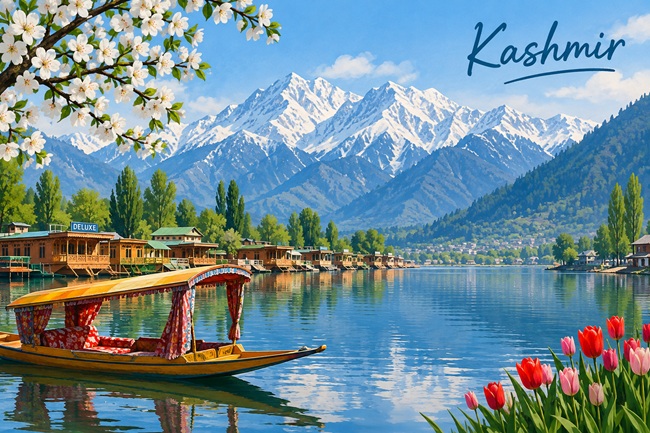
If we see the mountain landscape then we find that both Kashmir and Turkiye are covered with mountains. In Kashmir, there are many mountain ranges like Himalayas, Pir Panjal, Karakoram and Zanskar adding beauty to the beautiful land. Infact, Kashmir is being recognized by the mighty Himalayas. Some prominent mountain peaks in Kashmir are Mount Kolahoi, Harmukh Mountain, Apharwat Peak and Mount Amarnath. Turkiye has several mountain ranges but the two prominent mountain ranges are Taurus Mountains and Pontic Alps. The Taurus Mountains is situated parallel to the Mediterranean coast, it separates the sea from the central plateau. The Pontic Mountains lie in the northern Black Sea region known as Kara Deniz in Turkish language. It features wet alpine zones and the high Kaçkar subrange. Then there are Armenian Highlands or Eastern Peaks lying near the borders of Iran and Armenia. They contain high volcano elevations and dramatic tectonic highlands. There are some
When it comes to Climate then we find a major similarity and that is Snowy winters in both Kashmir and many regions of Turkiye. The Kashmir valley has cold snowy winters mainly in the higher regions and Turkiye has snowfall in winters in the eastern and northern parts. There are some famous lakes in Kashmir like the iconic Dal lake which is a tourist attraction and a subject of many movies and documentaries. It is famous for beautiful houseboats, shikaras with vibrant floating markets. Then there is another famous lake, Wular lake, which is Asia’s largest fresh water lake. Besides there are other water bodies; Vishansar, Krishansar, Gadsar, Satsar, Gangabal, Nundkol and Tarsar.
Lake Van is the largest Lake situated in the far Eastern Anatolian region in the province of Van and Bitlis, in the Armenian highlands. It is the world's largest soda lake with high alkalinity and deep blue waters. It is situated at an altitude of 1640 meters (5380 feet), with a surface area of 3713 square kilometers and a maximum depth of 451 meters, receiving water from many small streams that descend from the surrounding Mountains. The unique quality it has is that it does not freeze in winter. About its formation people believed that the nearby Mount Nemrut and Suphan (Süphan) blocked its natural outlet during prehistoric volcanic eruptions making it an endorheic basin. There are rumours among locals of the presence of mythical “Lake Van Monster” swimming in the deep waters of Van lake. There is a scenic island, Akdamar which has the historic 10th-century Armenian Church of the Holy Cross. On the Eastern shore, there is Van Castle which is an ancient fortification constructed by the Urartu kingdom.
Both Kashmir and Turkiye are rich in traditional architecture, both the places have an exquisite blend of Islamic and local architectural styles, especially Persian influence. There are some structures in Kashmir which reflect the fusion of Persian architectural styles with Kashmiri craftsmanship like Shahi Hamdan Mosque and Jamia Masjid. Traditional Kashmiri architecture blends climate-smart engineering, seismic resilience, and exquisite wooden craftsmanship shaped by the valley's geography and history. Kashmir is famous for wooden architecture like Shahi Hamdan Masjid, Jamia Masjid, Pattar Masjid, Akhun Mulla Shah
Masjid and Hari Parbat Qila. Then there are some ancient Hindu & Buddhist structures belonging to the 7th to 14th centuries like Sun Temple at Martand which is a monumental stone structure. Kashmir is also famous for Mughal Gardens built in the 16th -17th century by Mughal rulers. These are formal terraced gardens featuring symmetrical water channels, fountains, and pavilions that merge Persian design with the natural Kashmiri landscape. Some famous gardens are Shalimar garden and Nishat garden.
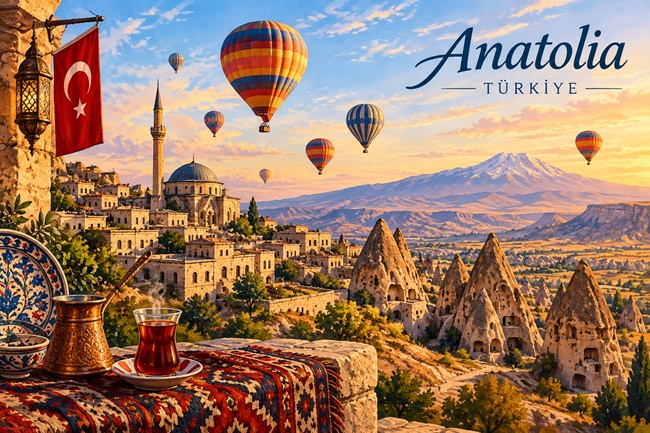
Turkiye has witnessed many empires which have a great impact on Turkish architecture, spanning Ancient Anatolian heritage, Byzantine masterpieces, and iconic Islamic designs developed during the Seljuk and Ottoman empires. The Ancient era of Anatolia has significant remains from the Greco-Roman period which are located throughout the country. The Byzantine Era has given the world-famous Hagia Sophia in Istanbul. The Seljuk Architecture emerged in Turkiye in the 11th century, which synthesizes Islamic styles with local Turkish stonework, and has intricate relief patterns and monumental portals. The rulers of the Ottoman Empire have built grand imperial mosques, public complexes (külliyes), elegant domes, slender minarets, and Iznik tilework. The Master architect Mimar Sinan designed some masterpiece structures like the famous Süleymaniye Mosque. In the Modern and Republican Era, the architecture of Turkiye shifted towards Western influences, Art Deco and Bauhaus style.
Both regions have highly regarded textile traditions, with Kashmir famous for its Pashmina wool, Kashmiri shawls, intricate Kani shawls, Sozni (needle embroidery), Kasida embroidery and traditional outfits like Pheran worn by men and women. Pashmina is extremely soft and fine fabric reared from a special kind of cashmere sheep. Sozni is the delicate needle-work using fine stitchery to make designs applied mainly on shawls. Kasida embroidery is the unique embroidery design using chain stitch to depict landscape and culture of Kashmir. Traditional Turkish handicrafts are a rich collection of woven carpets, hand-painted ceramics, and detailed metalworks passed down through centuries. Turkish hand-knotted rugs and carpets using natural wool, cotton and silk fibres are famous worldwide. Anatolian rug has unique geometric patterns and symbolic local meanings. The two most valued regional varieties of rugs are Hereke and U?ak. There is also a fascinating comparison between Turkish carpet traditions and Kashmiri carpet traditions. Both regions developed sophisticated traditions of weaving and decorative arts, although their designs, techniques and historical development are distinct.
While distant, both the places have tea as a part of culture in terms of greeting guests but both have their own variety of teas which are mostly used in their part of the world. In Kashmir, it is traditional ‘Kahva’ which has a social and cultural role while Turkish çay is an important part of social life. Kashmiri cuisine is famous for dishes like Wazvan, Rogan Josh, Gushtaba, and Yakhni, and the use of dried fruits and spices like saffron. Turkish cuisine is a synthesis of Central Asian, Mediterranean, and Middle Eastern flavors that grew out of the Ottoman Empire's royal kitchens. Some most famous Turkish cuisine include; Kebabs, Meze, Pide, Lahmacun, Manti, Baklava and Dolma. Turkish people use staples in their food like; Olive oil, fresh herbs (mint, dill, parsley), and warm spices (sumac, cumin, red pepper flakes). Tangy yogurt and local cheeses are used in many dishes especially in breakfast. Freshly brewed black tea (çay) and rich Turkish coffee are staples of daily life for Turkish people.
Kashmiri music and poetry blend Persian, Central Asian, and Indian traditions into a rich spiritual and folk heritage and Turkish music and poetry are also deeply intertwined, blending Central Asian roots, Byzantine influences, Islamic mysticism, and Western modernism. They have shared a deep, historical bond for over a thousand years, blending lyrical verse with traditional instruments like the saz and ney. Both the regions have been greatly influenced by the Persian language and Sufi mysticism. The classical music tradition of Kashmir is called Sufiana Kalam or Mausiqi. It is a synthesis of mystic poetry with structured choral melodies. Kashmiri instruments include; santoor, sehtar, saaz-i-kashmir and tabla or dukra. Kashmiri artists use Persian maqams related to specific times of day and seasons. Some famous folk music and dances of Kashmir are Chakri, Rouf, Wanvun and Ladishah.
In terms of Turkiye, there are some key traditions which connect Turkish music and poetry like Ashik tradition, Sufi and Mevlevi music, Divan literature and Classical Art and Anatolian Rock. Similar to Kashmir, Classical Turkish music also relies on maqam. Turkiye has a tradition of Divan Poetry is basically Ottoman court poetry which is a synthesis of Persian meters and Arabic poetry. Some key classical Turkish musical instruments include; ney, oud kemence and kanun. The Whirling Dervishes which is the Mevlevi Order uses hypnotic, ney melody and vocals to induce spiritual ecstasy.
The mystic poets of Kashmir are Lal Ded (14th century), Habba Khatoon (16th century). Some other poets like Mahmud Gami, Shams Faqir Wahab Khar and Nur Shah Wali reflect the fusion of Islamic and Kashmiri cultural elements. The most famous spiritual poet, who is currently the most widely read, Mevlana Rumi (13th Century) is the basis of Turkish spiritual thought and musical tradition. The other famous poets of Turkiye are Yunus Emre (13th century) and Nâz?m Hikmet (20th century). Emre's hymns known as ilahi are still sung in Turkiye and Hikmet is considered the father of modern Turkish poetry.
In terms of tourism, both Kashmir and Turkiye have mountains, lakes and cultural tourism while Kashmir has beautiful gardens, Turkiye has historical cities.
Persianate culture influenced the Ottoman world and, even more strongly, the cultural development of Kashmir under successive Muslim rulers. This influence can be seen in literature, court culture, architecture, gardens, calligraphy, clothing and cuisine.
Images created using ChatGPT
24-Oct-2026
More by : Dr. Shamenaz Sheikh
