Oct 18, 2026
Oct 18, 2026
How India is Hedging Against Trump without Confronting America
When Washington turns tariffs into instruments of geopolitical pressure, New Delhi is responding with trade agreements, strategic partnerships, and economic diversification.
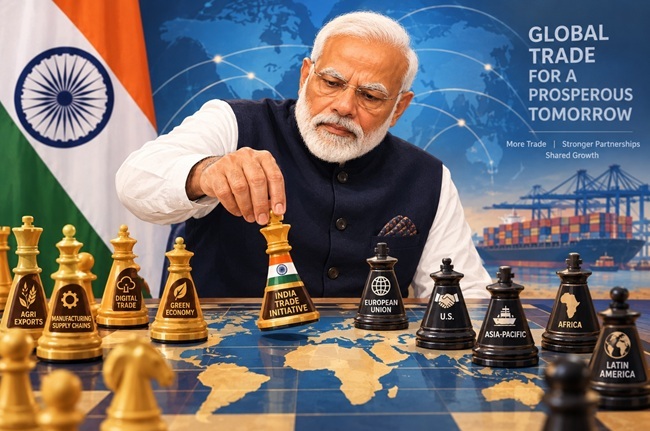
Image created with ChatGPT
Is Narendra Modi quietly rewriting the rules of India's foreign policy?
The August 30, 2026, edition of The New York Times carried a striking headline: “Striking Deals Around World, Modi Is Hedging Against Trump.”
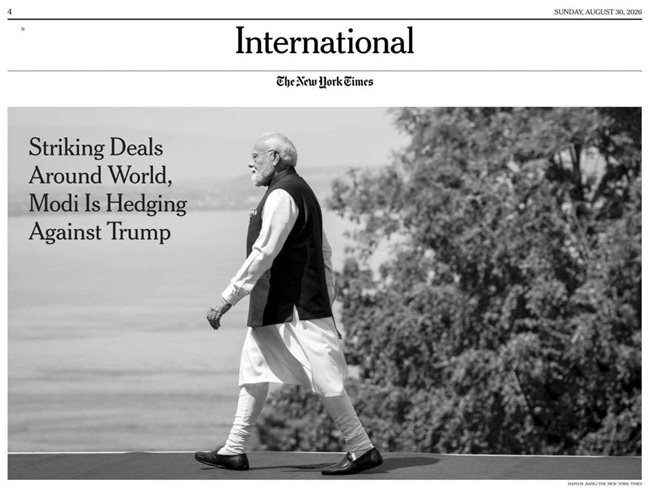
Image (c) New York Times, August 30, 2026
|
The New York Times headline captures an important transformation in India's international economic policy. Modi is not simply negotiating trade agreements. He is attempting to expand India's room for independent decision-making in a world where economic interdependence is increasingly being weaponized. |
The photograph of Prime Minister Narendra Modi walking alone offered an interesting visual metaphor. India, too, appears to be charting its own course through an increasingly uncertain international economic order. But the real story is not about Modi walking away from Donald Trump. It is about India learning an important lesson in international relations: A nation that depends excessively on another nation's goodwill eventually compromises its own freedom of choice.
For decades, India pursued strategic autonomy primarily through diplomatic and defense relationships. Today, Modi is extending that principle into international trade, technology, investment, energy security, and global supply chains.
The question is no longer whether India should align with America, Europe, Russia, or emerging economic powers. The more consequential question is whether India can develop sufficient relationships with all of them to avoid becoming excessively dependent on any one. That is precisely where Modi's emerging strategy becomes interesting.
When America's Friendship Comes With a ‘Price Tag’
India and the United States have spent more than two decades strengthening their strategic relationship. Defense cooperation, technology partnerships, investment flows, and the Indian diaspora have brought the two democracies closer. Yet Trump's return to the White House exposed an uncomfortable reality. Strategic friendship does not necessarily guarantee favorable economic treatment.
In 2025, the Trump administration imposed additional tariffs on Indian products, including punitive measures linked to India's purchases of Russian oil. Tariff rates on several Indian goods reached 50%. For Indian exporters of textiles, garments, leather products, and other labor-intensive goods, the implications were serious. The episode demonstrated how quickly access to an important export market could become vulnerable to political decisions taken thousands of miles away.
The situation subsequently improved. In February 2026, Washington and New Delhi announced a framework for an interim trade agreement that provided for an 18% reciprocal tariff on specified Indian goods, subject to the framework's conditions. The White House also outlined further negotiations toward a broader bilateral trade agreement. But the episode revealed a structural vulnerability that no temporary tariff concession could entirely eliminate.
If one country can significantly alter another country's export competitiveness through a presidential decision, is that relationship economically secure, however strategically important it may be? Modi's response has been to pursue two objectives simultaneously: negotiate with Washington while expanding India's commercial options elsewhere. This is not economic confrontation. It is economic risk management.
The European Union: India's ‘Biggest Strategic Trade Breakthrough’
Perhaps the most significant development in Modi's economic diplomacy has been the conclusion of the India–European Union Free Trade Agreement negotiations in January 2026.
After years of difficult negotiations, India and the 27-member European bloc reached an agreement covering economies representing approximately one-quarter of global GDP.
According to India's Ministry of Commerce and Industry, the agreement provides preferential market access for more than 99% of Indian exports by value. The European Union was already a major commercial partner, with bilateral merchandise trade reaching approximately $136.5 billion in FY2024–25.
Consider the strategic implications. When Washington raises barriers against Indian textiles, engineering products, or leather goods, improved access to European markets creates alternative commercial opportunities.
However, the EU agreement is not an immediate substitute for American demand. Its benefits depend on ratification, implementation, compliance with European standards, and the competitiveness of Indian manufacturers. Nevertheless, the agreement changes India's negotiating position. A country with several substantial export markets has greater bargaining power than one overwhelmingly dependent on a single destination.
Interestingly, Europe is also attempting to reduce its own excessive dependence on America and China. India and Europe are pursuing complementary objectives: greater economic resilience, diversified supply chains, and reduced exposure to geopolitical uncertainty. What appears to be a trade agreement is also an exercise in geopolitical insurance.
Britain, Switzerland & the ‘Economics of Diversification’
India's European strategy extends beyond the EU. The India–United Kingdom Comprehensive Economic and Trade Agreement entered into force on July 15, 2026. According to the Indian government, the agreement provides zero-duty access for nearly 99% of India's exports to Britain.
This is particularly important for labor-intensive sectors such as textiles, footwear, jewelry, and processed agricultural products. But an even more interesting agreement involves the European Free Trade Association, comprising Switzerland, Norway, Iceland, and Liechtenstein.
The India–EFTA Trade and Economic Partnership Agreement, effective October 1, 2025, includes an objective of mobilizing $100 billion in investment over 15 years and facilitating the creation of one million direct jobs in India. These are forward-looking objectives, not investments or employment already realized.
The significance extends beyond the numbers. Switzerland offers strengths in precision engineering, pharmaceuticals, and advanced manufacturing. Norway brings expertise in maritime industries and clean energy. Other EFTA partners offer specialized technologies and high-income markets.
For India, the objective is not merely to export more products. It is to attract capital, acquire technological capabilities, and strengthen domestic manufacturing. Trade diversification reduces dependence on foreign markets. Investment diversification reduces dependence on foreign capital sources. Technology diversification reduces dependence on foreign intellectual property. Together, these three dimensions provide a stronger foundation for strategic autonomy.
From the Middle East to Australia: Building ‘Multiple Economic Corridors’
Modi's trade diplomacy is not confined to Europe. The India–United Arab Emirates Comprehensive Economic Partnership Agreement, implemented in May 2022, has become an important example of India's expanding commercial relationships. Bilateral trade reached approximately $100 billion in FY2024–25, compared with $72.87 billion in FY2021–22. The UAE also provides India with access to investment capital, logistics infrastructure, and commercial networks connecting Asia, Africa, and the Middle East.
Australia represents another important partnership. Under the India–Australia Economic Cooperation and Trade Agreement, Indian exports gained preferential market access across Australia's tariff lines. India's merchandise exports to Australia increased from approximately $4 billion in FY2020–21 to $8.5 billion in FY2024–25, although this comparison includes years preceding the agreement's implementation.
Meanwhile, India concluded trade negotiations with New Zealand in December 2025 and signed an economic partnership agreement with Oman that same month. These agreements did not all originate as responses to Trump. Several preceded his second presidency.
Modi's strategy is better understood as an acceleration of India's existing economic diversification agenda in response to an increasingly unpredictable international environment.
Russia, America & the Art of ‘Strategic Hedging’
Trade agreements are only one component of India's strategy. Energy security provides an equally revealing example. India's purchases of discounted Russian crude oil after the invasion of Ukraine generated significant economic benefits but also created diplomatic friction with Washington. Trump's punitive tariffs demonstrated how energy procurement decisions could produce consequences for unrelated export industries.
India faced a difficult choice. Should it sacrifice access to competitively priced energy to satisfy American geopolitical preferences? Or should it preserve its procurement autonomy despite potential trade retaliation?
The February 2026 India–US trade framework offered a partial resolution. It included an American commitment to apply an 18% reciprocal tariff to specified Indian goods and recorded India's intention to purchase $500 billion worth of American energy, aircraft, technology products, and other goods over five years. The latter figure was a stated purchasing intention, not completed expenditure. This illustrates the difference between confrontation and hedging.
India can expand energy purchases from America while maintaining relationships with other suppliers. It can strengthen defense cooperation with Washington without automatically accepting every American position on Russia. Such flexibility is not evidence of diplomatic inconsistency. It is the essence of strategic autonomy.
However, autonomy does not mean immunity from consequences. India must continuously assess whether the economic benefits of a particular relationship outweigh the diplomatic and commercial risks it creates.
The ‘Economics of Hedging’: What Modi Is Actually Doing
In financial markets, hedging involves reducing exposure to adverse outcomes without necessarily abandoning the underlying investment. A company exposed to fluctuations in oil prices may purchase financial instruments to protect itself against unexpected increases.
India's international economic strategy follows a comparable principle. Its primary economic relationship with America remains valuable. Rather than abandoning that relationship, India is expanding alternative partnerships to reduce the consequences of unfavorable American decisions.
The strategy operates through four interconnected mechanisms.
The underlying logic is straightforward. The greater the number of credible economic alternatives available to India, the lower the potential cost of resisting pressure from any individual partner.
However, diversification is not free. Negotiating trade agreements requires concessions. Lower import tariffs can expose domestic producers to stronger competition. Regulatory harmonization can impose compliance costs. Greater openness can challenge industries accustomed to protection. Consequently, the quality of trade agreements matters more than their quantity.
Can Trade Agreements Really Protect India Against Trump?
Here lies the most important question. Signing multiple agreements does not automatically make an economy resilient. An Indian garment manufacturer facing American tariffs cannot necessarily redirect its products to Europe overnight. European buyers may demand different product specifications, environmental certifications, labor standards, and delivery schedules.
Similarly, Indian manufacturers cannot fully exploit preferential market access if electricity costs, logistics expenses, financing constraints, and regulatory inefficiencies undermine their competitiveness.
Trade agreements open doors. Domestic economic capabilities determine whether businesses can walk through them. India must complement diplomatic diversification with industrial competitiveness. This requires sustained investment in infrastructure, manufacturing productivity, export financing, technology adoption, and workforce development.
It also requires careful protection of strategically sensitive sectors without allowing protectionism to become a permanent substitute for competitiveness.
There is another uncomfortable reality. America remains too important for India to disregard. The United States is a major market for Indian goods and services, an important source of technology and investment, and a critical strategic partner in the Indo-Pacific. Consequently, replacing dependence on America with hostility toward America would be economically irrational. India's objective should be to reduce vulnerability without destroying valuable relationships.
Final Thoughts: ‘Strategic Autonomy’ Must Become ‘Economic Capability’
The New York Times headline captures an important transformation in India's international economic policy. Modi is not simply negotiating trade agreements. He is attempting to expand India's room for independent decision-making in a world where economic interdependence is increasingly being weaponized. Yet the ultimate measure of success will not be the number of agreements signed, countries visited, or diplomatic declarations issued. It will be whether Indian businesses gain sustainable access to international markets, whether manufacturing becomes more competitive, whether technology capabilities improve, and whether the country becomes less vulnerable to external economic pressure.
There is an important distinction between having many trading partners and possessing genuine economic independence. The former provides options. The latter requires productive capability. India's diplomatic relationships may create opportunities, but only its domestic institutions, entrepreneurs, workers, and industries can convert those opportunities into enduring national strength.
Trump's tariff policies may have accelerated India's search for alternatives. But the economic logic of diversification will remain relevant long after his presidency ends. Perhaps the most significant achievement of Modi's strategy will not be that India successfully hedged against one American president. It will be that India developed the economic flexibility to negotiate confidently with every major power, regardless of who occupies the White House.
A truly independent nation is not one that has no powerful friends. It is one that can afford to disagree with them. And that is the real test of India's emerging economic diplomacy.
17-Oct-2026
More by : P. Mohan Chandran
