Oct 24, 2026
Oct 24, 2026
When the Right to Protest Collides with the Right to Work
An Analytical Piece on Constitutional Rights, Livelihoods, Public Order,
and the Government's Responsibility to Balance Competing Freedoms
Democracy gives citizens the right to raise their voices against injustice. But does that right extend to preventing another citizen from earning a livelihood? When protesters occupy public spaces and small businesses suffer, whose fundamental rights should prevail? The answer lies not in choosing one right over another, but in understanding the constitutional responsibility of the State to protect both.
The Street Belongs to ‘Everyone’
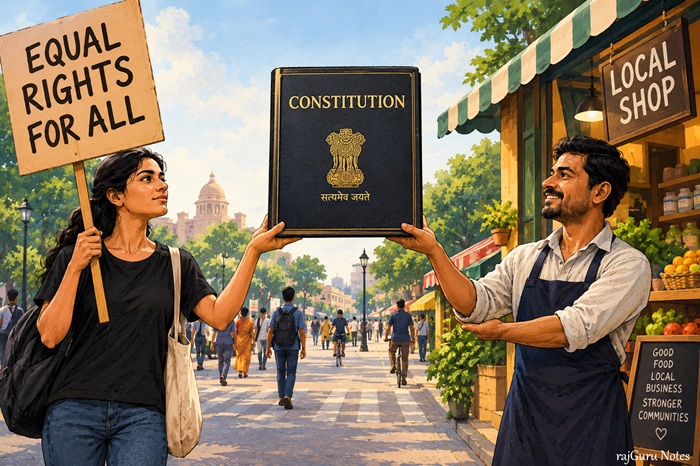
Imagine two Indian citizens beginning their day in New Delhi.
The first is a protester traveling to Jantar Mantar to demand justice. Perhaps the government has ignored repeated representations, parliamentary questions have yielded little, and administrative remedies have failed. For this citizen, public protest is not merely an option. It is the last remaining instrument of democratic accountability.
The second is a small trader operating a shop near the protest venue. His business depends on customers, deliveries, pedestrian access, and uninterrupted commercial activity. He has employees to pay, rent to meet, and a family to support. When demonstrations trigger barricades, traffic diversions, security restrictions, or prolonged disruptions, his income suffers.
Both citizens are exercising legitimate freedoms. Neither is necessarily responsible for the other's predicament. Yet, when their interests collide, the government faces a fundamental constitutional question: Can the State protect one citizen's democratic freedom without compromising another citizen's economic survival?
The recurring protests around Jantar Mantar, one of India's most recognizable democratic demonstration sites, bring this dilemma into sharp focus.
The problem is not whether India should permit protests. It must. The problem is whether the exercise of one constitutional freedom should impose disproportionate economic costs on citizens who are neither responsible for the grievance nor capable of resolving it.
Two Rights, One Constitution
The Indian Constitution recognizes both political liberty and economic dignity, although their constitutional foundations differ. Article 19(1)(a) guarantees freedom of speech and expression. Article 19(1)(b) protects the right to assemble peaceably and without arms. Together, they provide the constitutional foundation for peaceful public demonstrations.
However, these freedoms are not absolute. Article 19(2) permits reasonable restrictions on freedom of expression on specified grounds, while Article 19(3) allows reasonable restrictions on peaceful assembly in the interests of India's sovereignty and integrity or public order.
The livelihood question is equally important. Article 19(1)(g) guarantees citizens the right to practice any profession or carry on any occupation, trade, or business, subject to reasonable restrictions under Article 19(6).
Article 21 protects life and personal liberty. In Olga Tellis v. Bombay Municipal Corporation (1985), the Supreme Court recognized that the right to livelihood forms an integral component of the right to life.
An important distinction must nevertheless be maintained: the Constitution does not guarantee a business uninterrupted profits or immunity from every inconvenience arising from lawful public activity. Likewise, the right to protest does not confer an unrestricted entitlement to occupy any public road indefinitely. The Constitution protects both freedoms, but neither grants its holder absolute control over shared public space. This distinction is crucial because democratic rights cannot be interpreted in isolation from the rights of fellow citizens.
When the Supreme Court ‘Drew the Boundary’
India's judiciary has repeatedly confronted the tension between public demonstrations and competing civic rights. In Himat Lal K. Shah v. Commissioner of Police, Ahmedabad (1973), the Supreme Court recognized that the State could regulate public assemblies on streets but could not arbitrarily extinguish the freedom of assembly.
In Mazdoor Kisan Shakti Sangathan v. Union of India (2018), the Court directly examined restrictions on demonstrations at Jantar Mantar and the Ramlila Maidan. The judgment recognized the need to balance protesters' rights with those of residents and other affected citizens. Rather than treating public protest as inherently unlawful, the Court emphasized appropriate regulation.
The Shaheen Bagh protests subsequently presented another constitutional dilemma. During demonstrations against the Citizenship (Amendment) Act, a major public road in Delhi remained blocked for an extended period. In Amit Sahni v. Commissioner of Police (2020), the Supreme Court held that public roads and spaces could not be occupied indefinitely for demonstrations. The underlying principle was significant: dissent is constitutionally protected, but its location and manner remain subject to lawful regulation.
These judgments establish an important constitutional proposition. The State must facilitate democratic expression while preventing unreasonable interference with the legitimate rights of others. But judicial principles alone cannot resolve the everyday economic consequences of poorly managed protests. That requires administrative imagination.
The October 2026 Protests: When ‘Politics Disrupts Commerce’
The latest controversy makes this debate particularly urgent. On October 10, 2026, demonstrations associated with the youth-led Cockroach movement and opposition groups challenged electoral-roll revisions and demanded the resignation of Chief Election Commissioner Gyanesh Kumar.
Reuters reported that more than 2,000 protesters were detained as authorities imposed extensive security restrictions across Delhi. Transport disruptions and restrictions on movement affected areas well beyond the immediate protest location.
The economic consequences were not hypothetical. The Economic Times reported that protests had adversely affected festive-season shopping in Khan Market and Connaught Place, with retailers experiencing reduced customer footfall and declining business.
The controversy reached the Delhi High Court when a licensed street vendor from Palika Bazar sought intervention against a proposed October 16 demonstration at Connaught Place, citing possible disruption to trade and livelihood. The Court declined to prohibit the demonstration in advance, relying instead on the authorities' responsibility to maintain public order.
Meanwhile, Jantar Mantar's removal from the list of designated protest venues has generated another dilemma. Alternative locations include Ramlila Maidan, Burari Ground, and CBD Ground in Karkardooma. Yet relocating demonstrations does not necessarily eliminate the conflict. Traders near Ramlila Maidan have expressed concerns about potential livelihood losses, while Burari's distance from central Delhi raises questions about the visibility and effectiveness of demonstrations.
This reveals a deeper policy failure. Moving a protest from one neighborhood to another may simply transfer its economic costs from one group of citizens to another. Moreover, not every commercial disruption is caused by protesters. Police barricades, excessive security cordons, public transport shutdowns, and preventive restrictions can independently reduce business activity. The government must therefore examine not only the conduct of protesters but also the proportionality of its own response.
The ‘Economics’ of a Democratic Disruption
For a large corporation, a temporary decline in sales may represent an operational inconvenience. For a street vendor, it can determine whether the family eats that evening.
Consider a hypothetical small trader earning Rs.3,000 in daily sales with a net operating margin of 15%. A complete day's closure could eliminate Rs.450 in expected operating earnings, apart from possible inventory losses and continuing fixed costs. Ten disrupted trading days could mean Rs.4,500 in lost operating earnings.
These figures are illustrative, not measured losses from the Delhi protests. Actual losses would vary by business, margins, customer behavior, and the extent of disruption. The distinction matters because the economic burden of protest is rarely distributed equally.
A salaried employee may continue receiving wages during a disruption. A large retailer may recover some sales online. A daily-wage worker, hawker, or perishable-goods seller may have no comparable protection. Furthermore, when demonstrations coincide with major shopping periods, lost sales may not necessarily be recovered later.
The economic question is therefore not simply how much commerce is disrupted. It is who bears the cost, who benefits from the protest, and whether those bearing the cost have any influence over the underlying dispute.
This is a classic problem of negative externalities: an activity undertaken for one legitimate purpose imposes costs on third parties. However, protests also generate positive democratic externalities. They expose grievances, influence public debate, and create pressure for institutional accountability.
Public policy must recognize both. A purely economic calculation that treats every protest as a commercial loss would undermine democracy. An exclusively political calculation that ignores the livelihoods of affected citizens would undermine social justice. Neither approach is acceptable.
Why Prohibiting Protests Is Not the Answer
One tempting administrative response is to relocate every major demonstration to distant grounds where commercial disruption is minimal. But protest is not merely about assembling people. It is about being heard.
A demonstration demanding accountability from Parliament or the Union government loses part of its political significance when relocated so far away that its intended audience can conveniently ignore it. Democratic visibility is not an incidental feature of protest. It is frequently its central purpose. Yet visibility should not become a justification for indefinitely blocking commercial access.
The appropriate response is not unrestricted occupation or indiscriminate prohibition. It is proportionate regulation. The Supreme Court's 2018 Jantar Mantar judgment expressed the underlying principle particularly well: extinguishing one right completely is not the same as balancing competing rights. That principle should guide public administration.
A Seven-Point ‘Framework for Balancing Rights’
India needs a transparent protest-management framework built around constitutional proportionality and economic fairness.
These measures would convert protest management from a policing exercise into a framework of democratic governance.
Final Thoughts: Democracy Cannot Demand that the ‘Poor Pay’ for Everyone's Rights
India's Ministry of MSME dashboard recorded approximately 9.88 crore Udyam and Udyam Assist registrations as of October 15, 2026, including more than 4.11 crore registrations in trading activities. These are administrative registration figures, not a count of businesses affected by protests. Nevertheless, they demonstrate the enormous scale of economic activity that depends on small enterprises.
The lesson from Jantar Mantar extends beyond Delhi. A democracy cannot remain healthy if citizens are prevented from questioning those in power. Equally, a democracy cannot claim to protect constitutional freedoms while ignoring the economic vulnerability of citizens trying to earn an honest living. The protester seeking justice and the trader seeking customers are not natural adversaries. Both depend on a constitutional order that protects their dignity, independence, and freedom.
The real failure occurs when the State treats their rights as competing inconveniences rather than complementary responsibilities. Governments must therefore stop approaching every demonstration as either a security threat or an unrestricted democratic entitlement. The challenge is to protect dissent without making innocent citizens finance its consequences.
A protester should not have to surrender the right to be heard. A trader should not have to surrender the right to earn. And the government should not be permitted to evade its responsibility by protecting one at the expense of the other.
Ultimately, the quality of a democracy is measured not merely by how loudly its citizens can protest, but also by how effectively it protects those whose voices are seldom heard.
The Constitution belongs equally to the citizen ‘holding a placard’ and the citizen ‘opening a shop.’ The street belongs to both. So must constitutional justice.
Image ChatGPT generated
24-Oct-2026
More by : P. Mohan Chandran
