Oct 24, 2026
Oct 24, 2026
Can India's UPI Remain ‘Inclusive’ Without Remaining ‘Subsidized’?
When a public digital infrastructure becomes indispensable to an economy, should its success be measured by the revenue it generates or by the economic costs it eliminates?
India has accomplished something extraordinary. It has transformed digital payments from a banking convenience into an everyday economic activity. A vegetable vendor accepts Rs.20 through a QR code. An autorickshaw driver receives Rs.150 without searching for change. A street-side tea seller collects Rs.10 without purchasing an expensive card-swiping machine.
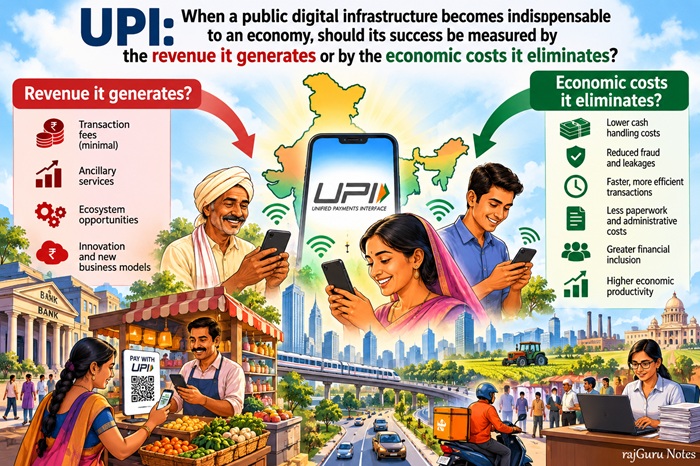
For millions of Indians, the Unified Payments Interface (UPI) has made financial transactions almost frictionless. But behind this remarkable achievement lies an uncomfortable economic question: Who pays for a payment system that appears free to everyone using it?
For years, India addressed this question through a combination of zero merchant discount rates (MDR), government incentives, and costs absorbed by banks and payment service providers. That arrangement helped establish UPI as one of the world's most successful digital public infrastructures. However, its extraordinary growth has also exposed a structural weakness: transaction volumes can increase indefinitely without generating proportionate revenue for the institutions responsible for maintaining the system.
The question is no longer whether UPI has succeeded. It has. The question is whether India can preserve its inclusiveness while making its underlying economics sustainable.
The Extraordinary ‘Economics of Scale’
The numbers demonstrate the magnitude of India's digital payments revolution. According to the National Payments Corporation of India (NPCI), UPI processed approximately 24.07 billion transactions in September 2026, representing payments worth Rs.29.37 lakh crore.
In FY2025–26, UPI processed approximately 241.62 billion transactions worth Rs.314.23 lakh crore. Its transaction volume increased by approximately 30% over the previous financial year. UPI accounted for approximately 85% of India's digital payment transactions by volume during FY2025–26. These figures establish an important distinction between commercial success and public infrastructure success.
A conventional payment company measures success through transaction revenue, merchant fees, margins, and profitability. A digital public infrastructure must also be evaluated through the economic activity it enables.
Consider a small retailer who previously handled Rs.10,000 daily in cash. Digital payments can reduce the time spent counting currency, returning change, maintaining cash balances, and visiting banks. These savings may not appear in NPCI's financial statements. Nevertheless, they represent genuine economic value.
Similarly, electronic payment records can improve bookkeeping and potentially help small businesses demonstrate financial activity when seeking formal credit. However, transaction digitization does not automatically produce tax compliance, creditworthiness, or financial inclusion. These outcomes depend on complementary institutions, financial literacy, and access to appropriate services.
UPI's economic contribution extends beyond the revenue generated by the payment itself. That distinction is fundamental to understanding its sustainability.
The ‘Hidden Cost’ of Free Transactions
Free services are rarely costless. Every UPI transaction requires a technological and institutional ecosystem involving banks, payment applications, telecommunications infrastructure, cybersecurity, fraud monitoring, dispute resolution, and settlement systems. These services require continuing investment.
In March 2025, the Union Cabinet approved an estimated Rs.1,500 crore incentive scheme for low-value UPI merchant transactions during FY2024–25. The scheme provided a 0.15% incentive on eligible transactions of up to Rs.2,000 involving small merchants. Government disclosures also showed incentive payouts for RuPay debit cards and UPI totaling Rs.1,389 crore in FY2021–22, Rs.2,210 crore in FY2022–23, and Rs.3,631 crore in FY2023–24. These payments were not simply subsidies to consumers. They supported financial institutions providing payment infrastructure without collecting conventional merchant fees.
The problem becomes clearer when viewed through the economics of scale. As transaction volumes increase, the average technological cost per transaction may decline. However, aggregate expenditure on fraud prevention, cybersecurity, customer support, infrastructure redundancy, and regulatory compliance can continue rising.
In September 2026, NPCI Chief Executive Dilip Asbe reportedly estimated the annual cost of operating the UPI payment ecosystem at approximately Rs.21,000 crore. He indicated that a proposed 0.4% MDR framework could recover approximately Rs.13,000–15,000 crore during its first year. The implication is significant.
A payment network can achieve extraordinary transaction growth while remaining financially dependent on government support or cross-subsidization. But does that necessarily make it economically inefficient? Not if the social benefits exceed the resources consumed.
October 2026: A Turning Point
India's UPI policy has now entered a new phase. Under the revised framework announced in September 2026, a 0.4% MDR applies to specified merchant transactions exceeding Rs.2,000, effective October 15. However, this date of implementation has been further deferred by the government, which will be communicated in due course.
Person-to-person transfers remain free, while merchant transactions up to Rs.2,000 and qualifying small-merchant payments retain zero MDR. Essential sectors, including fuel, telecommunications, insurance, railways, and agricultural inputs, receive differentiated treatment, with a flat Rs.5 charge on applicable transactions exceeding Rs.2,000.
The government estimates that approximately 96% of merchant transactions will remain unaffected. This represents an important philosophical shift.
Instead of treating free digital payments as an unconditional principle, India is beginning to distinguish between transactions that require protection and transactions that can contribute toward infrastructure costs.
Consider a transaction of Rs.10,000. At 0.4%, the merchant discount rate amounts to Rs.40. For a large retailer operating with reasonable margins, this may be manageable. For a small business operating on narrow margins, however, Rs.40 could materially affect profitability. A uniform percentage-based charge can therefore have unequal economic consequences. The revised framework recognizes some of these differences, but its effectiveness will depend on implementation.
If merchants respond by discouraging digital payments, demanding additional money from customers, or returning to cash, the policy could undermine some of UPI's economic advantages.
The government has stated that MDR is not a consumer charge. Nevertheless, the economic burden may still reach consumers indirectly through higher prices. A regulatory prohibition against directly charging customers does not eliminate the possibility of cost passing through. That is why the success of the new framework must be evaluated through merchant behavior, not merely projected revenue.
Financial Returns Vs. Social Returns
The central policy challenge concerns the distinction between private financial returns and economy-wide economic benefits.
A February 2026 socioeconomic impact study commissioned by the Department of Financial Services surveyed 10,378 respondents across 15 states. Among the small merchants surveyed, 94% reported adopting UPI, while 57% reported increased sales following digital payment adoption. Approximately 72% expressed satisfaction with digital payments. The study also reported that government incentive disbursements totaled Rs.8,276 crore between FY2021–22 and FY2024–25. These findings suggest meaningful benefits, although self-reported sales increases cannot establish that UPI alone caused higher revenue. This raises a broader economic question.
Suppose the government spends Rs.1,000 crore supporting digital payment infrastructure, while businesses and consumers collectively save Rs.5,000 crore through lower transaction costs and improved efficiency. Would that expenditure represent a financial loss or an economic investment? The answer depends on whether those savings are genuine, incremental, and attributable to the intervention. This is precisely why public digital infrastructure should be assessed through social cost-benefit analysis rather than conventional profitability alone.
Roads, public sanitation, and street lighting are not evaluated exclusively through the revenue they collect. Their economic value emerges through the activities they enable. Digital payment infrastructure deserves similar consideration. However, this argument cannot justify unlimited subsidies. Public spending must demonstrate measurable benefits, additionality, efficiency, and accountability.
Can India Develop a ‘Sustainable’ Middle Path?
India does not need to choose between permanently subsidizing every transaction and imposing charges indiscriminately. A more economically defensible model would combine three principles.
First, protect essential and low-value transactions. Small merchants, low-income consumers, and everyday payments should remain insulated from disproportionate charges. Digital inclusion must not become a privilege reserved for financially attractive customers.
Second, introduce differentiated cost recovery. Larger commercial transactions can contribute to infrastructure sustainability, provided charges remain transparent, proportionate, and sensitive to sector-specific margins.
Third, measure public returns independently. Government support should be linked to demonstrable outcomes such as merchant adoption, lower payment costs, fewer technical failures, improved accessibility, and reduced fraud losses.
The revised framework also provides for allocating 5% of MDR collections to a fund supporting small-merchant adoption. This is a constructive mechanism, provided its expenditure and outcomes are publicly audited.
India should additionally publish an annual UPI economic impact assessment distinguishing operating costs, public subsidies, private revenues, and estimated social benefits.
Without such transparency, the debate will remain trapped between two equally simplistic arguments: that digital payments must always be free, and that every transaction must pay for itself. Neither position adequately reflects the economics of public infrastructure.
Final Thoughts: Free Is a ‘Price,’ Not an ‘Economic Model’
India's UPI revolution demonstrates that technological infrastructure can create enormous public value without charging users directly. But zero pricing and zero economic cost are fundamentally different concepts.
A system that depends indefinitely on uncompensated infrastructure providers risks weakening the institutions responsible for its reliability. Conversely, excessive transaction charges could discourage precisely those users whose participation made UPI transformative.
The objective should therefore be neither permanent universal subsidization nor complete commercial monetization. It should be financial sustainability without sacrificing universal accessibility.
India's challenge is to establish who should pay, how much they should pay, and which economic benefits justify continued public support. Ultimately, the most important question is not whether UPI generates sufficient revenue to cover every rupee spent operating it. It is whether India can finance UPI efficiently while preserving the much larger economic value that the system creates.
A digital payment infrastructure should not become financially unsustainable because it is free. Nor should it become socially exclusionary because it must earn revenue. The real achievement would be to reconcile both objectives. After all, the purpose of public digital infrastructure is not merely to make transactions profitable. It is to make the economy more productive.
Image ChatGPT generated
24-Oct-2026
More by : P. Mohan Chandran