Oct 31, 2026
Oct 31, 2026
From Rising GDP to Rising Possibilities
What does it mean for a nation to become the world’s fourth-largest economy? Greater negotiating power? More investment? A stronger voice in shaping the global order? Certainly. But for a young graduate seeking employment, a small manufacturer awaiting payment, or a family saving for education, the question is more immediate: When does a bigger economy become a better life?
India’s economic transformation deserves celebration precisely because its possibilities extend beyond a position on a global scoreboard. Its expanding productive capacity can change the circumstances of millions, and influence how the world produces, consumes, and innovates.
The challenge is to convert that possibility into widespread prosperity.
First, Get the Scoreboard Right
The IMF’s October 2026 projections put India’s nominal GDP at approximately $4.52 trillion in 2027, potentially making it the world’s fourth-largest economy. Its real growth forecast for FY2026–27 has been raised to 7%, supported by resilient domestic demand and services activity. These measure different things: the first captures economic size in current US dollars; the second measures growth after adjusting for inflation.
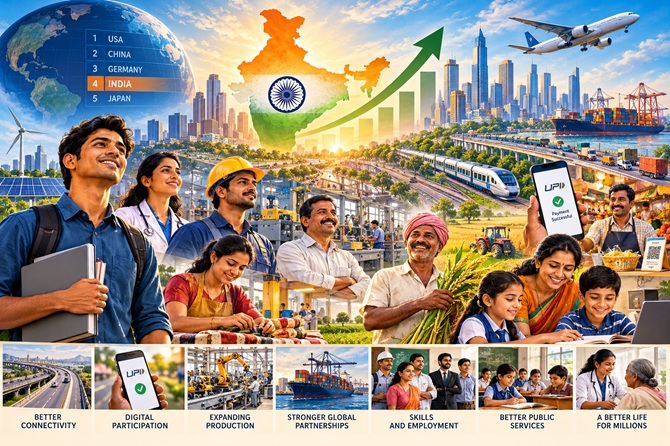
National confidence becomes stronger when its arithmetic is credible.
India’s deeper transformation is visible over decades. According to the World Bank, the economy has nearly quadrupled in real terms since 2000, while per capita income has almost tripled. Its share of the global economy increased from 1.6% in 2000 to 3.4% in 2023. Those changes reveal growing economic weight beyond the fluctuations of an annual ranking.
This achievement belongs to a cumulative national journey: institution building, entrepreneurship, successive reforms, public investment, and the aspirations of ordinary Indians. No single policy explains it; no single generation owns it.
The Foundations of a Larger Economic Role
Three mutually reinforcing changes help explain India’s momentum: better connectivity, digital participation, and expanding production.
Consider highways. Official figures show that the national highway network increased from 91,287 kilometers in 2014 to 146,145 kilometers in 2024 — approximately 60%. Network length alone does not establish road quality or logistics efficiency, but the expansion provides a substantial foundation for connecting markets.
The economic value of a road emerges through what it enables: a farmer reaching a buyer sooner, a factory receiving components reliably, or a smaller city attracting investment. Infrastructure earns its return when it reduces the cost of doing business and broadens access to opportunity.
Digital infrastructure operates through a similar logic. UPI processed approximately 185.9 billion transactions worth Rs.260.56 lakh crore in FY2024–25. Transaction value is not GDP; the same money can circulate repeatedly. Nevertheless, the scale demonstrates how deeply digital payments have entered everyday commerce.
A street vendor accepting a digital payment participates in a system that once would have required far more expensive infrastructure. Such systems can reduce transaction friction and create records that support financial access. Their lasting value depends on reliability, fraud protection, and whether small enterprises can use them productively.
Manufacturing offers another significant example. Government data place mobile phone production at approximately Rs.5.45 lakh crore in FY2024–25, compared with Rs.18,000 crore in FY2014–15. Mobile phone exports reached approximately Rs.2 lakh crore in FY2024–25.
These are substantial gains. The next challenge is to deepen domestic value addition through components, design, machinery, and intellectual property. Exporting an assembled product creates opportunities; developing more of the capabilities behind it can retain greater value.
India’s strategic opportunity lies in connecting these advances. Roads help goods move. Digital systems help transactions move. Industrial capabilities determine how much value India creates along the way.
Why the World Is Paying Attention
A larger economy offers a larger market, a broader investment base, and greater scope to finance research, infrastructure, and strategic capabilities. It also makes India more consequential to countries seeking resilient commercial partnerships.
The March 2026 India–Canada joint statement provides a concrete example. The two governments launched formal negotiations for a comprehensive trade agreement and expressed an aspiration to expand bilateral trade to CAD70 billion by 2030, alongside cooperation in energy and critical minerals. This is an ambition, not an achieved outcome, but it illustrates the practical interests shaping engagement with India.
Economic scale creates bargaining power. Productive capability makes that power durable.
India must continually improve the value it offers through skills, innovation, and execution. A large customer base attracts attention; indispensable capabilities attract enduring partnerships.
Forecasts Are Possibilities, Not Appointments With Destiny
The headline projections are striking. Morgan Stanley’s 2022 analysis envisaged GDP exceeding $7.5 trillion by 2031. Goldman Sachs’ 2023 analysis projected that India could become the second-largest economy by 2075, emphasizing productivity, investment, and workforce participation.
These projections come from different publication dates, assumptions, and time horizons. Their real analytical value lies in the conditions they identify. Can investment remain strong? Can workers become more productive? Can more women access paid employment? Can businesses grow without being obstructed by unpredictable rules and weak infrastructure?
A forecast describes what compounding might deliver. Institutions determine whether compounding survives.
The Unfinished Transformation
India’s achievements coexist with substantial development needs. World Bank data put GDP per capita at approximately $2,702 in 2025. That average is neither a typical household’s income nor a measure of income distribution, but it demonstrates the distance between aggregate economic size and individual prosperity.
The next phase must therefore prioritize productive employment, stronger public services, and broader participation.
Employment policy must help firms expand and workers move into better-paying activities. Education must produce usable capabilities alongside qualifications. Women need safe transport, childcare, and workplaces that make sustained participation possible. Smaller businesses need dependable electricity, timely payments, and predictable administration.
Regional development is equally important. India’s economic future cannot rest on a few metropolitan centers while other regions supply workers without developing sufficient opportunities themselves.
The World Bank’s 2025 assessment estimated that achieving high-income status by 2047 would require average annual real growth of 7.8% over 22 years. Its corresponding scenario included raising investment from 33.5% to 40% of GDP by 2035 and increasing overall labor force participation above 65%. These are demanding conditions, not automatic consequences of population size.
Final Thoughts
India has ample reason for confidence. Its transformation is visible in expanding markets, infrastructure, digital participation, and industrial ambition.
Yet the most meaningful national achievement will be measured in the choices citizens acquire: the ability to find dignified work, build an enterprise, access good healthcare, and educate a child without financial desperation.
Becoming the fourth-largest economy would be a significant milestone. Making prosperity more accessible would give that milestone its fullest meaning.
India’s biggest chapters may indeed lie ahead. Their quality will depend on whether the country invests as seriously in the capabilities of its people as it celebrates the size of its economy.
Image courtesy rajGuru Notes
31-Oct-2026
More by : P. Mohan Chandran
