Oct 31, 2026
Oct 31, 2026
One Nation, One Digital Voice:
Can India Build the World’s Largest Real-Time Democracy?
From Periodic Elections to Continuous Public Consultation:
A Technological Vision for India’s Democratic Future
India is the world's largest democracy. Yet, like most democracies, its principal mechanism for understanding the collective political will of its citizens remains periodic elections. Between elections, governments largely depend on opinion polls, media reports, social media sentiment, public demonstrations, electoral outcomes, and intelligence assessments to understand what citizens think about important policies. But how accurately do these mechanisms represent the views of 1.4 billion people?
Can a demonstration involving 50,000 people establish the political preferences of an entire nation? Can a million social media posts accurately reflect the sentiments of hundreds of millions of citizens? And should governments interpret the loudest voices as necessarily representing the majority?
What if every eligible Indian could communicate an opinion directly to the government through a mobile phone, securely, independently, and within minutes?
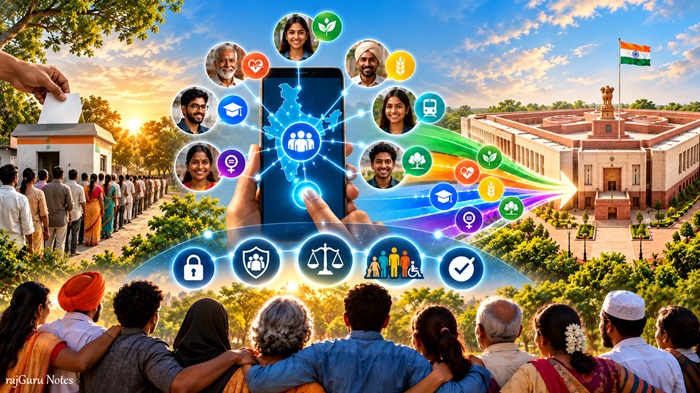
India should seriously examine the feasibility of establishing a National Digital Democracy Grid (NDDG): a secure technological infrastructure enabling citizens to express their views on major public policies, legislative proposals, governance initiatives, and nationally consequential developments.
Such a system could fundamentally transform the relationship between citizens and the state.
India Already Possesses Much of the Technological Foundation
India has demonstrated an extraordinary ability to develop digital public infrastructure at population scale.
According to the Telecom Regulatory Authority of India (TRAI), India had approximately 1.2 billion wireless telephone subscriptions in early 2025. However, subscriptions should not be confused with unique individuals, since some people possess multiple connections while others have none.
The Unique Identification Authority of India (UIDAI) has issued more than 1.4 billion Aadhaar numbers cumulatively, including numbers associated with deceased individuals.
Meanwhile, the National Payments Corporation of India's Unified Payments Interface (UPI) processed approximately 16.7 billion transactions in December 2024 alone.
These achievements demonstrate India's technological capacity to authenticate identities, manage large-scale digital transactions, and operate interconnected public infrastructure.
The next challenge is considerably more complex.
Can India move from digital financial transactions to secure digital democratic participation?
Money can be transferred digitally. Government benefits can be delivered digitally. Public grievances can be registered digitally.
Why should citizens not be able to express their opinions on important government decisions through an equally accessible technological platform?
The National Digital Democracy Grid: How Would It Work?
Imagine a secure national digital participation platform administered through a central technological infrastructure in New Delhi, supported by geographically distributed data centers.
Every eligible citizen could access the platform through a verified mobile application or other authenticated channel.
When the government proposes a consequential policy, citizens would receive a notification explaining the proposal, its expected benefits, potential disadvantages, and implications.
They could then register their preferences.
For example:
Should India introduce a particular nationwide education reform?
Citizens could select Support, Oppose, or Undecided.
The platform would generate an authenticated, publicly auditable aggregate of responses.
Crucially, one eligible individual should have only one opportunity to respond to each consultation, irrespective of how many mobile phones or SIM cards that individual possesses.
Aadhaar-based identity verification could be evaluated as one authentication option, subject to legal authorization and privacy safeguards. However, authentication should not require permanently linking citizens' political preferences to their Aadhaar numbers.
The architecture should use privacy-preserving credentials that establish eligibility without revealing individual political choices.
It must also provide alternatives for citizens without Aadhaar-linked mobile numbers, smartphones, reliable internet access, or adequate digital literacy.
Otherwise, technological democracy could inadvertently become democracy for the digitally privileged.
When Protests Claim to Represent the Nation
Consider a hypothetical situation.
A political movement organizes nationwide demonstrations demanding the resignation of an elected government. Its organizers claim that the country overwhelmingly supports their demands.
The government disputes that assertion.
Television channels broadcast conflicting narratives. Social media platforms become battlegrounds of competing political claims.
How can the country establish the actual distribution of public opinion?
A national digital consultation could ask citizens whether they support the movement's stated demands.
The results might reveal substantial support, overwhelming opposition, or a deeply divided electorate.
Whatever the outcome, the country would possess an additional source of evidence rather than relying exclusively on political rhetoric.
However, an important constitutional distinction must be maintained.
A protest does not become illegitimate merely because a majority disagrees with it.
Article 19 of the Indian Constitution protects freedom of speech and peaceful assembly, subject to constitutionally permitted restrictions. Minority viewpoints cannot be extinguished through digital majoritarianism.
Similarly, an opinion poll cannot constitutionally replace a parliamentary confidence vote or an election.
The objective should not be to suppress dissent but to distinguish measurable public sentiment from unsupported claims of universal public support.
A credible platform must therefore be independent of partisan control, publish neutral questions, disclose participation rates, and permit scrutiny of its methodology.
From Opinion Polls to Verified Public Consultation
Traditional opinion polls estimate public preferences by questioning representative samples.
A digital democracy platform could potentially invite participation from every eligible citizen.
However, even millions of authenticated responses would not automatically represent the entire population.
Participation would remain voluntary, and citizens with stronger political opinions might respond disproportionately.
Consequently, the system should publish demographic participation patterns, regional differences, nonresponse rates, and methodological limitations.
Its results should be described as verified consultation responses rather than definitive national mandates.
Independent statisticians could also conduct representative surveys to assess whether participation bias materially affects the findings.
Such methodological transparency would strengthen rather than weaken the credibility of digital democracy.
Could India Eventually Conduct Elections Through Mobile Phones?
This is perhaps the most consequential possibility.
Imagine a migrant worker employed in Mumbai but registered to vote in Bihar.
Instead of traveling hundreds of kilometers to exercise the franchise, the worker could cast a ballot securely through an authorized digital voting mechanism.
The potential benefits are enormous: greater convenience, reduced travel costs, improved accessibility, and potentially higher participation.
India's 2024 Lok Sabha election involved approximately 979.75 million registered electors, according to the Election Commission of India. Approximately 65.8% participated.
Even modest improvements in participation could bring millions of additional citizens into the electoral process.
Estonia provides an important international example. Its official election statistics indicate that 51.1% of participating voters in the 2023 parliamentary election voted online.
Nevertheless, Estonia's experience cannot simply be transplanted into India.
India's population, technological diversity, cybersecurity exposure, and electoral environment create significantly different challenges.
Aadhaar authentication alone cannot guarantee a secure election.
A mobile voting system must also prevent malware, coercion, vote buying, impersonation, server manipulation, and unauthorized disclosure of individual ballots.
It must preserve ballot secrecy while allowing independent verification of electoral integrity.
These are difficult technical and institutional challenges, and no digital election architecture should be described as absolutely foolproof.
Therefore, mobile-based voting should initially be explored through independently audited pilots, rigorous security evaluations, and narrowly defined applications rather than immediate nationwide implementation.
The ‘Five Pillars’ of Digital Democracy
India's proposed National Digital Democracy Grid should rest on five institutional principles.
The central infrastructure may be located in Delhi, but operational authority and security architecture should not be concentrated in a single government-controlled server.
Distributed infrastructure, independent oversight, and transparent auditing would reduce institutional and technological vulnerabilities.
From ‘Representative Democracy’ to ‘Participatory Democracy’
The deeper significance of this proposal extends beyond mobile voting.
It concerns the evolution of democracy itself.
Representative democracy empowers elected legislators to make decisions on behalf of citizens.
Participatory democracy creates additional opportunities for citizens to influence public decisions between elections.
The two models need not compete.
A National Digital Democracy Grid could strengthen representative institutions by giving legislators better evidence about public preferences.
Consider major decisions concerning agricultural reforms, educational policies, environmental regulations, infrastructure projects, or public expenditure.
Instead of discovering widespread dissatisfaction only after implementation, governments could consult citizens before making consequential decisions.
However, public opinion should inform policymaking rather than mechanically determine every outcome.
Some necessary policies are unpopular. Some popular demands are economically unsustainable. Constitutional rights cannot depend on majority approval.
Good governance requires balancing public preferences with constitutional obligations, expert evidence, fiscal realities, and long-term national interests.
Final Thoughts: Let Every Indian Be ‘Heard’
India has already demonstrated that technological innovation can transform financial inclusion, public-service delivery, and economic participation.
Could democratic participation become its next great digital achievement?
The opportunity is compelling.
A secure national platform could reduce dependence on speculative political narratives, improve public consultation, expose policymakers to genuine citizen concerns, and make democratic participation more continuous.
But its legitimacy would depend on a fundamental principle: the system must serve citizens, not monitor their political loyalties.
The government should be able to understand what India thinks without acquiring the power to identify and punish individuals for what they think.
That distinction separates democratic innovation from digital authoritarianism.
The ultimate ambition should not be to create a technological instrument for validating governments or discrediting protests.
It should be to create a trusted public institution through which every Indian can be heard.
For centuries, democracy has struggled with a fundamental question: How can the voice of the individual influence the decisions of the state?
India now possesses the technological capabilities to attempt a remarkable answer.
Let every citizen have a voice. Let every voice count only once. Let every opinion remain free.
And let technology strengthen democracy without ever becoming more powerful than democracy itself.
PS: An important recommendation: India's first objective should be to establish a secure, voluntary national public-consultation platform, not immediately introduce mobile voting for parliamentary elections. This would allow the government to evaluate technological reliability, public participation, cybersecurity, constitutional compliance, and institutional independence before considering legally binding digital elections.
The distinction between one mobile number, one response and one eligible citizen, one response is particularly important. The latter is the appropriate democratic standard.
31-Oct-2026
More by : P. Mohan Chandran
