Nov 07, 2026
Nov 07, 2026
How Donald Trump’s Economic Nationalism, Technology Restrictions, Diplomatic Confrontations, and Military Adventurism Are Threatening the Very American Supremacy He Promised to Restore
Can a nation become greater by alienating the very countries that helped make it great? Can America retain its technological supremacy while restricting access to some of the world's finest scientific and engineering talent? Can tariffs make American industries competitive when American consumers and businesses ultimately bear much of their cost? Can a president promise peace while embroiling his country in another prolonged Middle Eastern conflict? And can a superpower remain a superpower when its allies increasingly regard it as an unpredictable partner rather than a dependable leader?
These questions expose a fundamental contradiction at the heart of Donald Trump's second presidency.
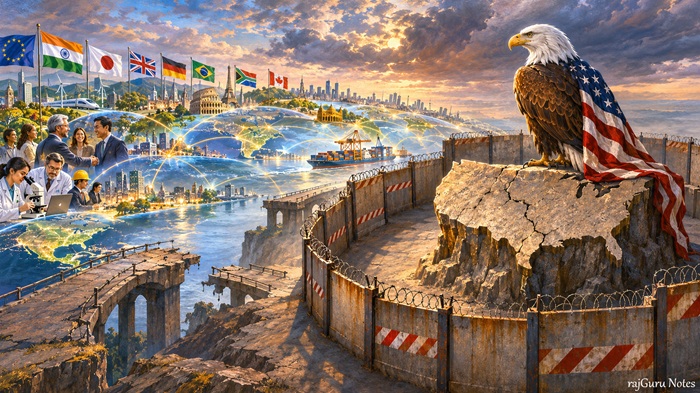
Trump returned to the White House promising to Make America Great Again aka MAGA. Yet, increasingly, his policies appear to be making America more expensive, more isolated, more confrontational, and potentially less competitive.
The irony is extraordinary. A president who claims to be defending American economic supremacy may be accelerating the erosion of the very foundations upon which that supremacy was built.
America did not become the world's leading economic and technological power by closing its doors. It became powerful by attracting talent, capital, innovation, entrepreneurship, and international partnerships.
Trump's political philosophy increasingly challenges that historical formula.
And the consequences are becoming difficult to ignore.
1. The Economic Paradox: Making America Expensive Again
Trump's tariff strategy rests on an appealing proposition: tax foreign imports, protect domestic industries, encourage American manufacturing, and reduce dependence on overseas suppliers.
The difficulty is that tariffs are not paid directly by foreign governments. They are collected from American importers, who frequently pass substantial portions of the costs to American businesses and consumers.
Research published by Yale University's Tobin Center in July 2026 estimated that approximately 90% of the tariffs examined were passed through to prices paid by American importers.
The study found that average US tariff duties increased from 2.4% to 9.6% in 2025, reaching their highest level in approximately eight decades.
Tariffs generated substantial federal revenue and reduced China's direct share of American imports. However, the researchers found no clear evidence that trade diversion primarily benefited America's allies.
Instead, production and sourcing increasingly shifted toward other East Asian economies.
Meanwhile, the Tax Policy Center estimated that tariffs announced during Trump's second administration would impose an average burden of approximately $920 per American household in 2026.
Lower-income households would experience a proportionately greater increase in their effective federal tax burden.
Consider the contradiction.
An American household purchases an imported washing machine, computer, or electronic component. The administration celebrates higher tariffs as a victory against foreign competition. Yet the American consumer encounters higher prices, while domestic manufacturers dependent on imported components also confront rising production costs.
Who has actually won?
Protectionism can be justified when it safeguards strategically important industries, addresses unfair subsidies, or creates breathing space for domestic manufacturing.
But protection without productivity becomes an expensive form of economic self-deception.
A country cannot tariff its way into technological excellence. It must innovate its way there.
2. The Technology Contradiction: Restricting the Talent That Built Silicon Valley
Perhaps nowhere is Trump's economic nationalism more paradoxical than in the technology sector.
For decades, America benefited enormously from Indian engineers, Chinese researchers, European scientists, and entrepreneurs from virtually every continent.
Its universities educated global talent. Its technology companies commercialized that talent. Its immigration system, despite its imperfections, enabled America to attract intellectual capital on an extraordinary scale.
Now, that competitive advantage faces growing political restrictions.
In October 2026, the Trump administration suspended several major technology and IT services companies from a key employment-based green-card certification program, citing alleged misuse of immigration rules.
The affected companies reportedly included Microsoft, Cognizant, Infosys, Tata Consultancy Services, Wipro, and HCL, among others.
Importantly, these were restrictions on a specific immigration certification mechanism, not blanket bans on the companies conducting business in America. The allegations also should not be confused with proven wrongdoing by every affected company.
The administration has also pursued substantially higher H-1B visa fees.
According to the Brookings Institution, an August 2026 regulatory proposal contemplated a fee of $103,265 for certain H-1B petitions, following earlier attempts to impose a $100,000 payment.
Brookings noted that more than 70% of H-1B recipients were Indian citizens and nearly 65% worked in computer-related occupations.
Certainly, protecting American workers against exploitation and discriminatory hiring practices is a legitimate governmental responsibility.
But there is a difference between preventing labor-market abuse and making international talent prohibitively expensive.
American technology leadership depends not merely on domestic capital but on the world's intellectual capital.
If skilled professionals increasingly perceive America as an uncertain destination, competing innovation centers stand to benefit.
The question is not whether America should protect American jobs.
It is whether America can protect those jobs by weakening the companies that create them.
Silicon Valley became Silicon Valley because America attracted the world's brightest minds, not because it insisted that brilliance must possess an American passport.
3. China: When National Security Becomes Technological Protectionism
Trump's restrictions on Chinese technology companies reveal another strategic dilemma.
In July 2026, the administration introduced restrictions targeting new Chinese humanoid robots, quadruped robots, and connected power inverters, citing cybersecurity and critical-infrastructure concerns.
In August, Reuters reported that additional restrictions on Chinese optical components used in American data centers were under consideration.
The proposed measures could increase procurement costs for American cloud infrastructure companies.
There are legitimate national security concerns surrounding sensitive technology, espionage, and critical infrastructure.
However, indiscriminate technological decoupling carries consequences.
China is not merely a manufacturing competitor. It is a formidable participant in artificial intelligence, robotics, electric vehicles, telecommunications, and advanced industrial supply chains.
Excluding Chinese technologies may protect certain American manufacturers, but it can also reduce competition, increase costs, and accelerate China's development of independent technological ecosystems.
Washington risks creating precisely what it fears: a technologically self-reliant rival increasingly insulated from American commercial influence.
Technological supremacy is not established by preventing competitors from entering the marketplace. It is demonstrated by consistently outperforming them.
4. Iran: The President Who Promised Peace but Delivered War
Trump's confrontation with Iran represents perhaps the most consequential contradiction of his presidency.
On February 28, 2026, the United States and Israel launched military operations against Iran.
By September, the conflict had continued for nearly seven months, disrupted global energy supplies, and contributed to rising American gasoline prices.
The administration argues that military action is necessary to prevent Iran from developing nuclear weapons and to safeguard American security interests.
Yet the fundamental strategic question remains unanswered: What constitutes victory?
Destroying military installations? Eliminating nuclear capabilities? Changing Iran's government? Establishing regional deterrence?
These are different objectives requiring different strategies.
A July Reuters/Ipsos poll found that only approximately one-third of Americans supported the war.
More significantly, 69% believed Trump had failed to explain America's military objectives clearly, including approximately four in ten Republicans.
History offers uncomfortable parallels.
Vietnam demonstrated that overwhelming military capabilities do not guarantee political victory.
Iraq illustrated how removing a perceived threat can create prolonged instability.
Afghanistan revealed the limitations of military power when political objectives remain elusive.
America should defend itself against genuine threats. But military intervention must satisfy three fundamental tests: necessity, proportionality, and a credible political endgame.
Without them, military superiority can become strategic exhaustion.
A nation already confronting fiscal pressures and domestic economic anxieties cannot indefinitely treat international military intervention as a substitute for diplomacy.
5. Venezuela and Norway: When Diplomacy Becomes Personal
Trump's treatment of Venezuela and Norway illustrates two different manifestations of confrontational foreign policy.
In January 2026, American forces captured Venezuelan President Nicolás Maduro in an operation that Trump defended as restoring American influence in the Western Hemisphere.
Supporters celebrated the removal of an authoritarian leader. Critics questioned the legality of unilateral intervention and warned that it could establish dangerous precedents for other major powers.
The larger concern extends beyond Venezuela.
If Washington asserts that military strength legitimizes intervention in another sovereign country, what prevents Beijing or Moscow from invoking comparable arguments in their respective neighborhoods?
America cannot simultaneously defend a rules-based international order and selectively disregard its underlying principles.
Norway presents an even more extraordinary example.
On October 25, 2026, Trump publicly disparaged Norway and suggested Norwegian immigrants were unwelcome because he had not received the Nobel Peace Prize.
There was no indication that his remarks had become official immigration policy.
Nevertheless, antagonizing a prosperous NATO ally over an award decided by an independent Nobel committee is diplomatically counterproductive.
Norway is not an adversary. It is a longstanding American security partner.
Its sovereign wealth fund, technological capabilities, energy resources, and strategic position in the Arctic make it an important participant in Western economic and security cooperation.
Why transform a dependable partner into an unnecessary diplomatic controversy?
Great powers accumulate influence through institutions, alliances, and credibility. They squander it when personal grievances begin dictating national diplomacy.
6. The Republican Rebellion: When Criticism Comes From Within
The most revealing criticism of Trump's policies is not necessarily coming from Democrats.
It is emerging from sections of his own Republican Party.
In June 2026, the Republican-controlled House of Representatives voted 215–208 in favor of a resolution intended to restrict Trump's continuation of military operations against Iran without congressional authorization.
Four Republican representatives joined Democrats in supporting the measure.
Although the resolution did not itself terminate the conflict, the vote demonstrated growing bipartisan concern about presidential war powers.
The political consequences extend beyond Congress.
According to Reuters reporting on October 24, a Reuters/Ipsos poll found that 78% of Americans blamed Trump's policies for price increases exceeding their earnings.
Some Republican candidates were distancing themselves from aspects of his foreign and trade policies ahead of the November midterm elections.
These developments suggest that Trump's political difficulties cannot be dismissed merely as partisan opposition.
His administration faces an increasingly difficult question from ordinary Americans:
If America is becoming greater, why is everyday life becoming more expensive?
7. The Strategic Miscalculation: Confusing Dominance With Leadership
The deeper problem is philosophical.
Trump appears to view international relations primarily through transactional bargaining, economic leverage, and demonstrations of military strength.
His supporters argue that previous administrations tolerated unfair trade practices, excessive dependence on China, immigration abuses, and disproportionate American contributions to international security.
Some of these concerns are legitimate.
Indeed, strategic industrial policy, immigration enforcement, and stronger allied burden-sharing can serve American interests.
But identifying genuine problems does not automatically validate every proposed solution.
There is a crucial distinction between strategic autonomy and economic isolation, between military deterrence and military adventurism, and between negotiating assertively with allies and humiliating them publicly.
America's postwar supremacy rested on something more durable than military strength.
It rested on an extraordinary combination of technological leadership, financial institutions, international alliances, educational excellence, entrepreneurial dynamism, and global confidence.
Trump risks weakening several of these foundations simultaneously.
From an Indian strategic perspective, the consequences are particularly instructive.
America's restrictions on Indian technology professionals may encourage India to strengthen domestic innovation ecosystems and diversify international partnerships.
Similarly, aggressive American trade and technology policies could accelerate efforts by other countries to reduce excessive dependence on Washington.
This does not mean America's global leadership is about to collapse. Its technological capabilities, capital markets, universities, and military resources remain formidable.
But strategic influence can erode long before economic or military supremacy disappears.
The danger is not that America suddenly becomes weak. It is that other countries gradually discover they can no longer afford to depend upon it.
Final Thoughts: Is Trump Making America Great, or Making America Less Indispensable?
The tragedy of Trump's presidency may ultimately lie not in his ambition to restore American greatness, but in his misunderstanding of how that greatness was achieved.
America became exceptional because it combined power with opportunity, competition with innovation, and national ambition with international cooperation.
Its greatest strategic asset was not simply its ability to compel other nations.
It was its ability to attract them.
There is nothing inherently wrong with putting America first. Every responsible government must safeguard its national interests.
But putting America first should not mean putting America's consumers last, its allies on notice, its innovators at a disadvantage, and its soldiers in conflicts without clearly defined objectives.
The real measure of national greatness is not how many countries a president can threaten, how many foreign companies he can restrict, or how many tariffs he can impose.
It is whether his policies make his country more prosperous, more secure, more innovative, and more respected.
Trump's defenders can point to legitimate achievements and objectives, including increased tariff revenue, reduced direct dependence on Chinese imports, and efforts to address security vulnerabilities.
Nevertheless, those gains must be weighed against higher costs, diplomatic friction, economic uncertainty, and the human and financial consequences of war.
The balance is increasingly troubling.
America's greatest danger may not come from China, Iran, or any external competitor.
It may come from the gradual erosion of the institutional credibility, economic openness, and diplomatic relationships that made American leadership possible.
A superpower does not cease to be great when other nations become stronger. It begins to lose its greatness when it mistakes intimidation for influence, isolation for independence, and confrontation for leadership.
And that leaves five questions worth contemplating.
Can America remain the world's innovation capital while discouraging global talent?
Can it protect domestic prosperity through policies that increase household costs?
Can it demand respect from allies while publicly humiliating them?
Can it sustain global leadership while pursuing military confrontations without clear political outcomes?
And, most importantly, will history remember Donald Trump as the president who ‘restored American greatness,’ or the president who ‘accelerated the decline of America's global influence’?
The answers will determine not merely Trump's political legacy, but the trajectory of American power in the twenty-first century.
Image courtesy rajGuru Notes
07-Nov-2026
More by : P. Mohan Chandran
