Nov 07, 2026
Nov 07, 2026
When America Buys Russian Diesel but Questions India's Oil
The Contradictions of Washington's Energy Diplomacy,
the Pakistan Financing Question,
& India's Right to Strategic Autonomy
Why should India's purchase of Russian crude oil be condemned as financing a war while America's purchase of Russian diesel is defended as protecting its national interests? Why should New Delhi face economic pressure for securing affordable energy when Washington invokes domestic fuel prices to justify dealing with the same country?
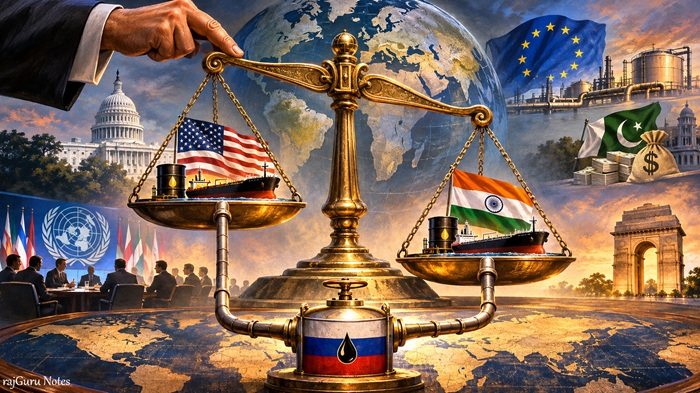
If purchasing Russian petroleum indirectly finances Moscow's military operations, does that economic relationship become morally acceptable when the buyer happens to be the United States? Why are India's commercial transactions subjected to geopolitical scrutiny while Pakistan continues receiving international financial assistance despite longstanding concerns about terrorist organizations operating from its territory? And, perhaps most importantly, who determines whether national interest is a legitimate justification for economic engagement with a controversial country?
These questions expose a fundamental contradiction in contemporary international relations: the tension between the universal principles powerful nations profess and the national interests they actually pursue.
The latest controversy surrounding President Donald Trump's Russian diesel agreement has brought that contradiction into particularly sharp focus.
When Russian Oil Becomes American Diesel
In August 2025, the Trump administration imposed an additional 25% tariff on Indian goods, bringing duties on some products to as much as 50%. Washington explicitly linked the punitive measure to India's continued purchases of Russian petroleum.
The argument was straightforward: India's energy payments provided revenue to Moscow, thereby indirectly sustaining Russia's military campaign against Ukraine.
White House trade adviser Peter Navarro publicly criticized India's Russian oil trade, while Treasury Secretary Scott Bessent questioned the commercial advantages Indian refiners derived from discounted Russian crude.
The underlying economic argument was not entirely unreasonable. Petroleum exports generate revenue for the Russian state, and those revenues contribute to the government's overall fiscal capacity, including military expenditure.
However, an important question arises when the country advancing that argument subsequently enters into its own petroleum arrangement with Russia.
In October 2026, Trump announced an agreement with Moscow involving substantial Russian diesel supplies to the United States.
According to Associated Press reporting, the arrangement contemplated more than 300,000 metric tons immediately, another 500,000 tons in November, approximately one million tons subsequently, and additional supplies thereafter. The US Treasury also issued a temporary authorization permitting specified Russian diesel transactions.
This was a significant reversal in American energy policy.
The distinction between an announced supply agreement and verified physical deliveries remains important. The available reporting establishes the agreement and regulatory authorization; it does not establish that every contemplated shipment had already arrived.
Nevertheless, the policy contradiction is substantial.
Washington had previously treated Russian petroleum purchases as grounds for penalizing India. Now, faced with domestic fuel-price pressures, the same administration was prepared to facilitate Russian diesel entering American markets.
Trump defended his decision by invoking American economic interests. Reuters reported that fuel prices had increased substantially following the US war against Iran and that the administration was seeking relief for consumers ahead of the November 2026 midterm elections.
The principle appeared to change when the economic consequences moved from New Delhi to Washington.
The relevant question is not whether America should protect its consumers. Every responsible government must consider energy affordability. It is whether India should be denied the same consideration. If energy security is a legitimate national priority for 340 million Americans, why should it cease to be legitimate for more than 1.4 billion Indians?
The Economics of India's Russian Oil Purchases
India's dependence on imported petroleum is a structural economic vulnerability rather than a diplomatic preference.
As one of the world's largest oil consumers and importers, India must continuously balance energy security, foreign-exchange expenditure, inflation, refinery economics, and geopolitical relationships.
Following Russia's invasion of Ukraine in February 2022, Western sanctions and declining European demand created opportunities for Asian refiners to purchase discounted Russian crude.
Indian companies increased their purchases substantially.
According to Reuters, Russia accounted for less than 1% of India's crude purchases before the war, but its share subsequently increased dramatically. By September 2025, India was importing approximately 1.62 million barrels of Russian crude daily, representing roughly one-third of its total petroleum imports.
The commercial logic was evident. Discounted crude could reduce import expenditure, improve refining economics, and help moderate domestic energy-price pressures. Moreover, India was not simply purchasing Russian petroleum to satisfy a geopolitical ambition. Its refiners were responding to the economics of international commodity markets.
During June 2026, disruptions affecting Middle Eastern supplies contributed to another increase in India's Russian crude purchases. Reuters, citing Kpler and LSEG shipping data, reported that Indian refiners received approximately 2.7 million barrels per day from Russia that month, accounting for more than half of India's crude imports.
The episode illustrated an uncomfortable reality: energy procurement cannot always be separated from international crises. India's dependence on imported petroleum makes diversification essential. Yet diversification also requires access to commercially viable supplies.
To argue that India should absorb substantial economic costs for geopolitical reasons while other countries invoke exceptions for their own consumers is to demand an unequal distribution of sacrifice.
Importantly, India's oil purchases were not equivalent to direct military assistance to Russia. They were commercial transactions that generated revenue for the Russian economy.
That distinction does not eliminate their possible contribution to Russia's war-financing capacity. It does, however, distinguish ordinary energy trade from the deliberate financing of military operations. The same distinction must apply to every country, including the United States.
Europe's Russian Energy Paradox
The contradictions are not confined to Washington. European governments have repeatedly emphasized the importance of reducing Russia's energy revenues. The European Union has introduced extensive restrictions on Russian petroleum and has sought to reduce its dependence on Russian natural gas. Yet the transition has been uneven.
According to the Centre for Research on Energy and Clean Air (CREA), the European Union remained the third-largest buyer of Russian fossil fuels in September 2026, accounting for approximately €1.7 billion in purchases.
The figures are revealing:
| European country | Russian fossil fuel imports, Sep 2026 |
| Hungary | €475 million |
| France | €446 million |
| Slovakia | €390 million |
| Bulgaria | €132 million |
| Netherlands | €116 million |
France's purchases consisted of liquefied natural gas, while Hungary and Slovakia continued importing Russian pipeline energy.
These figures require context. European countries have implemented significant sanctions, reduced several categories of Russian energy imports, and faced genuine infrastructure constraints in replacing pipeline supplies. Nevertheless, the continued transactions raise questions about the consistency of international pressure.
When European economies require Russian natural gas, policymakers recognize the practical difficulties of rapidly restructuring energy systems. When India requires Russian crude, the discussion frequently shifts toward the moral implications of supporting Moscow.
The distinction between energy security and geopolitical responsibility becomes difficult to defend unless the same principles are applied across countries.
There is another irony. CREA reported that refineries in India, Türkiye, and Brunei processing Russian crude exported approximately €1 billion worth of petroleum products to sanctioning countries in September 2026. That does not mean every importing country knowingly violated sanctions. Refined-product origin rules, trade restrictions, and refinery supply chains are complex. But it demonstrates how interconnected international energy markets remain, even amid geopolitical confrontation.
The modern petroleum economy does not operate according to neat ideological boundaries. Oil travels through tankers, refineries, trading houses, and international distribution networks. Its commercial identity can change through refining, even when its economic origins remain traceable.
The central contradiction is that countries seeking to restrict Russian energy revenues remain, in different ways and to different degrees, economically connected to Russian hydrocarbons. That reality makes selective pressure on India particularly contentious.
The Pakistan Question: Financial Assistance & Terrorism Concerns
An equally sensitive issue concerns America's relationship with Pakistan. For decades, India has raised concerns about terrorist organizations operating from Pakistani territory, including groups implicated in attacks against Indian civilians and security personnel. Pakistan's history of terrorist-financing deficiencies is documented internationally.
The Financial Action Task Force (FATF), the global body responsible for combating money laundering and terrorist financing, placed Pakistan under increased monitoring in 2018. Pakistan remained subject to enhanced scrutiny until October 2022, when FATF removed it from the monitoring list after recognizing progress in addressing identified deficiencies. This history provides a legitimate basis for continued scrutiny of Pakistan's counterterrorism enforcement. The question is whether international financing institutions apply sufficiently rigorous safeguards to ensure that assistance serves its stated purposes.
The IMF's multibillion-dollar financial assistance
In September 2024, the International Monetary Fund approved a 37-month, approximately $7 billion Extended Fund Facility arrangement for Pakistan. The program subsequently continued through additional reviews and disbursements.
On May 8, 2026, the IMF announced the completion of its third review under the Extended Fund Facility and second review under the Resilience and Sustainability Facility. These decisions permitted Pakistan to draw approximately $1.1 billion under the former and $220 million under the latter.
Meanwhile, the World Bank introduced a new ten-year Country Partnership Framework for Pakistan, associated with an anticipated $20 billion financing envelope. Its objectives include improving education, nutrition, climate resilience, energy infrastructure, and public-sector financial management.
The United States is the IMF's largest shareholder and exercises substantial influence over its governance. The financing arrangements raise a legitimate strategic question for India.
If Washington argues that money paid for Russian petroleum indirectly strengthens Moscow's military capabilities because government resources are fungible, should similar concerns about fiscal fungibility inform the oversight of assistance to countries facing documented terrorist-financing risks?
When National Interest Becomes a Selective Argument
The Russian diesel controversy illustrates a broader feature of international politics: governments frequently interpret economic obligations through the prism of domestic political pressures. Trump's October 2026 agreement provides a particularly instructive example.
According to Associated Press reporting, the average American diesel price was approximately $6.23 per gallon when the agreement was announced, after reaching $6.52 in September.
Trump emphasized lowering fuel prices for American farmers, truckers, and consumers. This was an economic justification. India's justification for purchasing Russian crude was also predominantly economic. Yet Washington's response to the two situations differed substantially.
The Council on Foreign Relations observed that Trump's diesel arrangement risked weakening Western economic pressure on Russia while potentially delivering limited relief to American consumers. Its analysis also highlighted concerns that the policy reversal could undermine coordination with European allies. The criticism was not confined to India or America's geopolitical competitors.
American lawmakers from both major political parties questioned the agreement, including its compatibility with legislation restricting Russian energy transactions. Ukraine's President Volodymyr Zelenskyy also condemned the arrangement, arguing that additional Russian energy revenues could prolong the war.
This is significant because the criticism reflects a concern shared by Ukraine itself: the economic consequences of purchasing Russian petroleum do not disappear when the purchaser changes. Washington can legitimately argue that exceptional circumstances justify temporary sanctions relief. But the credibility of that argument depends on acknowledging that other governments also confront exceptional circumstances. India's energy-security concerns cannot be dismissed merely because its economic interests differ from those of the United States.
The Moral Problem of ‘Selective’ Economic Sanctions
Economic sanctions are instruments of foreign policy rather than neutral moral judgments. They can seek to deter aggression, restrict access to military technology, impose economic costs, or encourage diplomatic negotiations. Their effectiveness depends on international cooperation, enforcement, market conditions, and the availability of substitutes. However, sanctions also create distributional consequences.
A wealthy economy with substantial domestic energy production may find it easier to reduce imports from a sanctioned country than a developing economy heavily dependent on imported fuel. Consequently, identical restrictions can impose radically different economic burdens.
For India, petroleum-price increases affect transportation, agriculture, manufacturing, household expenditure, and inflation. Higher fuel costs can also worsen the current account deficit and place pressure on public finances. These consequences matter because foreign policy is ultimately exercised within the constraints of domestic economic responsibility. This does not mean India should disregard the humanitarian consequences of Russia's war in Ukraine. Russia's invasion raises serious questions under international law, and Ukraine's sovereignty and territorial integrity deserve consideration. It means that international responsibility must be reconciled with the developmental needs of countries that did not initiate the conflict.
A more consistent approach would assess Russian energy transactions according to transparent criteria: their contribution to Russian revenues, the availability of alternative supplies, the humanitarian consequences of restrictions, and the feasibility of coordinated international action. Such criteria would apply equally to India, the United States, China, and European economies.
India's Strategic Autonomy Is Not a Diplomatic Privilege
India's foreign policy has historically emphasized strategic autonomy: the ability to pursue national interests without automatically subordinating its decisions to the preferences of competing global powers. This principle does not place India beyond criticism. Nor does it mean every Indian foreign-policy decision is necessarily correct. Rather, it recognizes that India must make difficult choices within a complex international environment.
India maintains important relationships with Russia, the United States, Europe, and countries across the Global South. Its defense requirements, energy dependence, technology ambitions, export markets, and geopolitical security concerns cannot be reduced to a single bilateral relationship.
The appropriate response to American pressure is neither automatic confrontation nor unquestioning compliance. It is disciplined diplomacy based on reciprocity. India can recognize legitimate American concerns about Russia's energy revenues while requesting consistency in the application of those concerns. It can strengthen energy diversification without accepting that its petroleum purchases are inherently less legitimate than those undertaken by Western countries. It can maintain a productive strategic partnership with Washington while insisting that disagreements be managed through negotiation rather than selective economic coercion. Above all, it can distinguish friendship from subordination. A strategic partnership between two sovereign democracies should permit disagreement without automatically converting disagreement into punishment.
Final Thoughts: The ‘Credibility of Power’ Depends on the ‘Consistency of Principle’
The controversy surrounding Russian petroleum is ultimately about something larger than crude oil, diesel, tariffs, or sanctions. It concerns the credibility of international leadership.
The United States possesses legitimate economic and security interests. It also has the sovereign authority to determine its trade policies, impose lawful restrictions, and advocate international action against Russia. India possesses corresponding interests and responsibilities. Neither country's national interests automatically override the other's.
The October 2026 Russian diesel agreement has created a particularly difficult question for Washington's diplomacy because it introduces an exception to the very economic pressure that the administration previously directed toward India.
Likewise, continued international financial assistance to Pakistan deserves transparent scrutiny, especially given the country's documented history of deficiencies in combating terrorist financing. But scrutiny must distinguish legitimate development assistance from actual support for terrorism. These distinctions are essential because credible criticism must rest on evidence rather than accusation.
The enduring lesson is that geopolitical principles acquire legitimacy through consistent application. A policy that recognizes energy security as essential for American consumers but treats comparable Indian concerns as unacceptable requires a convincing explanation. A financial system that emphasizes accountability must demonstrate that its safeguards operate irrespective of geopolitical alliances. And an international order that invokes universal standards must be prepared to subject powerful countries to those same standards.
The questions remain uncomfortable. Can Washington credibly demand reductions in Russian energy revenues while authorizing Russian diesel transactions for its own economic benefit?
Should international financial institutions strengthen safeguards when lending to countries with documented histories of terrorist-financing deficiencies?
Can Western governments reconcile their legitimate security concerns with the economic realities confronting developing countries?
And can India defend its strategic autonomy without disregarding the wider humanitarian consequences of international conflicts?
Perhaps the most important question is this: If national interest justifies an exception for a powerful country, on what principled basis can the same consideration be denied to another sovereign nation?
The answer will determine whether international economic diplomacy is governed by consistently applied rules, or by exceptions negotiated through power.
Illustration courtesy rajGuru Notes
07-Nov-2026
More by : P. Mohan Chandran
