Nov 14, 2026
Nov 14, 2026
Thirteen Diwalis, a Lifetime of Discipline,
and the Extraordinary Stamina of Narendra Modi
What drives a man who has spent more than two decades at the helm of government? What sustains his energy when most people his age have retired from demanding professional responsibilities? Why would a Prime Minister repeatedly choose remote military outposts over the comforts of celebrating Diwali at home? Is such conduct merely political symbolism, or does it reveal something deeper about leadership, discipline, and personal commitment? And why has Indian political discourse become so polarized that even acknowledging an opponent's admirable qualities can invite accusations of ideological allegiance?
These questions deserve consideration beyond the familiar divisions of Indian politics.
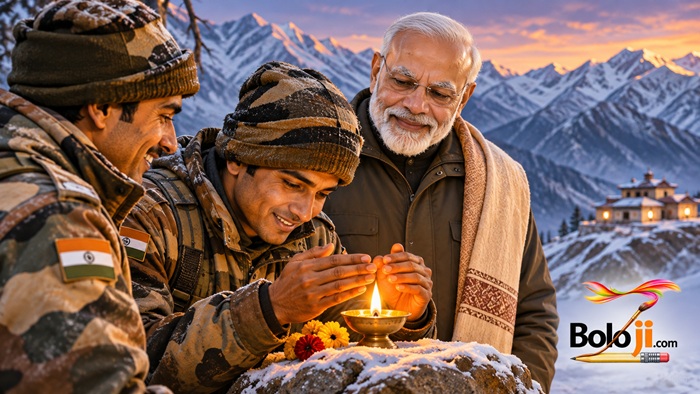
For some, Narendra Modi is an extraordinary leader who has transformed India's political landscape. For others, he is a deeply polarizing politician whose decisions, governance style, and ideological positions warrant rigorous scrutiny.
Both perspectives belong in a democracy.
Yet there is another dimension to Modi's public life that merits examination independently of electoral loyalties: his personal discipline, formidable political stamina, and deliberate practice of spending Diwali with India's armed forces.
It is a story that begins not in the corridors of Parliament, but in the unforgiving mountains of the Himalayas.
A Diwali Above the Clouds
October 23, 2014.
Across India, millions of homes were illuminated with oil lamps. Families gathered around festive meals. Children celebrated with fireworks. Temples reverberated with prayers, and the country embraced one of its most cherished festivals.
Thousands of kilometers away from the festivities, at the Siachen military complex in Ladakh, soldiers stationed in one of the world's most inhospitable military environments were preparing for another day of duty.
At such altitudes, the cold can be merciless. Oxygen is scarce. Snow and ice dominate the landscape, and even routine activities can become physically demanding.
For the soldiers deployed there, Diwali was another festival spent away from their families.
Then came an unusual visitor.
India's newly elected Prime Minister, Narendra Modi, had decided to spend part of his first Diwali in office with the soldiers stationed in the Siachen region.
There were no elaborate family celebrations awaiting him at the military post. No festive gathering of political dignitaries. No comfortable drawing room filled with relatives exchanging sweets.
Instead, there were soldiers wearing heavy winter clothing, surrounded by a landscape that seemed almost indifferent to human existence. Modi greeted the personnel, interacted with them, and shared the occasion. It was a powerful gesture.
A Prime Minister could have sent a message from New Delhi. He could have addressed the armed forces through television. He could have offered ceremonial greetings from the comfort of his official residence. Instead, he traveled to the mountains. That decision established a pattern that would become one of the most recognizable traditions of his prime ministership.
But the significance of the visit was not that a political leader had endured a few hours of discomfort. The soldiers endured those conditions for weeks and months. The significance was that the country's highest elected executive had chosen to acknowledge their sacrifices through his physical presence.
Leadership is not always about sharing another person's suffering. Sometimes, it begins with demonstrating that their suffering has not been forgotten.
Thirteen Diwalis, Thirteen Different Landscapes, One Remarkable Tradition
What began at Siachen in 2014 did not remain an isolated gesture. Over the following twelve years, Modi repeatedly traveled to military installations and security-force outposts across India during Diwali. The geography changed. The uniforms changed. The operational challenges changed. But the underlying message remained remarkably consistent.
The chronology is supported by government records and contemporary reporting.
Thirteen consecutive Diwalis. Thirteen different occasions. From snow-covered mountains to scorching deserts, from contested borders to the open ocean, and finally to the forests of central India. The pattern is difficult to dismiss as an accidental feature of his schedule. It represents a consciously cultivated leadership tradition. And traditions, when sustained consistently, often communicate more powerfully than speeches.
The Aircraft Carrier That Became a Diwali Destination
October 20, 2025.
The Arabian Sea stretched toward the horizon. Aboard INS Vikrant, India's first indigenously built aircraft carrier, naval personnel were carrying out their professional responsibilities far from their families.
The carrier, commissioned in September 2022, represented a major achievement in India's indigenous defense manufacturing capabilities.
Built by Cochin Shipyard Limited, the approximately 45,000-ton warship symbolizes India's ambition to strengthen its maritime security and technological self-reliance.
For Modi, the 2025 Diwali celebration aboard Vikrant carried two messages. The first was personal: recognition of sailors who spend extended periods away from their families. The second was strategic: the growing importance of maritime security to India's economic and geopolitical interests.
In his address, Modi emphasized the Indian Ocean's importance to global commerce, citing its role in transporting substantial portions of the world's oil and containerized trade.
Those figures, like other strategic statistics, depend on the geographical boundaries and measurement methods used. Nevertheless, the underlying reality is indisputable: India's maritime security is intimately connected with international trade, energy supplies, and economic stability.
The symbolism of the occasion was unmistakable. An aircraft carrier is not a luxury cruise ship. It is a floating military airbase designed for complex combat operations. Its personnel work in a demanding environment where operational readiness, technical precision, and collective discipline are indispensable.
The Prime Minister's visit did not make their responsibilities easier. But it publicly acknowledged their importance. There is a distinction worth emphasizing here.
A political leader's presence at a military installation does not automatically establish superior patriotism. However, repeatedly making the effort to recognize military personnel can demonstrate a meaningful commitment to public acknowledgment of their service.
That distinction allows appreciation without surrendering critical judgment.
Bastar 2026: From ‘Defending Borders’ to ‘Securing the Interior’
The thirteenth Diwali celebration was particularly significant because its setting differed from most earlier visits.
On November 8, 2026, Modi traveled to the CoBRA operations base at Karanpur in Bastar. CoBRA, or Commando Battalion for Resolute Action, is a specialized unit of the Central Reserve Police Force trained for operations in difficult terrain, particularly against Maoist insurgents.
For decades, parts of central India experienced violence associated with the Maoist insurgency. Security personnel operated in dense forests, faced improvised explosive devices, and confronted an adversary familiar with the local geography.
The conflict also imposed substantial human costs on civilians, including displacement, disrupted livelihoods, and restricted access to public services.
According to the Prime Minister's Office, Modi used the 2026 Diwali visit to recognize the contribution of security forces to the government's campaign against Maoist violence. He declared that the country had reached a historic milestone in overcoming the insurgency.
Such declarations should be assessed against independent security data and the durability of peace on the ground. A reduction in insurgent violence, however substantial, must not be confused with the automatic resolution of the socioeconomic grievances that can sustain internal conflict. Nevertheless, the choice of Bastar was symbolically significant.
Modi was acknowledging that national security does not end at the international border. It also involves protecting citizens from violence within the country. During the visit, he distributed sweets to security personnel and expressed gratitude for their sacrifices.
The Prime Minister's Office recorded his message: “Diwali is sweeter with those who protect us!” The statement was simple, but its emotional appeal was unmistakable.
For personnel deployed in remote operational areas, recognition from the country's political leadership can have considerable symbolic value. Yet the most meaningful measure of national gratitude must extend beyond ceremonial visits.
It must include adequate equipment, dependable medical support, family welfare, appropriate compensation, rehabilitation, and sustained institutional care for veterans and the families of personnel killed in service.
A box of sweets is a gesture of appreciation. A functioning welfare system is evidence of institutional commitment. A responsible nation should provide both.
Seventy-Six Years Old, Twenty-Five Years in Government:
Where Does the Energy Come From?
Narendra Modi was born on September 17, 1950. As of November 2026, he is 76 years old. He became Chief Minister of Gujarat in October 2001 and Prime Minister of India in May 2014. Consequently, he has completed approximately 25 years in executive leadership at the state and national levels. These dates are verifiable through his official parliamentary biography.
Twenty-five years is a considerable period to occupy demanding executive positions. Political leadership involves more than delivering speeches or attending ceremonial functions. It requires continuous engagement with competing administrative priorities, political negotiations, security briefings, economic developments, international diplomacy, and unforeseen crises. The demands are especially significant in a country of India's population, geographical diversity, and institutional complexity.
Modi's public schedule has frequently included extensive domestic travel, international diplomatic engagements, election campaigning, and major government events. His official biography also identifies yoga as part of his daily routine. However, one popular assertion requires qualification.
The claim that Modi has taken “not a single day of leave” should not be treated as independently established proof that he has never rested, taken personal time, or temporarily reduced his workload. Official leave records, public appearances, and actual hours worked are different measures. Likewise, the physical and psychological effects of his schedule cannot be established without reliable medical and occupational information. What can reasonably be concluded is that Modi has maintained a conspicuously active public and political career well into his seventies. That is a legitimate subject of admiration, irrespective of political affiliation.
But there is an important lesson here. The true measure of discipline is not simply how long a person works. It is how consistently that person converts effort into meaningful results.
Endurance is admirable. Effectiveness is essential. And sustainable leadership requires both.
The Politics of Appreciation:
Why Must Every Compliment Become an Ideological Declaration?
Imagine a conversation between two Indians. One says, “I disagree with Modi's economic policies.” The other responds, “But his energy and discipline are impressive.” Immediately, the conversation becomes adversarial.
The first is accused of being anti-Modi. The second is labeled an Andhbhakt, or blind devotee. Neither accusation necessarily follows from what was said. This is one of the more unfortunate consequences of contemporary political polarization.
Public figures increasingly become objects of either unconditional admiration or categorical rejection. Their actions are judged not merely on their merits, but through the ideological identities assigned to them.
A person who admires Modi's discipline is assumed to endorse every government decision. Someone who criticizes his policies is presumed incapable of appreciating his personal qualities. Both assumptions are intellectually indefensible.
Political judgment should not operate like a loyalty oath. It should permit discrimination between strengths and weaknesses, achievements and failures, intentions and consequences.
One can admire Modi's stamina while questioning his economic decisions. One can appreciate his recognition of soldiers while demanding greater accountability for defense preparedness. One can acknowledge his political communication skills while criticizing aspects of his government's institutional conduct. These positions are not contradictory. They represent the very essence of independent judgment.
Admiration becomes blind devotion only when it refuses to recognize shortcomings. Criticism becomes prejudice when it refuses to acknowledge strengths. A mature democracy needs citizens capable of both.
Patriotism Is Not the Monopoly of Any Political Leader
The original argument surrounding Modi's Diwali celebrations often invites comparisons with previous prime ministers. Such comparisons deserve caution.
India has been led by prime ministers who served during wars, economic emergencies, political instability, and profound national crises.
Their leadership records can and should be scrutinized, but their patriotism cannot be measured simply by comparing the number of Diwalis they spent at military installations.
Nor does a disputed account of a former leader's travel arrangements justify characterizing every previous prime minister as someone who demanded royal comforts. Such sweeping comparisons weaken an otherwise compelling argument about Modi's personal discipline.
A leader's patriotism should be evaluated through a combination of intentions, decisions, constitutional conduct, institutional responsibility, and measurable outcomes. Ceremonial gestures can reinforce those qualities. They cannot substitute for them.
The same principle applies to Modi. His repeated Diwali visits are worthy of recognition on their own merits. They do not require the denigration of his predecessors to become meaningful.
The Leadership Principle: Showing Up Matters
There is an enduring principle of leadership that transcends politics. People are more likely to feel recognized when their leaders make the effort to meet them in the environments where they work.
A chief executive who visits a factory floor may better appreciate operational difficulties. A hospital administrator who interacts with nurses during night shifts may develop a clearer understanding of staffing pressures. A university vice-chancellor who spends time with teachers and students may discover problems that never appear in formal reports.
Similarly, a prime minister who visits military personnel at remote installations can obtain direct exposure to the environments in which they serve.
Of course, high-level visits are carefully organized. They involve extensive security arrangements and logistical support. They cannot be equated with the daily hardships endured by soldiers.
Nevertheless, the act of appearing in person carries symbolic significance. It communicates that the work being performed is worthy of the leader's attention. Modi appears to understand this dimension of political leadership particularly well. His Diwali visits also illustrate the power of repetition in building a recognizable leadership identity.
One visit might attract attention. Two visits might establish a preference. Thirteen consecutive visits create a tradition. The tradition, in turn, becomes part of the leader's public identity.
Political communication scholars would recognize this as a form of symbolic leadership: the use of visible, repeated actions to reinforce particular values and associations.
Critics may reasonably argue that such appearances also produce political dividends. Indeed, they probably do. But political benefit and sincere appreciation are not necessarily mutually exclusive.
A public act can communicate gratitude while simultaneously strengthening a leader's public image. The challenge is to evaluate both dimensions without automatically reducing one to the other.
The Difference Between ‘Personal Commitment’ and ‘Public Accountability’
There is, however, a deeper question. Can a leader's personal commitment become so central to public discourse that it overshadows the performance of the institutions he leads? This possibility deserves serious attention.
Modern democracies are not intended to function through the extraordinary endurance of a single individual. They depend upon resilient institutions, competent administrators, transparent procedures, and effective systems of accountability.
A prime minister may possess remarkable stamina. But the quality of governance ultimately depends on the performance of ministries, public institutions, regulatory bodies, security agencies, and administrative machinery.
Personal discipline is an asset. Institutional effectiveness is the objective. This distinction becomes especially important when assessing leaders who cultivate strong personal identities.
The danger is not admiration itself. The danger arises when admiration becomes a substitute for evaluation.
A citizen should be able to say that Modi's commitment to visiting soldiers is impressive while simultaneously asking whether defense personnel receive adequate equipment, whether veterans' grievances are addressed promptly, and whether military modernization is proceeding efficiently.
Similarly, appreciating his demanding public schedule should not prevent scrutiny of employment generation, economic growth, social cohesion, public expenditure, or institutional independence. These are not expressions of disloyalty. They are obligations of democratic citizenship.
The highest form of respect for a political leader is not unquestioning obedience, but holding that leader to the standards his office demands.
The Soldiers Who Deserve the Greater Applause
There is another dimension to the Diwali story that deserves even greater attention. Every year, when photographs emerge of Modi interacting with soldiers, public discussion inevitably focuses on the Prime Minister. His clothing is analyzed. His speeches are debated. His gestures become political talking points. His supporters celebrate his presence, while critics examine the political messaging.
Yet the central figures in these photographs are not necessarily the politicians. They are the soldiers. Consider the young officer stationed at a remote Himalayan post. He may have parents waiting for him hundreds of miles away. His children may be celebrating Diwali without him. His spouse may be managing the household alone. The soldier's absence is not an occasional inconvenience. It is part of the professional and personal sacrifice associated with military service.
Consider the naval sailor aboard an aircraft carrier. For him, Diwali may be another operational day at sea.
Or consider a CoBRA commando deployed in a forest region where the possibility of an ambush or explosive device requires constant vigilance. These individuals do not receive the same public attention as political leaders. Yet their responsibilities are continuous.
The Prime Minister's visit lasts hours. Their duty continues after his departure. This does not diminish Modi's gesture. It places that gesture in its proper perspective.
The greatest value of a prime ministerial Diwali visit is not that it demonstrates the leader's willingness to travel. It is that it reminds the nation of the sacrifices made by those who cannot travel home.
The soldiers are not supporting characters in the Prime Minister's story. They are the reason the story matters.
Final Thoughts: Respect Without Blindness, Criticism Without Hatred
Thirteen Diwalis. From Siachen to Bastar. From Himalayan outposts to the deck of INS Vikrant.
At 76, Narendra Modi continues to maintain an active public schedule and a tradition of celebrating Diwali with personnel serving in difficult and often dangerous environments. That consistency is worthy of acknowledgment.
His 25 years in executive government also demonstrate unusual political longevity. But political longevity is not synonymous with flawless governance, just as physical stamina is not proof of infallible judgment.
The strongest appreciation of Modi is one that does not depend upon exaggeration. There is no need to claim that he has never rested. There is no need to portray every previous prime minister as indifferent to soldiers. There is no need to assume that every public appearance is entirely devoid of political calculation. And there is certainly no need to insist that someone who admires Modi's discipline must endorse every decision he makes.
His record of Diwali visits is sufficiently distinctive to stand on its own. It illustrates consistency, the political importance of symbolism, and a sustained effort to recognize India's security personnel. More importantly, it provides an opportunity to reconsider the impoverished quality of contemporary political discourse.
A democracy should not force its citizens to choose between unconditional admiration and uncompromising hostility. It should encourage them to recognize merit wherever it exists and demand accountability wherever it is necessary.
One may disagree with Modi's policies without dismissing his discipline. One may appreciate his energy without endorsing his ideology. One may admire his commitment to visiting soldiers without assuming that every government decision is beyond criticism. And one may recognize his contribution to public life without declaring him incapable of error.
Respect is not surrender. Appreciation is not allegiance. And independent judgment is not disloyalty.
Perhaps that is the most important lesson of this extraordinary Diwali tradition. The story is not merely about a 76-year-old Prime Minister who continues to travel across India. It is also about the soldiers who remain at their posts when the rest of the country celebrates, the responsibilities that accompany public office, and the maturity required to appreciate a leader without idolizing him.
The next time photographs emerge of Modi celebrating Diwali with India's security personnel, perhaps the public conversation should move beyond the familiar accusations of Andhbhakt and political opportunism. Perhaps we should ask more meaningful questions.
Can we appreciate a political opponent's admirable qualities without compromising our convictions? Can we distinguish personal discipline from governmental performance? Can our admiration for a leader coexist with rigorous scrutiny of his decisions? Can we celebrate symbolic gestures while demanding substantive improvements in the welfare of our armed forces? And, above all, can we develop the intellectual maturity to recognize that patriotism belongs neither to one political party nor to one individual, but to every citizen who sincerely serves the nation?
The answers will reveal something important not only about Narendra Modi, but also about the quality of India's democratic culture.
For ultimately, the greatness of a democracy is not measured by how passionately its citizens worship their leaders. It is measured by how intelligently they evaluate them.
14-Nov-2026
More by : P. Mohan Chandran
