Nov 20, 2026
Nov 20, 2026
Did Modi Outmaneuver Trump's Tariff Threat?
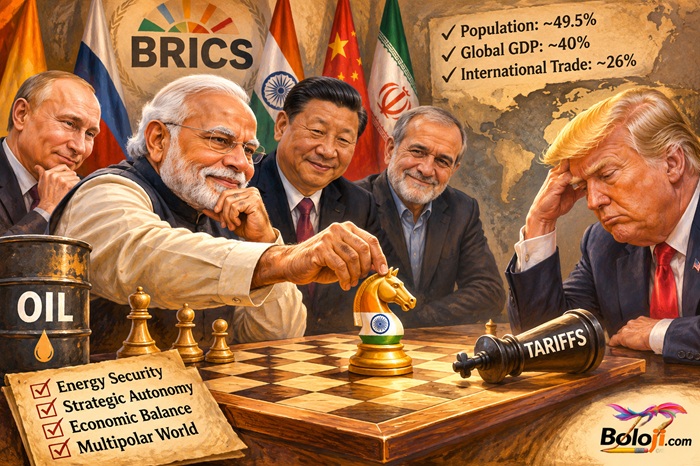
When Washington threatened economic punishment, New Delhi chose strategic patience. Was Trump's retreat merely another diplomatic compromise, or did India demonstrate that geopolitical intelligence can sometimes be more powerful than economic coercion?
The Meeting That Changed the Conversation
September 12, 2026.
New Delhi.
Inside the BRICS Summit, four powerful political figures occupied the same diplomatic stage.
Narendra Modi. Vladimir Putin. Xi Jinping. Masoud Pezeshkian.
Four leaders representing countries with different interests, competing ambitions, and complicated relationships with Washington. Outside the conference halls, another powerful figure loomed over their deliberations.
Donald Trump.
His weapon was not a missile, aircraft carrier, or nuclear submarine.
It was a tariff.
Washington had threatened severe economic penalties against countries purchasing Russian energy. The possibility of tariffs reaching 100% had become another instrument in America's campaign to pressure Moscow.
But something interesting happened.
On October 19, Reuters reported that Trump had waived key Russia-related sanctions and tariffs, easing India's energy concerns and improving prospects for a bilateral trade agreement.
The threat had not disappeared from American foreign policy. But an important instrument of economic coercion had been withdrawn.
Why?
Was it diplomacy? Economic necessity? American domestic politics? Or had India quietly demonstrated that threatening a major emerging economy could produce consequences Washington preferred to avoid?
And somewhere in this geopolitical drama lies a fascinating question.
Did Trump change his mind, or did the strategic environment change his calculations?
The ‘Chessboard’ Behind the ‘Conference Table’
The BRICS Summit was real. So were the geopolitical tensions. The September 12–13 meeting brought together leaders representing an increasingly influential grouping of emerging economies. According to India's Ministry of External Affairs, BRICS countries collectively account for approximately 49.5% of the world's population, 40% of global GDP, and 26% of international trade.
These figures require attention.
BRICS is not a military alliance. Nor is it a unified economic bloc capable of dictating international policy. Nevertheless, it represents an enormous concentration of consumers, producers, energy resources, manufacturing capabilities, and geopolitical influence.
Individually, these countries have vulnerabilities. Collectively, their economic significance makes confrontation considerably more complicated. And this is where Modi's diplomatic approach becomes interesting.
India has maintained relationships with Russia while strengthening its strategic engagement with the United States. It has competed with China while preserving channels for diplomatic dialogue. It has maintained ties with Iran while deepening relationships with Israel and the Gulf monarchies.
This is not necessarily ideological inconsistency. It is strategic autonomy. And strategic autonomy becomes particularly valuable when great powers begin demanding exclusive loyalties.
The Oil Weapon: Why Washington Cannot Ignore Energy Prices
Imagine a hypothetical conversation among geopolitical strategists.
One asks: What happens if Russian oil supplies contract significantly?
Another responds: Global energy markets become nervous.
What happens if tensions simultaneously threaten shipping through the Strait of Hormuz? Oil prices could rise further. And what happens when American motorists begin paying more for gasoline? The consequences can become political.
This hypothetical illustrates the economic pressures confronting any American administration attempting to weaponize energy sanctions.
Oil is not an ordinary commodity. It influences transportation, agriculture, manufacturing, aviation, logistics, and household expenditure. A sudden increase in crude oil prices can spread through entire economies. The Strait of Hormuz is particularly significant because it connects major Gulf energy producers with international markets.
The US Energy Information Administration has estimated that approximately one-fifth of global petroleum liquids consumption passes through this strategic waterway. Any sustained disruption therefore threatens far more than the countries directly involved. It can affect inflation, business confidence, and economic growth across continents.
Now consider Trump's political circumstances. An administration confronting voters over living costs must consider the consequences of policies that could increase energy prices. This does not establish that Modi orchestrated an oil-market squeeze. No credible public evidence establishes the alleged instructions to Iran and Russia. But it reveals an important strategic reality.
Economic sanctions are not costless weapons. Their consequences can return to the country imposing them. That is the paradox of economic coercion in an interconnected world.
Why Trump's ‘Retreat’ Matters
Reuters reported on October 19 that Trump's decision to waive key Russia-related sanctions and tariffs had reduced pressure on India's energy security. The report also quoted US Secretary of State Marco Rubio indicating that bilateral trade negotiations were very close to an agreement and that those negotiations had influenced the waiver decision. This is an important distinction.
The available evidence supports a diplomatic and economic explanation for the American decision. It does not establish a secret agreement among Modi, Putin, Xi, and Pezeshkian. Nevertheless, the outcome deserves analysis.
These objectives could not necessarily be pursued simultaneously without compromise.
India's importance to American strategic interests complicated Washington's ability to treat New Delhi merely as another sanctions target. This is where economic size becomes diplomatic leverage. A country that is economically insignificant can be pressured relatively easily. A country whose market, manufacturing potential, technology partnerships, and geopolitical position are important to American interests presents a different calculation.
India was not negotiating from a position of complete dependence.
Neither was Washington.
The resulting compromise reflects the realities of interdependence.
The ‘Chanakyan’ Dimension: Winning Without Confrontation
Centuries before modern international relations became an academic discipline, Kautilya examined how rulers could preserve their interests in a world characterized by competing kingdoms, uncertain alliances, and shifting balances of power. His Arthashastra emphasized intelligence, diplomacy, economic resources, alliances, and the careful assessment of relative power.
Its enduring insight is not that rulers should deceive everyone. It is that effective statecraft requires understanding the interests and vulnerabilities of other political actors.
Consider India's position. Confronting Washington directly over every disagreement would impose substantial diplomatic and economic costs. Abandoning Russia merely to satisfy American pressure could undermine India's defense and energy relationships. Aligning unconditionally with China would contradict India's strategic interests. And treating Iran exclusively through the prism of American foreign policy could constrain India's regional options.
Modi's government has instead pursued relationships across competing geopolitical camps. This approach does not guarantee success. But it preserves choices. The country with more credible options generally possesses greater negotiating leverage than the country dependent on a single partner. This is the essence of strategic autonomy. Not neutrality. Not indecision. Not opportunism without principles. Rather, the deliberate preservation of national decision-making space.
In business strategy, companies call this reducing concentration risk.
In international relations, it is a form of strategic hedging.
Kautilya would certainly have recognized the logic.
The Gujarati ‘Commercial Instinct’
There is another interesting dimension to Modi's political style. He comes from Gujarat, a region with a long commercial history extending through Indian Ocean trading networks, merchant communities, maritime commerce, and entrepreneurial enterprises. Gujarati commercial culture has historically emphasized negotiation, adaptability, networks, and the management of business risk. However, diplomatic skill cannot be explained by regional identity alone.
The more meaningful parallel is between commercial negotiation and international diplomacy.
A successful negotiator does not merely ask what he wants.
He asks what the other party needs.
What does Washington want from India? Market access, investment, technological cooperation, defense partnerships, and strategic collaboration in the Indo-Pacific.
What does India want from Washington? Technology, investment, market opportunities, security cooperation, and a predictable trading relationship.
What does Russia want? Energy customers, diplomatic engagement, and economic relationships despite Western sanctions.
The strategic challenge is to identify overlapping interests without surrendering essential national priorities.
This resembles a sophisticated commercial negotiation. And perhaps that is the more useful interpretation of the much-discussed Gujju mind. Not an ability to manipulate world leaders through secret conversations. But an instinct for recognizing that every negotiation contains multiple currencies of exchange. Sometimes the currency is money. Sometimes it is energy. Sometimes it is technology. And sometimes it is geopolitical relevance.
The India That ‘Refused to Stop’
While geopolitical tensions intensified, India's economy continued expanding. According to the Ministry of Statistics and Programme Implementation,
These are quarterly figures, not full-year growth estimates. Nevertheless, they demonstrate considerable economic momentum amid global uncertainty.
India also remains one of the world's largest crude oil importers. Its energy security therefore depends on reliable supplies, competitive prices, diversified sourcing, and effective management of geopolitical risks.
Maintaining economic growth while navigating sanctions, trade disputes, and regional conflicts is not a trivial achievement. But economic resilience should not be confused with economic invulnerability. India remains exposed to imported energy inflation, external demand shocks, currency volatility, and disruptions in international supply chains. The real test of national strength is not whether a country avoids every external shock. It is whether its institutions and policies can absorb those shocks without derailing long-term development. India's experience offers encouraging evidence, although the structural vulnerabilities remain significant.
The ‘Uncomfortable Question’: Who Actually Won?
It is tempting to declare that Modi defeated Trump. But international diplomacy rarely produces victories as simple as a cricket scoreboard. Trump obtained additional time to assess sanctions. India obtained relief from an immediate economic threat. Russia benefited from the postponement of punitive measures. American businesses gained a better prospect of concluding a trade agreement with India. But Ukraine's position became more precarious.
Reuters reported that tensions between Washington and Kyiv had intensified, with disagreements over Ukrainian attacks on Russian energy infrastructure, disruptions affecting satellite communications, and American efforts to pursue arrangements involving Russian diesel. These developments raise serious questions about the distribution of geopolitical costs.
If Washington relaxes economic pressure on Moscow while Ukraine continues facing Russian military attacks, the strategic consequences extend far beyond tariff negotiations. One country's diplomatic flexibility can become another country's strategic vulnerability. Therefore, the outcome cannot be judged exclusively through India's interests. Nor can temporary tariff relief be mistaken for a permanent settlement.
On October 17, Rubio indicated that Trump intended to use up to 60 days to assess the economic consequences of Russia-related sanctions and tariffs. The decision was a pause, not necessarily a final retreat. And that distinction matters.
Psychological Warfare: The Art of Making the Opponent Reconsider
One of the most effective forms of strategic influence does not involve forcing an adversary to surrender. It involves making the adversary reconsider whether confrontation serves his own interests.
Trump's political identity rests heavily on negotiation, tariffs, economic pressure, and the projection of American strength. But every negotiating strategy has limitations. Threatening tariffs against a major trading partner may create leverage. Actually implementing those tariffs can produce economic consequences that undermine the original objective.
The distinction resembles a familiar business negotiation. A company threatens to terminate its relationship with a critical supplier unless prices are reduced. The supplier refuses to concede immediately. The company then discovers that replacing the supplier would disrupt production, increase costs, and damage customer relationships. Suddenly, compromise becomes attractive. The supplier has not defeated the company. It has demonstrated that the relationship possesses mutual value.
India's diplomatic position contains a similar logic. Washington can exert considerable economic pressure on New Delhi. But Washington also has strategic reasons to preserve the relationship. The more India strengthens its economic capabilities, diversifies its international partnerships, and develops domestic technological and industrial capacity, the more credible its negotiating position becomes. That is how economic development translates into geopolitical influence.
Final Thoughts: The Difference Between ‘Playing Chess’ and ‘Owning the Chessboard’
Did Narendra Modi secretly persuade Iran to tighten the Strait of Hormuz, Russia to restrict oil production, and China to coordinate an economic trap for Donald Trump? There is no verified public evidence establishing such a conspiracy. The colorful conversations circulating in the original narrative should therefore be understood as political storytelling, not documented history. But dismissing the entire episode because its dramatic details are unverified would overlook a more consequential development.
India has become important enough that major powers must increasingly account for its interests. That is a substantial geopolitical achievement.
Yet none of this means India can disregard American pressure, ignore Chinese competition, or remain unaffected by global energy disruptions. Strategic autonomy must be earned continuously through economic strength, diplomatic credibility, military preparedness, technological capability, and institutional resilience.
Modi deserves scrutiny for his policies, just as every democratic leader does. Where his government has successfully expanded India's diplomatic options, that achievement deserves recognition. Where outcomes remain uncertain, triumphalism should give way to careful evaluation. Perhaps the most important lesson from this episode is not that Modi outsmarted Trump through an elaborate secret plan. It is that India increasingly possesses the economic and diplomatic relevance to influence how other countries calculate their interests.
Kautilya understood that power was not merely the capacity to punish an opponent. It was also the ability to shape the circumstances under which the opponent made decisions. And therein lies the real significance of India's emerging geopolitical position.
The most sophisticated chess player does not necessarily capture the opponent's king. Sometimes, he creates a position in which the opponent decides that continuing the attack is no longer worth the cost.
Whether that fully explains Trump's decision remains unproven. But the broader lesson is unmistakable. A nation becomes powerful not when it can threaten everyone, but when others discover that ignoring its interests is no longer an affordable option. That is the India worth building. And that is the New Bharat worth understanding.
Bharat Mata Ki Jai!
21-Nov-2026
More by : P. Mohan Chandran
