Nov 21, 2026
Nov 21, 2026
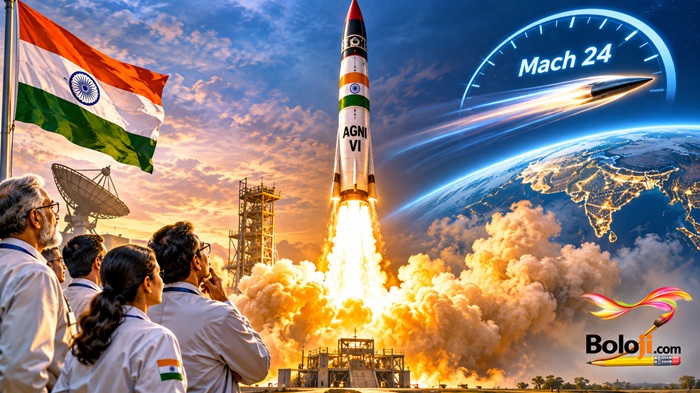
Can a missile change India’s place in the world before India has publicly confirmed its first flight? What does Mach 24 tell us about the destructive power of a nuclear weapon? If India already possesses the means to deter a nuclear adversary, what would a longer-range Agni add? And when Indians speak with pride about how far a missile might travel, do we give equal thought to how far the consequences of its use would reach?
On April 30, 2026, Samir V. Kamat, chairman of India’s Defence Research and Development Organisation (DRDO), gave a revealing answer to a question about Agni-VI. His organization was ready to proceed, he said, once the government made its decision. Eight days later, India successfully tested what the Ministry of Defence called an “Advanced Agni missile.” The announcement confirmed a trial involving multiple re-entry vehicles.
What India Has Already Demonstrated
Consider what happened off the Odisha coast on March 11, 2024. During Mission Divyastra, Indian radar and telemetry stations tracked multiple re-entry vehicles released in the first flight test of an indigenously developed Agni-V equipped with MIRV technology. The acronym stands for multiple independently targetable re-entry vehicles. In plain English, one missile can carry several vehicles intended for different destinations. The government reported that the mission met its objectives. It did not disclose an operational warhead count.
That achievement built on a documented foundation. In October 2021, the Ministry of Defence described Agni-V as a three-stage, solid-fueled ballistic missile with a range of up to 5,000 kilometers. In May 2026, the ministry confirmed a further Advanced Agni trial with a multiple-re-entry system. Read the announcements in sequence and an important feature of Indian technological progress emerges. Indian scientists have demonstrated advances in range and in the complexity of what a missile can carry. Each achievement has a date, an identified test, and an official account against which a claim can be checked.
What, then, can reasonably be said about Agni-VI itself? The distinguishing ambition most consistently associated with it is intercontinental reach beyond Agni-V. Multiple-warhead capability is a plausible expectation because India has tested the underlying technology. The proposed successor’s actual range, payload configuration, speed, and service timetable remain publicly unverified. One telling example is a 2019 newspaper clipping archived on DRDO’s own website. The article explicitly characterized its specifications as speculative. A government agency can archive a newspaper without certifying the newspaper’s claims.
What Mach 24 Would Actually Mean
Mach 24 means 24 times the local speed of sound. The word local matters because the speed of sound changes with atmospheric conditions, particularly temperature. Equally important is the point in flight at which a speed is measured. A figure recorded during one portion of a ballistic flight cannot simply be applied to the entire journey. Converting an unattributed Mach number into an exact arrival time lends an uncertain claim several decimal places of undeserved authority.
Even if a future test verifies Mach 24, the number will answer a narrow question about velocity. It will tell us little by itself about explosive yield, the reliability of the entire system, or the judgment of the people authorized to use it. Speed matters politically because leaders who believe they have little time to assess an alarming report may feel pressure to act before they understand it. The most consequential minutes in a nuclear crisis may be the ones a prime minister spends asking whether the first report is accurate.
Would Agni-VI Change India’s Global Standing?
India is already on the global nuclear map. The Stockholm International Peace Research Institute (SIPRI) estimated that in January 2026 India possessed 190 nuclear warheads, compared with 170 for Pakistan and up to 620 for China. Russia and the United States together held nearly 86 percent of the world’s nuclear inventory. These are independent estimates, and a warhead count alone is a poor measure of security. They do, however, expose a flaw in the idea that India needs a Mach 24 missile to enter the company of nuclear powers. It already belongs to that small group.
What a verified intercontinental successor could change is the calculation of a government considering nuclear coercion against India. Deterrence rests on a judgment made in another capital. Would an attack leave India capable of responding? Does its leadership have the political resolve to do so? Would any conceivable gain justify the consequences? Greater reach could strengthen India’s answer where distance presently creates doubt. Indigenous development would also carry diplomatic weight. A country that commands the relevant science can make a consequential defense decision on its own terms, including the decision to defer it.
There are limits to that argument. India’s stated policy of credible minimum deterrence requires policymakers to give the word minimum some practical meaning. China’s larger arsenal is relevant to India’s security, but its size supplies no automatic answer to how many weapons India needs. Nor would an additional kilometer of range necessarily produce an additional kilometer’s worth of security. The strongest case for Agni-VI would identify a gap in India’s ability to deter coercion and explain how the successor closes it. National prestige alone is an expensive reason to commission a strategic weapon.
The Reach of the Destruction
To understand what nuclear lethality means, consider one number from Hiroshima that rarely appears in missile debates. Of the 298 physicians in the city when the atomic bomb fell, 270 were themselves exposed. A prefectural reconstruction study records that many patients consequently went without medical treatment. Hiroshima estimates that roughly 140,000 people had died by the end of December 1945, out of a population of approximately 350,000 at the time of the bombing. The months between August and December belong in that sentence. For thousands of families, the catastrophe was still unfolding long after the aircraft had gone.
Hiroshima offers no numerical forecast for Agni-VI. It illuminates something more fundamental about nuclear destruction. An ordinary disaster creates demand for doctors, hospital beds, transport, and clean water. A nuclear explosion can destroy the people and institutions that supply them at precisely the moment demand becomes overwhelming. A missile’s range can be marked neatly on a map. The death of a physician who might have treated hundreds of survivors has no equally tidy boundary.
The consequences could also reach people living far outside the countries at war. In 2022, researchers led by Lili Xia published a Nature Food study modeling how soot from a nuclear conflict could alter climate and food production. In one modeled India–Pakistan war scenario, the authors estimated that more than two billion people could die as food supplies collapsed. That is a conditional result for an exchange involving many weapons. Its scale depends on assumptions about soot, climate, harvests, and access to food. Attributing it to one Agni missile would misrepresent the research. Its genuine warning is sobering enough. A family far removed from South Asia could suffer through the price and availability of its next meal.
Final Thoughts
One of South Asia’s most consequential missile agreements contains no promise to give up missiles. In 2005, India and Pakistan agreed to notify each other ahead of specified ballistic missile flight tests. The achievement was modest and practical. A government observing a launch would have information it could use to distinguish a scheduled test from a possible attack. That agreement deserves a place alongside Mission Divyastra in any serious account of Indian strategic capability. One achievement demonstrated what Indian scientists could accomplish. The other showed what Indian diplomacy could do with an adversary’s fear.
My view is that a successfully tested Agni-VI could strengthen India’s strategic autonomy if it addresses a genuine weakness in deterrence. The most encouraging detail in this story may be Kamat’s acknowledgment that the decision belongs to the government. Scientists can tell elected leaders what India is capable of building. Those leaders owe citizens an answer to a harder question about the security that expenditure would buy. Until India releases evidence of a Mach 24 flight, its scientists deserve credit for the formidable achievements they can claim on the record.
If Agni-VI eventually flies, will it give an Indian prime minister greater freedom to resist coercion in a crisis? Will a rival government better understand the cost of aggression and retain enough time to correct a mistake? Can India bring the same ingenuity to preventing a nuclear misunderstanding that it has brought to missile research? And if the finest outcome is that this weapon spends its entire service life unused, should that be the achievement by which we judge it?
21-Nov-2026
More by : P. Mohan Chandran
