Nov 21, 2026
Nov 21, 2026
History has an inconvenient habit of remembering what political parties would prefer to forget. And democracy has an even more inconvenient habit of allowing citizens to ask questions that politicians would rather not answer.
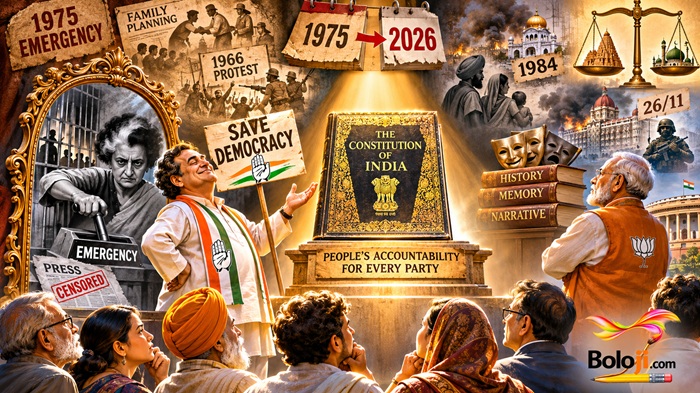
Not political prejudice but a historical accountability.
Can a political party that once suspended fundamental freedoms credibly present itself as the ultimate guardian of democracy? Can an organization that presided over the imprisonment of political opponents, censorship of newspapers, and coercive sterilization campaigns lecture an elected government about constitutional morality? How does a party associated with the horrors of the 1984 anti-Sikh massacres reinvent itself as the custodian of civil liberties? Does political memory have an expiration date? Or has Indian politics reached a stage where those who once endangered democracy now expect the nation to applaud them for promising to rescue it?
Welcome to the extraordinary theater of Indian politics, where history is inconvenient, memory is selective, and irony has apparently become a full-time occupation.
The Indian National Congress, the party that governed India through the Emergency of 1975–77, now raises the slogan of saving democracy by removing Narendra Modi.
One might reasonably ask: Saving democracy from whom? And, more importantly, saving it for what?
For a political organization whose historical record includes some of independent India's most disturbing abuses of state power, the claim to be democracy's indispensable protector invites considerable skepticism.
This is not to suggest that Congress has no right to criticize the government. In a democracy, even those with deeply compromised historical records retain the right to participate in political debate.
But the right to criticize does not confer immunity from criticism. And the right to invoke democracy does not automatically establish democratic credibility.
The Night Democracy Was Sent on ‘Compulsory Leave’
Let us travel back to June 25, 1975.
India was still a relatively young republic. Its Constitution had promised citizens liberty, equality, justice, and democratic representation.
Then Prime Minister Indira Gandhi declared a national Emergency.
Suddenly, constitutional freedoms became negotiable. Political dissent became dangerous. Opposition leaders were imprisoned. Newspapers faced censorship. The executive acquired extraordinary powers.
The country that had fought British colonial rule in the name of freedom found its own elected government severely restricting that freedom.
What an extraordinary achievement!
A political organization that had helped lead India's struggle against colonial domination was now presiding over the suppression of democratic opposition. The contradiction was almost Shakespearean.
The Emergency was not a minor administrative miscalculation. It represented a profound assault on constitutional democracy.
The Supreme Court's notorious judgment in ADM Jabalpur v. Shivkant Shukla (1976) further illustrated the institutional consequences of the Emergency. The majority accepted a deeply restrictive position concerning judicial remedies for unlawful detention during the suspension of constitutional protections.
The episode remains a warning about what happens when political authority overwhelms constitutional restraint. Yet, half a century later, Congress invokes constitutional morality while demanding the removal of Modi. The irony is difficult to overlook.
A party may legitimately reform itself and reject its past mistakes. But such reform requires more than changing slogans. It requires confronting the historical record with humility and consistency.
Democracy is not merely a word to be rediscovered when one occupies the opposition benches. It is a principle to be respected particularly when one possesses the power to suppress it.
When ‘Family Planning’ Became ‘State Planning of Families’
The Emergency also witnessed one of India's most disturbing exercises in coercive population control.
During 1976–77, approximately 8.13 million sterilization procedures were performed under an aggressively implemented family-planning campaign.
The program became associated with coercion, administrative pressure, and violations of individual autonomy. The poor and politically powerless were especially vulnerable.
Imagine the contradiction. A government claimed to be working for national development while subjecting citizens to extraordinary interference in their most intimate personal decisions.
The state that was supposed to protect bodily autonomy became an instrument of coercion. The family-planning slogan Hum Do, Hamare Do acquired a troubling association with this period, although the slogan itself should not be confused with every coercive measure undertaken during the Emergency.
And now, the political organization associated with that history speaks solemnly about individual liberty. How reassuring! Perhaps the constitutional rights of citizens become especially precious when a political party is no longer in a position to restrict them.
The Bloodstained Memory of 1984
Now consider another chapter. October 31, 1984. Indira Gandhi was assassinated. What followed was an appalling eruption of anti-Sikh violence. Thousands of innocent Sikhs were murdered. Homes were destroyed. Families were terrorized. The institutions entrusted with protecting citizens failed catastrophically.
Official figures record 3,325 deaths nationwide, including 2,733 in Delhi. The violence and the subsequent failures of accountability became enduring stains on the republic's conscience.
The involvement of Congress-linked political figures in the violence was not merely a matter of political accusation. Judicial proceedings eventually established the culpability of particular individuals. Yet, justice was delayed for decades. What does this episode reveal? That constitutional democracy is not safeguarded merely by conducting elections or delivering speeches about national unity. Its legitimacy depends on protecting citizens when communal passions erupt and when politically influential individuals are implicated in violence.
For the families of those murdered in 1984, democracy was not an abstract philosophical concept. It was the protection that failed to arrive. It was the justice that took decades. It was the constitutional promise that remained painfully unfulfilled.
Today, Congress speaks of defending democracy. It is entitled to do so. But it must also accept that its historical record gives citizens compelling reasons to demand explanations rather than applause.
A political party cannot demand that the nation remember its sacrifices for independence while conveniently forgetting its failures after independence.
The Curious Case of ‘Selective Secularism’
Congress has long presented secularism as one of its defining political commitments. Yet, its approach to India's religious and civilizational identity has generated recurring controversies.
Consider the reconstruction of the Somnath Temple. Jawaharlal Nehru expressed reservations about the association of senior constitutional authorities with its inauguration, while President Rajendra Prasad supported participation.
For critics, the disagreement raised an enduring question: Why should the revival of a major Hindu religious and historical institution be viewed with suspicion in a country whose civilizational inheritance extends across millennia?
Then came the Ram Setu controversy. In 2007, an affidavit submitted in connection with the Sethusamudram project questioned historical and scientific claims concerning Lord Rama and the construction of Ram Setu.
The Congress-led government subsequently withdrew the controversial affidavits. The episode exposed a striking failure of political sensitivity.
A government may legitimately examine geological and archaeological evidence. But it must also recognize that civilizational landmarks possess meanings that cannot be reduced to engineering calculations.
The historical Haj subsidy generated another debate about the consistency of state policy toward religious practices. The question was not whether Muslim pilgrims deserved dignity or assistance. The question was whether public expenditure on religious activities was being governed by consistent, transparent, and constitutionally defensible principles.
Secularism cannot be credible if citizens perceive its application as selective. Nor can cultural confidence flourish when expressions associated with India's civilizational traditions are repeatedly drawn into political controversy.
The debates surrounding Vande Mataram, Bharat Mata ki Jai, and Sanskrit philosophical expressions illustrate how deeply national identity has become entangled with party politics.
But there is a distinction worth preserving. Respecting India's Hindu civilizational heritage does not require diminishing the constitutional rights of other communities. Equally, respecting religious minorities does not require treating India's majority cultural inheritance as something inherently embarrassing.
A confident civilization should not have to apologize for its heritage, and a confident democracy should not have to compromise equality to celebrate that heritage.
When Saints Faced Bullets
On November 7, 1966, a major demonstration demanding a nationwide prohibition on cow slaughter took place near Parliament. The protest escalated into violence, and police opened fire. Eight people died, including seven protesters and one police officer. The episode remains a painful chapter in the history of relations between religious movements and the Indian state.
The government's responsibility to maintain public order did not eliminate its obligation to ensure that force was necessary and proportionate. For critics of Congress, the incident became a symbol of the state's confrontational approach toward certain Hindu religious demands.
It also raised a fundamental democratic question. When citizens assemble to express deeply held religious convictions, how should the state respond? Certainly, violence by protesters cannot be justified. But neither should the use of lethal force escape rigorous scrutiny.
A government that claims to defend civil liberties must demonstrate that commitment when confronted by movements it finds politically inconvenient. Otherwise, constitutional principles risk becoming instruments of selective convenience.
National Security Cannot Be a ‘Political Costume’
The controversies surrounding the 26/11 Mumbai terrorist attacks and subsequent political commentary demonstrate another danger: the temptation to turn national tragedies into ideological contests.
The attacks were carried out by Pakistan-based Lashkar-e-Taiba terrorists. Yet, conspiracy narratives circulated in political discourse, including allegations attempting to associate Hindu nationalist organizations with the attacks. Such claims demanded evidence, not political amplification.
Similarly, India's territorial setbacks and unresolved disputes involving Pakistan and China invite legitimate examination of the strategic decisions made by successive governments.
The Kashmir conflict, the 1962 war, and the evolution of India's border disputes cannot be understood through slogans alone. But neither should the complexity of these events become an excuse to avoid evaluating historical leadership.
National security demands accountability. It demands strategic foresight. Above all, it demands that political leaders place national interests above partisan advantage. A political organization cannot claim ownership of patriotism simply because it once governed the country. Patriotism is demonstrated through decisions and their consequences.
The Great Democratic Transformation: From Ruling to Rescuing
And now we arrive at the most fascinating chapter. Congress, once India's dominant governing party, has increasingly positioned itself as a defender of democracy against Narendra Modi. The transformation is remarkable.
The party associated with the Emergency invokes constitutional freedom. The party that presided over coercive sterilization campaigns invokes personal liberty. The party burdened by the legacy of 1984 invokes protection of citizens. The party whose governments encountered serious controversies concerning civilizational identity invokes national unity. And the party that once exercised extraordinary centralized authority warns against the concentration of political power.
One almost expects history to interrupt the proceedings and request an opportunity for cross-examination. Yet, the central issue is not whether Congress should be prohibited from criticizing Modi. Of course it should not. The right to criticize an elected government belongs to every citizen and political organization.
The issue is whether Congress can credibly claim a position of moral superiority without demonstrating that it has learned from the authoritarian excesses and institutional failures associated with its own history.
Democratic credibility is not inherited from the freedom struggle. It must be earned through consistent respect for democratic principles.
Modi, Viksit Bharat & the Politics of Performance
Narendra Modi's leadership has brought a different political vocabulary into prominence. National development, digital transformation, infrastructure expansion, manufacturing, strategic autonomy, and civilizational identity occupy important positions in his government's agenda.
The ambition of Viksit Bharat 2047 offers a long-term developmental objective. Its realization will depend on measurable progress in economic productivity, education, employment, technological capability, public institutions, and living standards. The Modi government should be judged on these outcomes. Its achievements deserve recognition where evidence supports them. Its failures deserve scrutiny where evidence establishes them. That is how democratic accountability works.
But there is a fundamental difference between criticizing a government's policies and claiming that the country's survival depends upon removing its leader. Political opposition becomes intellectually unconvincing when it substitutes denunciation for a credible alternative program.
If Congress believes Modi's developmental approach is inadequate, it must demonstrate how its own policies would produce superior outcomes. If it believes constitutional institutions are endangered, it must identify specific institutional failures and propose enforceable safeguards. If it claims to defend democratic freedoms, it must explain how its present commitments differ from the authoritarian practices of the Emergency.
Merely declaring Remove Modi, Save the Country does not answer these questions. A slogan may mobilize supporters. It cannot replace a governing philosophy.
Final Thoughts: Democracy Does Not Suffer From ‘Amnesia’
The Indian National Congress possesses a long and consequential history. Its contributions to the independence movement and nation-building are part of that history. So are the Emergency, coercive sterilization campaigns, the anti-Sikh massacres, and controversies concerning the exercise of state power.
A mature political organization should be prepared to confront both. It cannot reasonably demand historical recognition for its achievements while treating scrutiny of its failures as an act of political hostility. Nor should any other political party expect immunity from the same standard.
The Constitution does not belong to Congress. It does not belong to the BJP. It belongs to the people of India. Democracy is not a ceremonial possession that political parties retrieve from storage whenever they lose an election. It is a discipline requiring restraint when exercising power, tolerance when confronting dissent, and accountability when institutions fail.
The deepest irony of Congress's contemporary democratic rhetoric lies not in its right to oppose Modi, but in the contrast between its present claims and some of the most troubling episodes of its own governing history. That contradiction deserves neither automatic forgiveness nor historical exaggeration. It deserves sustained public scrutiny. And so, five questions remain.
History has an inconvenient habit of remembering what political parties would prefer to forget. And democracy has an even more inconvenient habit of allowing citizens to ask questions that politicians would rather not answer.
The party that once suspended democracy is entitled to speak about saving it. But it is not entitled to demand that India forget the suspension.
That is not political prejudice. That is historical accountability.
21-Nov-2026
More by : P. Mohan Chandran
