Nov 28, 2026
Nov 28, 2026
In The Creator and the Created, Rajender Krishan explores the intricate relationship between individual consciousness and collective civilization through the central proposition that civilization represents the multiplication of human consciousness. He contends that the institutions, ideologies, traditions, religious beliefs, laws, and technological systems that govern human existence are essentially products of human thought and experience. Yet, once established, these creations gradually acquire an influence of their own, shaping the very consciousness from which they originated. The essay thus examines the paradox of humanity creating structures that eventually begin to regulate, condition, and sometimes dominate their creators.
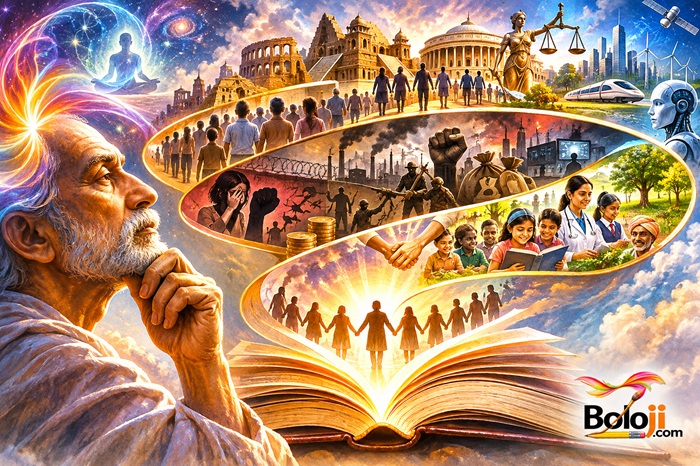
The author perceptively observes that multiplication is inherently neutral, capable of magnifying both human virtues and human weaknesses. Greed, fear, prejudice, and servility, when collectively reinforced, may evolve into systemic exploitation, institutional discrimination, authoritarian tendencies, and intellectual conformity. Conversely, compassion, integrity, mutual understanding, and a sense of interconnectedness, when nurtured collectively, can become the foundations of social justice, ethical governance, and humane civilization. Civilization, therefore, is not necessarily synonymous with progress; its moral character depends upon the qualities of consciousness it perpetuates and amplifies.
One of the essay's most compelling dimensions is its examination of the reciprocal relationship between the individual and society. Although individuals initially create social institutions and collective traditions, these inherited structures subsequently influence the formation of individual identity, beliefs, values, and behavior. The author extends this dialectical relationship into philosophical and religious realms, drawing upon the Atma–Paramatma concept of Indian philosophy, the biblical Logos, and the Nasadiya Sukta of the Rig Veda. These references provide a broader framework for contemplating the nature of creation, the evolution of collective beliefs, the emergence of religious authority, and the limitations of human comprehension, while carefully distinguishing philosophical analogy from theological assertion.
The discussion further highlights the tendency of human creations to acquire power over their originators. Money, governments, institutions, traditions, and technology, initially conceived as instruments to facilitate human existence, may gradually become forces that dictate human priorities, behavior, and choices. What is intended to serve humanity may ultimately demand human submission. Nevertheless, the author does not regard this transformation as inevitable or entirely destructive; its consequences depend upon the manner in which individuals and successive generations preserve, question, regulate, or reform their inherited systems.
Equally significant is the author's rejection of the notion that personal enlightenment alone can bring about social transformation. Inner purification, meditation, compassion, and moral awakening may improve individual conduct, but they cannot independently dismantle entrenched injustice, discriminatory laws, or exploitative institutional arrangements. Similarly, structural reforms may prove superficial if the attitudes, prejudices, and ethical deficiencies underlying those structures remain unaltered. The essay consequently advocates a complementary relationship between inward transformation and outward action, emphasizing that spiritual consciousness must translate into social responsibility, while institutional reform must be sustained by genuine human awareness.
The author also extends the principle of multiplication to creative expression, suggesting that literary and artistic works transcend the intentions of their creators through the diverse interpretations, experiences, and sensibilities of their audiences. A thought may inspire a poem, a poem evoke a painting, and a painting generate further reflections, allowing meaning to evolve through successive encounters. Creativity thus becomes another manifestation of the dynamic interaction between individual expression and collective consciousness.
Philosophically contemplative and socially relevant, the essay brings together spirituality, psychology, institutional critique, human responsibility, and creative expression within a coherent conceptual framework. Its principal strength lies in demonstrating how individual thoughts, attitudes, and actions, when collectively sustained, can shape the moral and intellectual character of civilization. Although its foundational proposition is interpretive rather than empirically established, the metaphor of multiplication offers a stimulating perspective on the interconnectedness of human consciousness and social existence.
Ultimately, the essay presents humanity as both the creator and the creation of its own civilization. The ideas, institutions, beliefs, and systems that human beings construct do not remain static or external; they return to influence their perceptions, choices, identities, and future creations. Its concluding insight—that what we multiply returns to multiply us—captures the profound reciprocity between human agency and its consequences, reminding us that the future of civilization depends not merely upon what we create, but upon what we consciously choose to nurture, perpetuate, question, and transform.
The write-up is illuminating and intellectually engaging, exploring questions of human existence and collective consciousness that resonate universally, irrespective of cultural, social, or philosophical differences.
28-Nov-2026
More by : Dr. Dalip Khetarpal
Top | Perspective | Home