Nov 28, 2026
Nov 28, 2026
From India’s “Dead Economy” To America’s Growth Model!
When Political Arrogance Meets Economic Reality
Can an economy pronounced dead by the President of the United States suddenly become a model for American economic prosperity? Can a country dismissed as economically irrelevant become an example that the world's largest economy should emulate? What happens when political rhetoric collides with economic reality? Is Donald Trump's latest admiration for India's economic growth an acknowledgment of his earlier misjudgment, or another demonstration of his extraordinary ability to change economic narratives according to political convenience? And, more importantly, has India achieved something that even its most vocal international critics can no longer afford to ignore?
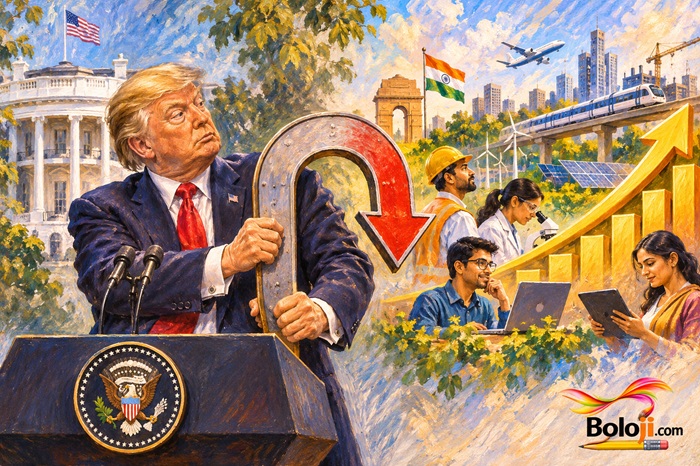
There is an old saying that facts are stubborn things. Donald Trump appears to have discovered just how stubborn they can be!
In July 2025, Trump contemptuously dismissed India and Russia as “dead economies.” Barely sixteen months later, on November 20, 2026, the same American President invoked India's economic growth to argue that the United States could achieve an astonishing 15–20% GDP growth if its central bank pursued a more accommodative monetary policy.
Yesterday, India was an economic corpse. Today, it is an economic classroom. And the man who pronounced the death certificate now wants America to learn from the supposed deceased!
The irony is difficult to miss. The contradiction is even harder to defend.
But beneath this remarkable reversal lies a larger story about India's economic resilience, the contradictions of Trump's economic diplomacy, and the growing inability of major powers to dismiss India's economic significance.
From ‘Contempt’ to ‘Compliment’: The Remarkable Reversal
On July 30, 2025, amid escalating trade tensions between Washington and New Delhi, Trump declared on Truth Social: “I don’t care what India does with Russia. They can take their dead economies down together, for all I care.”
The statement was not an isolated economic observation. It emerged amid disagreements over India's tariffs, trade barriers, and continuing economic relationship with Russia.
Trump had announced a 25% tariff on Indian imports. On August 6, 2025, he imposed an additional 25% tariff linked to India's purchases of Russian oil, taking the combined headline tariff burden to 50% on affected goods.
The message was unmistakable: India was being subjected to economic pressure, and its economic standing was being publicly disparaged.
Now consider what happened on November 20, 2026.
Speaking to reporters at the White House, Trump declared: “If you look at India, they have low interest rates, and they have a 7% GDP. We’d have a 14%, 15%, maybe even a 20% GDP.”
He simultaneously accused the US Federal Reserve of being excessively political and keeping borrowing costs unnecessarily high.
What a transformation!
The economy that supposedly had no pulse in July 2025 had become an example of economic vitality by November 2026.
The country whose economic prospects were dismissed during a tariff confrontation was suddenly being cited to challenge American monetary policy.
Interestingly, this was not Trump's first reversal. In July 2026, he had already acknowledged in a CNBC interview that India was performing well, growing at approximately 7–8%.
His latest statement represents a continuing change in public characterization rather than an entirely unexpected conversion.
Nevertheless, one fundamental question remains unanswered.
If India was truly a dead economy in 2025, how did it become an economic benchmark in 2026 without undergoing an economic resurrection?
The obvious answer is that India's economy was never dead in the first place.
What changed was not the fundamental reality of India's economic momentum, but Trump's description of it.
The Numbers Trump Conveniently ‘Ignored’
Economic performance is not determined by presidential adjectives. It is measured through production, investment, consumption, productivity, trade, and income.
Consider India's actual economic record.
According to India's revised national accounts, released in February 2026, real GDP growth for FY2025–26 was estimated at 7.6%, compared with 7.1% in FY2024–25.
The October 2026 IMF projections, reproduced in the Reserve Bank of India's bulletin, provide an even more revealing comparison:
| Economy | 2026 Growth Forecast |
| India | 7.0% |
| China | 4.5% |
| United States | 2.3% |
| Euro Area | 1.1% |
| Japan | 0.7% |
| World | 3.1% |
Source: RBI, October 2026, citing IMF projections. India's figures follow its fiscal year; other figures generally follow calendar years.
India's projected growth was approximately three times that of the United States and more than twice the global average. Apparently, Trump's definition of a dead economy differs considerably from that of the IMF!
The irony becomes sharper when we examine India's international trade.
India's combined merchandise and services exports reached approximately $825 billion in FY2024–25, compared with $468 billion in FY2013–14 — an increase of roughly 76%. Services exports alone rose from approximately $158 billion to $387 billion during that period.
These numbers do not establish that India has overcome every economic challenge. It continues to confront unemployment, income disparities, infrastructure gaps, and relatively low per capita income. But they decisively undermine the characterization of India as an economically moribund nation.
An economy can have structural weaknesses without being economically dead. And a President who fails to recognize that distinction is engaging in political theater rather than serious economic analysis.
The Hypocrisy of Selective Economic Admiration
Trump's contradiction becomes particularly revealing when we examine the circumstances surrounding his two statements. In July 2025, India was resisting American pressure over trade and its relationship with Russia. Trump responded with tariffs and disparaging rhetoric.
In November 2026, Trump was confronting the Federal Reserve over interest rates. Suddenly, India's growth became a convenient argument for his preferred monetary policy. The common denominator was not India's economic condition.
It was Trump's immediate political objective.
When India resisted American economic pressure, its economy was supposedly dead. When India's growth figures could be used to criticize the Federal Reserve, its economy became worthy of admiration. This is precisely why Trump's statements invite accusations of double standards.
One cannot credibly dismiss a country's economic vitality when its policies are inconvenient and subsequently celebrate that same vitality when its performance supports one's domestic political argument.
Of course, political leaders are entitled to revise their assessments when circumstances change. Indeed, intellectual honesty demands such revisions. But intellectual honesty also requires acknowledging earlier errors.
Trump has offered no comparable public acknowledgment that his earlier characterization was unjustified. Instead, India has moved from economic irrelevance to economic inspiration without the President explaining the transformation. That is not economic consistency. It is rhetorical opportunism.
The 20% Growth Fantasy: Economics or Exaggeration?
There is another dimension to Trump's latest remarks that deserves serious scrutiny. His suggestion that America could achieve 15–20% GDP growth through lower interest rates is economically extraordinary.
Lower interest rates can stimulate investment, consumption, and borrowing. However, they cannot automatically transform a mature, multitrillion-dollar economy into one growing at emerging-market rates.
The IMF's October 2026 projections placed US growth at approximately 2.3%, against India's 7%. A sustained American growth rate of 20% would therefore represent an unprecedented departure from its normal economic trajectory. Moreover, the Federal Reserve must consider inflation, employment, financial stability, and monetary credibility.
The RBI itself demonstrated this balancing act in October 2026 when it raised its policy repo rate by 25 basis points to 5.50%, citing inflationary pressures and geopolitical uncertainty. The Federal Reserve had raised its target range to 3.75–4.00% in September 2026.
Thus, the latest official policy decisions available show something particularly inconvenient for Trump's comparison: India's policy rate was actually higher than America's benchmark rate. The two rates are not perfectly comparable, but neither supports the simplistic proposition that India grows faster merely because it maintains lower interest rates.
India's higher growth reflects several structural factors, including its development stage, domestic demand, investment requirements, services sector, and demographic potential. India's economic model is not reducible to one monetary-policy instrument.
Trump is correct to recognize India's growth performance. He is considerably less convincing when he implies that replicating one supposed feature of India's monetary policy could quadruple or quintuple America's growth rate. Economic policymaking requires considerably more sophistication than economic slogan-making.
India's Resilience: The Answer to Economic Intimidation
India's experience also illustrates an important principle of international economic relations. Economic strength is not demonstrated by issuing retaliatory statements whenever another country makes provocative remarks. It is demonstrated through sustained economic performance.
When Trump imposed punitive tariffs in 2025, India's policymakers confronted difficult choices involving export competitiveness, energy security, strategic autonomy, and bilateral relations. The immediate economic risks were substantial.
Contemporaneous assessments by Barclays and Nomura suggested that higher American tariffs could reduce India's GDP growth by approximately 20–30 basis points. Nevertheless, India retained considerable economic momentum. Its resilience reflects the cumulative contribution of domestic consumption, services exports, investment, digitalization, entrepreneurship, and economic reforms across successive governments.
The Modi administration's emphasis on infrastructure, digital public infrastructure, manufacturing incentives, and formalization has contributed to this transformation, although their individual effects require careful empirical assessment. Equally important is India's determination to maintain strategic flexibility in its international economic relationships.
India's energy procurement decisions, including its purchases of Russian crude, have reflected considerations of affordability, supply security, and national interest.
Washington may disagree with individual Indian policies. But disagreement does not justify economic denigration. And the latest acknowledgment from Trump demonstrates why major powers must distinguish between political displeasure and economic reality.
When the World's Largest Economy Looks Toward India
There is a deeper significance to Trump's latest statement. For decades, India looked toward advanced economies for lessons in industrialization, infrastructure, technological development, and institutional reform. Today, elements of India's economic experience are attracting international attention.
India's digital public infrastructure, particularly UPI, Aadhaar-enabled services, and digital identity systems, illustrates how technological infrastructure can facilitate financial inclusion and reduce transaction costs.
Its globally competitive IT services industry demonstrates how human capital and technological specialization can generate international economic influence. Its expanding domestic market provides businesses with opportunities for scale that relatively smaller economies cannot easily replicate.
None of these achievements means that India has surpassed the United States in productivity, technological sophistication, per capita income, or overall economic power. It has not. But economic influence is not determined exclusively by present wealth. It is also shaped by growth potential, market size, institutional capabilities, and the capacity to adapt. That is where India's international significance is increasing.
The most revealing aspect of Trump's remarks is not his exaggerated prediction of 20% American growth. It is his recognition that India's economic performance has become relevant to America's domestic economic debate.
A country once dismissed as economically insignificant has become sufficiently important to be invoked by the American President himself. That represents a meaningful shift in international economic discourse.
The Larger Problem: When ‘Political Convenience’ Replaces ‘Economic Credibility’
Trump's reversal raises an uncomfortable question about the credibility of economic pronouncements made by powerful political leaders.
Markets respond to information. Investors assess risk. Businesses make long-term capital allocation decisions. Governments negotiate trade agreements based on expectations of economic stability.
When political leaders repeatedly substitute exaggeration for evidence, they risk undermining confidence in their own assessments. Calling India a ‘dead economy’ in 2025 was not merely undiplomatic. It was inconsistent with available economic evidence.
Praising India's growth in 2026 is more consistent with that evidence, but the absence of any acknowledgment of the earlier mischaracterization makes the reversal conspicuous.
The issue is not that Trump has praised India. That acknowledgment is welcome. The issue is that economic judgments should not fluctuate according to whether another country is cooperating with or resisting American demands.
India cannot be economically dead when it disagrees with Washington and economically exemplary when its statistics become politically useful. Economic reality does not change according to the occupant of the White House.
Final Thoughts: The Economy That Refused to Die!
Donald Trump's transformation from India's economic critic to its unexpected admirer offers a fascinating lesson in international politics.
In July 2025, he dismissed India as a dead economy. In July 2026, he acknowledged that India was performing well.
In November 2026, he invoked India's growth to argue that America itself could achieve substantially higher economic expansion.
The progression is remarkable. Yet India's response need not be triumphalist.
India still has substantial economic challenges to overcome. Its future success will depend on employment generation, productivity improvements, manufacturing competitiveness, educational quality, innovation, and equitable development.
A presidential compliment cannot resolve these challenges, just as a presidential insult could not erase India's economic achievements. The lesson is straightforward.
Nations should be judged by their economic fundamentals, not by the fluctuating opinions of powerful foreign leaders.
Trump's latest remarks do not prove that India's economy is flawless. They demonstrate that his earlier dismissal was economically indefensible. The country he once ridiculed is now the country he cites. The economy he pronounced dead is now the economy he considers worth studying. And the President who once dismissed India's economic future is now invoking India's performance to criticize America's own economic management.
What changed so dramatically in sixteen months — India's economic fundamentals or Trump's political calculations? If India was truly a ‘dead economy,’ why does its growth now deserve American attention? Can a leader credibly claim economic expertise while making such contradictory assessments? Should India seek validation from foreign leaders whose judgments change with political circumstances? And, ultimately, is the greatest vindication of India's economic progress not Trump's praise, but the stubborn persistence of the very growth he once dismissed?
History has a peculiar sense of humor.
Donald Trump pronounced India's economy dead. Sixteen months later, he wants America to learn how to grow from it.
Perhaps the most appropriate response is neither outrage nor celebration.
It is simply to let the numbers speak.
After all, the economy was ‘never dead.’ Only the ‘diagnosis’ was ‘wrong!’
28-Nov-2026
More by : P. Mohan Chandran