Nov 28, 2026
Nov 28, 2026
India’s Ascent: How India’s Rise in the Asia Power Index Reflects a Changing Geopolitical Order
What makes a nation truly powerful? Is it the magnitude of its military arsenal, the resilience of its economy, the dexterity of its diplomacy, or its ability to influence the decisions of other sovereign nations? What happens when a country once regarded predominantly as a land of untapped potential begins translating that potential into tangible geopolitical influence? Is the Asian geopolitical order gradually evolving from bipolarity toward tripolarity? And is India emerging as an indispensable third pillar of that evolving order?
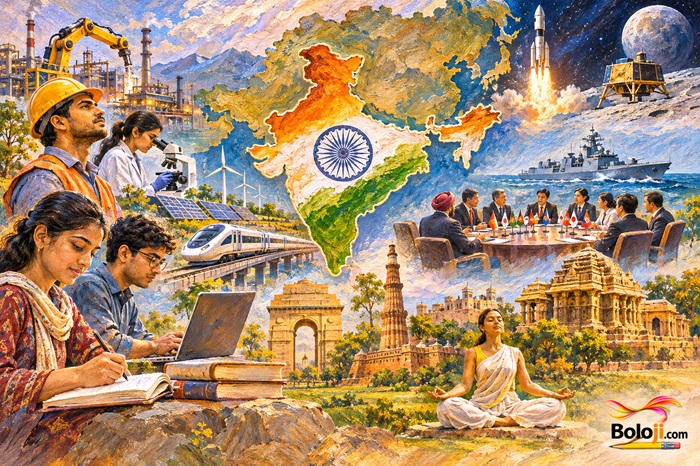
The answers to these questions can, to a considerable extent, be found in the 2026 Asia Power Index, released on November 23, 2026, by the Lowy Institute, an independent Australian think tank.
India has retained its position as the third-most powerful country in the region for the third consecutive year, with its comprehensive power score increasing from 40.0 in 2025 to 40.5 in 2026. More significantly, the power differential between India and China has narrowed to its lowest level since the inception of the index in 2018.
This development deserves more than a fleeting celebration of statistical achievement. It warrants a deeper examination of India's evolving geopolitical stature, economic resilience, strategic autonomy, technological capabilities, and growing diplomatic influence.
For India, the distinction is not merely between being a populous country and a powerful country. It is between possessing potential and exercising influence.
Understanding the Asia Power Index
Introduced in 2018, the Asia Power Index evaluates the capacity of countries to influence their external environment and shape international developments.
The 2026 edition assesses 27 countries and territories across 131 indicators, encompassing eight principal dimensions of national power: economic capability, military capability, resilience, future resources, economic relationships, defense networks, diplomatic influence, and cultural influence.
Unlike conventional rankings that assess countries predominantly through GDP or military expenditure, the index examines both the resources a nation possesses and its ability to translate those resources into influence.
Asia Power Index 2026: The Five Leading Powers
| Rank | Country | Power Score (Out of 100) |
| 1 | United States | 78.9 |
| 2 | China | 73.6 |
| 3 | India | 40.5 |
| 4 | Japan | 38.6 |
| 5 | Russia | 32.2 |
Source: Lowy Institute, Asia Power Index 2026.
The index includes extra-regional countries such as the United States because of their substantial strategic presence in the Indo-Pacific.
India is currently the only country classified as a major power, with the United States and China occupying the superpower category. Japan, Russia, and other countries fall within the index's middle-power classification.
India's position ahead of Japan and Russia in this composite assessment is particularly significant, although it does not imply superiority over these countries in every individual dimension of national power.
India's Historical Trajectory: From Retrenchment to Resurgence
India's ascent becomes more intelligible when one examines its performance since the inception of the Asia Power Index.
| Year | India's Rank | Power Score | Classification |
| 2018 | 4th | 41.5 | Major power |
| 2019 | 4th | 41.0 | Major power |
| 2020 | 4th | 39.7 | Major power |
| 2021 | 4th | 37.7 | Major power |
| 2023 | 4th | 36.3 | Major power |
| 2024 | 3rd | 39.1 | Major power |
| 2025 | 3rd | 40.0 | Major power |
| 2026 | 3rd | 40.5 | Major power |
Sources: Lowy Institute's historical Asia Power Index reports and historical data compilations.
No edition was published in 2022.
India's trajectory has not been an uninterrupted upward progression. Between 2018 and 2023, its relative power score declined amid several challenges, including the economic repercussions of the pandemic.
However, the subsequent resurgence has been remarkable.
Between 2023 and 2026, India's comprehensive power score increased by 4.2 points, representing an improvement of approximately 11.6%. In 2024, India overtook Japan, and in 2025, it regained its major-power classification.
Although India's current score remains marginally below its inaugural 2018 0.2score, its relative geopolitical standing has improved. Its recovery illustrates the country's resilience and its growing ability to convert national capabilities into regional influence.
India's Eight Dimensions of Power
India's performance across the eight parameters in the 2026 index reveals the multidimensional character of its resurgence.
| Parameter | Rank | 2026 Score | Annual Change |
| Economic capability | 3rd | 26.4 | -0.7 |
| Military capability | 4th | 48.5 | +0.5 |
| Resilience | 4th | 55.4 | -0.1 |
| Future Resources | 3rd | 56.2 | +1.1 |
| Economic relationships | 7th | 19.9 | +0.2 |
| Defense networks | 9th | 18.6 | +2.2 |
| Diplomatic influence | 4th | 70.3 | -0.5 |
| Cultural influence | 4th | 42.8 | +2.3 |
Source: Lowy Institute, Asia Power Index 2026.
India's greatest improvements in 2026 occurred in cultural influence and defense networks, suggesting that its rise is increasingly characterized by both hard power and soft power.
Economic Resilience: The Bedrock of National Power
Geopolitical ascendancy without economic prosperity is ultimately unsustainable. Military modernization, technological innovation, diplomatic engagement, and infrastructure development all necessitate a formidable economic foundation.
According to the Ministry of Statistics and Programme Implementation's September 2026 revision, India's real GDP grew by 7.8% in FY2025–26. The economy also registered growth of 7.8% during the first quarter of FY2026–27.
India's expanding manufacturing ecosystem, digital economy, services exports, infrastructure investments, and entrepreneurial capabilities have augmented its economic relevance.
Nevertheless, the Lowy Institute recorded a marginal decline in India's relative economic capability in 2026, attributing it partly to a weakening rupee, changes in IMF economic measurement, and declining outward investment.
This distinction is important. Domestic economic growth does not automatically translate into international economic leverage. India must increasingly become a country upon which global supply chains, financial markets, and technological ecosystems depend.
Military Modernization: From ‘Import Dependency’ to ‘Export Capability’
One of the most consequential manifestations of India's transformation has been the expansion of its indigenous defense manufacturing ecosystem.
Consider the following statistics:
India's export of BrahMos missiles to Southeast Asia, its indigenous aircraft carrier INS Vikrant, its expanding naval capabilities, and its domestic defense manufacturing initiatives collectively signify an important industrial and strategic transition.
The Lowy Institute specifically identified BrahMos exports and expanding regional military engagement as contributors to India's improved defense-network ranking.
The transformation from being predominantly a purchaser of military technology to becoming an increasingly credible producer and exporter of defense equipment constitutes a significant milestone in India's strategic evolution.
A country that manufactures weapons for its own security strengthens its sovereignty. A country that exports them also acquires opportunities for geopolitical influence.
Diplomatic Dexterity & Strategic Autonomy
India's diplomatic strength lies partly in its capacity to engage with competing geopolitical blocs without necessarily subordinating its national interests to any one of them.
India participates in the Quad alongside the United States, Japan, and Australia while simultaneously remaining a member of BRICS and the Shanghai Cooperation Organization. It maintains longstanding relations with Russia while cultivating strategic partnerships with Western countries.
The admission of the African Union as a permanent member of the G20 during India's presidency in 2023 exemplified its ability to help advance the interests of the Global South within multilateral institutions.
The 2026 Lowy Institute report also recorded improved expert assessments of Prime Minister Narendra Modi's effectiveness in advancing India's regional diplomatic interests, although assessments of his global leadership weakened amid India's relatively restrained diplomatic profile during the Gulf conflict.
India's diplomatic approach reflects a modern manifestation of strategic autonomy: maintaining multiple partnerships without surrendering independent decision-making.
Technological Prowess: The New Currency of Power
Twenty-first-century geopolitical supremacy will increasingly be determined not merely by territorial expanse or military arsenals but by technological sovereignty.
India's achievements are particularly noteworthy in this context.
The World Intellectual Property Organization's Global Innovation Index 2026 ranked India 38th globally and identified it among the middle-income economies that have made the greatest advances in innovation since 2013.
India's Unified Payments Interface (UPI) processed approximately 241.62 billion transactions during FY2025–26, compared with approximately 20 million transactions in FY2016–17.
On August 23, 2023, Chandrayaan-3 made India the fourth country to accomplish a lunar soft landing and the first to achieve one in the Moon's southern high latitudes.
These achievements demonstrate India's capacity to develop technological solutions at scale.
From digital payments to space exploration, India is increasingly demonstrating that technological innovation need not remain the exclusive preserve of affluent Western economies.
Civilizational Influence: India's Soft Power Advantage
India possesses a source of influence that cannot be manufactured in laboratories, procured through military contracts, or acquired through foreign investments — its civilizational heritage.
Yoga, Ayurveda, Buddhism, Indian philosophy, literature, cinema, cuisine, and the global Indian diaspora collectively constitute an enormous reservoir of cultural capital.
India's cultural influence score increased by 2.3 points in 2026, the largest improvement among its eight parameters.
While military power can compel nations to reconsider their actions, cultural power can persuade societies to reconsider their perceptions.
The former generates deterrence; the latter generates affinity. India possesses considerable opportunities to leverage both.
The China Conundrum: Has India Arrived?
India's emergence as the third-most powerful country should not be misconstrued as its attainment of geopolitical parity with China.
China's comprehensive power score of 73.6 remains substantially higher than India's 40.5.
Moreover, India's Power Yield — the difference between its actual power and the power expected from its resources — remained negative at −3.3 in 2026, although it improved from −4.0 in 2025.
India continues to confront challenges pertaining to manufacturing competitiveness, research expenditure, employment generation, human capital development, energy dependency, and regional economic integration.
The demographic dividend could become a demographic liability unless accompanied by adequate education, skilling, healthcare, and employment opportunities.
India must not allow the euphoria of its third position to engender complacency. The objective should not merely be to improve its ranking but to improve the underlying capabilities that determine the ranking. A ranking is a consequence of national transformation, not a substitute for it.
Final Thoughts
India's resurgence in the Asia Power Index represents an important chapter in the redistribution of geopolitical power in the twenty-first century.
The country is increasingly evolving from a consumer of technology into a creator of technology, from a defense importer into a defense exporter, and from a participant in multilateral institutions into an active contributor to their evolving agendas.
However, the journey from a major power to a superpower will require sustained economic expansion, institutional resilience, technological self-reliance, social prosperity, and strategic foresight.
The real triumph will not be India occupying the third position on an international index, but India developing the capabilities that make its position enduring and its influence indispensable.
Can India transform its demographic magnitude into unparalleled productive capacity? Can it convert technological ingenuity into global technological leadership? Can it translate its civilizational heritage into enduring geopolitical influence? Can it progressively bridge the formidable power differential separating it from China and the United States?
And will the twenty-first century eventually be remembered not merely as the Asian Century, but as the century in which India rediscovered its civilizational confidence and emerged as one of the principal architects of a new world order?
28-Nov-2026
More by : P. Mohan Chandran