Sep 30, 2026
Sep 30, 2026
INTRODUCTION
Recently, I read an article written by Pushpa Narayan in the Times of India dated 23rd September 2026. The article concerns the cooking oils we use in our kitchens. The header of the article reads “What Ghee and Coconut Oil May Be Doing to Your Cholesterol”. The contents are based on a survey undertaken by ICMR involving ten thousand volunteers. The main purpose of the survey was to find the correlation between the food habits, mainly the choice of cooking oils, and the level of Low-Density Lipoprotein (LDL) in the blood. LDL is also notoriously known as the Bad Cholesterol. This blog aims to summarize the contents of the article and provide a little more relevant information.
SALIENT FINDINGS OF THE SURVEY
The Table below summarizes the findings of the study. The Table lists seven different types of cooking media that are used in India. The second column contains relative risk factors with groundnut oil as the reference. For defining “risk,” a threshold value of 130 mg/dL is considered. Any level beyond this would be considered “high”. The third column tells us the regions where a particular oil is dominantly used. Please note that I have used quotes for the Risk in the column header. This is done with a purpose, as will be clear later.
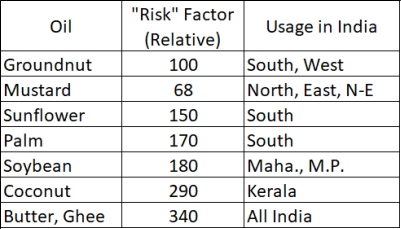
The last two rows fully justify the title of the article. People who use predominantly coconut oil or ghee/butter are about three times more likely to have high LDL compared to those who use groundnut oil predominantly. Another important finding is that mustard oil is better than groundnut oil from the LDL point of view. Based on these two observations, the survey committee has made a recommendation that groundnut oil, instead of palm oil, be sold in the ration shops. Dr. V.Mohan, the well-known diabetologist, argues that the higher cost of groundnut oil will more than offset the cost of expensive medical treatment, which may include stents and bypass surgery.
RECOMMENDED CONSUMPTION LEVELS
To have good overall health, the medical community recommends that the consumption of edible oils should not exceed 27 grams per day. This translates to about three and a half liters per month for a family of four.
INTERPRETATION OF RISK FACTOR
The survey focused on correlating the LDL levels and the quality and the nature of food consumption. The implied understanding has been that a high LDL level results in a higher risk of heart ailments, mainly in the form of clogged arteries. This was the scenario till about eleven years ago. In the year 2015, United States officials finally gave the green signal for a U-turn on previous warnings on cholesterol, which were on the “naughty” list of nutrients for nearly 40 years. Here is an important excerpt from the communication:
Butter, full-fat dairy products, nuts, coconut oil, and meat
have now been classified as "safe"
and have been officially removed from the "nutrients of concern" list.
Here is the link to the original report issued by the U.S. government.
To give a wider publicity to this important information, I published a brief article on this website. Please see
https://www.boloji.com/blog/1773/fatty-foods-eat-happily-without-any-fear
SUMMARY
This article is written with the intention of removing misgivings, fears, and concerns from the minds of people about food and the associated health hazards. Specifically, when it comes to the choice of the cooking medium, people should be guided only by the consideration of taste and affordability. Very importantly, people are well advised to treat the social media information with caution and discretion.
