Nov 14, 2026
Nov 14, 2026
Professor V. Rajaraman: The Unsung Academic
who Laid the Intellectual Foundations of India's IT Revolution
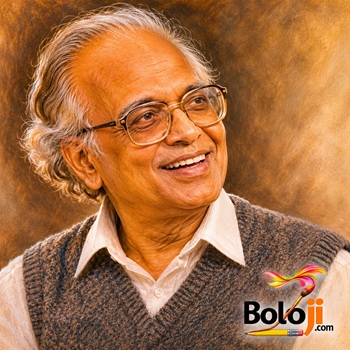 What makes a nation technologically powerful? Is it the billions of dollars invested in infrastructure? The multinational corporations that establish their headquarters on its soil? The entrepreneurs who build billion-dollar enterprises? Or the visionary teachers who cultivate the intellectual capital from which these enterprises eventually emerge?
And what if India's extraordinary transformation into a global IT powerhouse began not in the boardrooms of Bengaluru or Hyderabad, but in a modest classroom at IIT Kanpur?
The story of Professor V. Rajaraman offers a compelling answer.
The Man Who Saw ‘Tomorrow’ Before India Saw ‘Today’
History has an unfortunate habit of celebrating those who harvest success while overlooking those who sow its seeds.
India celebrates N. R. Narayana Murthy, Nandan Nilekani, Azim Premji, and numerous other architects of its information technology revolution. Yet, relatively few Indians recognize the pioneering academic who helped establish the educational foundations upon which generations of technology professionals built their careers.
His name was Professor V. Rajaraman, one of the founding figures of computer science education in India.
Born in 1933 in Erode, Tamil Nadu, Rajaraman belonged to a generation that witnessed India's transition from colonial subjugation to political independence and, eventually, technological self-reliance.
After studying physics at St. Stephen's College, Delhi, and engineering at the Indian Institute of Science, Bengaluru, he earned an MSc in Electrical Engineering from MIT in 1959, then completed his PhD in adaptive control systems at the University of Wisconsin–Madison in 1961.
At a time when opportunities in advanced computing were overwhelmingly concentrated in the United States, Rajaraman chose to build his academic career in India. It was a decision whose consequences would extend far beyond his lifetime.
When a ‘Computer’ Became a ‘Revolution’
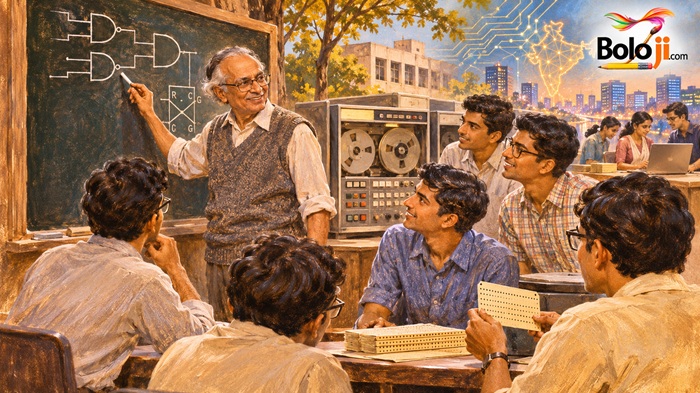
In the early 1960s, computers were unfamiliar machines to most Indians. They were expensive, enormous, and largely confined to specialized scientific and governmental applications.
The arrival of an IBM 1620 computer at IIT Kanpur in 1963 marked an important milestone in India's technological education. But Rajaraman recognized something more consequential than the machine itself. Computers could process information. Education could produce the minds capable of transforming information into innovation.
At IIT Kanpur, he helped pioneer formal computer science education, contributing to the establishment of one of India's earliest academic programs in the discipline during the mid-1960s.
Among the students exposed to computing at IIT Kanpur was N. R. Narayana Murthy, who would later establish Infosys in 1981.
The connection is historically significant, although India's IT revolution cannot be attributed to any single teacher or institution.
Rajaraman understood a fundamental principle of national development: technological sovereignty cannot be purchased exclusively through imported machinery. It must be cultivated through indigenous intellectual capability.
Machines become obsolete. Knowledge multiplies. And teachers create the conditions under which knowledge can multiply across generations.
The ‘Architect’ of India's ‘Digital Human Capital’
Rajaraman's contributions extended beyond IIT Kanpur. He played an influential role in developing computer science curricula and promoting postgraduate computer applications education, including the Master of Computer Applications (MCA) model.
The MCA pathway subsequently became an important avenue through which graduates from diverse academic backgrounds entered India's expanding software industry.
For countless middle-class families, computer education became an instrument of economic mobility. It transformed employment aspirations, expanded professional opportunities, and enabled Indian talent to compete internationally.
Rajaraman also contributed to India's efforts to develop indigenous advanced computing capabilities, including institutional initiatives associated with the emergence of the Centre for Development of Advanced Computing (C-DAC).
His academic legacy included numerous influential textbooks and the supervision of doctoral researchers. These contributions illustrate an often-neglected truth about economic development.
A country's greatest technological asset is not necessarily the technology it possesses, but the knowledge its people possess.
Recognition Beyond Riches
Rajaraman's contributions were recognized with the prestigious Shanti Swarup Bhatnagar Prize in 1976 and the Padma Bhushan in 1998. He guided more than 30 doctoral researchers, published over 70 research papers, and authored numerous textbooks that educated generations of Indian students. His achievements become even more remarkable when viewed against the economic circumstances of his time.
India lacked the financial resources, technological infrastructure, and industrial ecosystem enjoyed by advanced economies. Yet Rajaraman demonstrated that intellectual leadership could compensate, at least partially, for material scarcity. He did not establish a billion-dollar corporation. He helped develop the intellectual infrastructure that enabled others to establish such corporations.
Final Thoughts: The Teacher Behind the ‘Technological Revolution’
On November 8, 2025, Professor V. Rajaraman passed away in Bengaluru at the age of 92. His death marked the departure of an extraordinary educator whose influence extended from classrooms and research laboratories to India's expanding digital economy.
The Indian Institute of Science remembered him as an inspirational educator who embodied the philosophy of simple living, high thinking. His life also raises some uncomfortable questions about our collective priorities.
Why do we celebrate entrepreneurs who create companies but seldom recognize teachers who create entrepreneurs? Why do corporate valuations attract greater attention than intellectual contributions? Why does society measure success predominantly through wealth rather than wisdom? And why do the architects of a nation's educational foundations so often remain anonymous?
Perhaps the greatest tribute to Rajaraman would be to recognize that education is not merely another sector of the economy. It is the foundation upon which every other sector ultimately depends.
Narayana Murthy helped build Infosys. Rajaraman helped build the educational ecosystem that made India's Infosys generation possible. One created an enterprise. The other helped cultivate generations of enterprise builders. And therein lies his extraordinary legacy.
India's IT revolution was not born merely when computers entered corporate offices. It was also born when visionary educators brought computer science into Indian classrooms.
Professor V. Rajaraman was among the foremost of those visionaries.
