Sep 25, 2026
Sep 25, 2026
 Kabir, an orphan child believed to be a Hindu, was abandoned after birth at a pond in Benaras. A poor Muslim weaver’s family the Nimas, found the abandoned child and they adopted him. During those times of political, social, and religious upheaval, he did not find acceptance from either of the dominant communities of Hindus and Muslims. The direct impact of his being ostracized was that he did not get much of a chance to be educated, as schools of those days were run along religious lines. There was little acceptance of students in these institutions for those who did not belong to their own religious order.
He was illiterate, yet he has become one of the most quoted poets in Indian literature and history, and his compositions are most sung. His poetry was so powerful that it left everyone in awe. It had an undeniable impact on the masses across the religious divide. If there is one poet that everyone coming out of that multicultural influence of the Indian subcontinent had heard of, it was Kabir. Besides being a leading poet, he was a religious reformer, who founded his own order. Even today his influence is no less than it was during his own time.
The Hindu priests and Muslim Mullahs were at loggerheads with each other while constantly trying to prove that their professed faith was superior to the other. But Kabir had boldly declared that he does not follow the rituals of either faith in these words:

Pandit mulaa(n) jo likh dheeaa ||
Chhaadd chale ham kachhoo na leeaa ||3||
–– (SGGS, PG. No. 1159)
Translation: Whatever the Pandits and Mullahs have written and prescribed, I have rejected; I do not accept any of it. ||3||
Guru Arjan Dev Ji has further elucidated what Kabir words meant as:
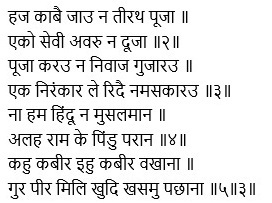
Hajj kaabai jaau na teerath poojaa ||
Eko sevee avar na dhoojaa ||2||
Poojaa karau na nivaaj gujaarau ||
Eik nirankar le ridhai namasakaarau ||3||
Naa hum hindhoo na musalamaan ||
Alleh raam ke pi(n)dd paraan ||4||
Kahu kabir ih keeaa vakhaanaa ||
Gur peer mil khudh khasam pachhaanaa ||5||3||
–– (SGGS, PG. No. 1136)
Translation: I do not make pilgrimages to Mecca, nor do I worship at Hindu sacred shrines. I serve the One God, and not any other. ||2|| I do not perform Hindu worship services, nor do I offer the Muslim prayers. I have taken the One Formless God into my heart; I humbly worship Him there. ||3|| I am not a Hindu, nor am I a Muslim. My body and breath of life is bestowed by the Divine who is called Allah and Raam. ||4|| Says Kabir, this is what I say: meeting with the Guru, my Spiritual Teacher, I have established a deep connection with Divine. ||5||3||
This was a stark, open challenge to the authority of the priestly class in both faiths. Therefore, the leaders of both the communities agreed that Kabir was a pariah and must be eliminated. They jointly petitioned the ruler, Sikander Lodhi, for it when he visited Benaras in 1494. The ruler gave the edict that an elephant should crush Kabir. The orders were being implemented, but the elephant refused to obey its driver (Mahaut). Kabir recorded the entire episode as below.
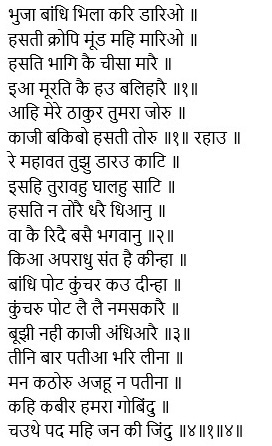
Bhujaa baa(n)dh bhilaa kar ddaario ||
Hasatee karop moo(n)dd meh maario ||
Hasat bhaag kai cheesaa maarai ||
Eiaa moorat kai hau balihaarai ||1||
Aaeh mere Thaakur tumaraa jor ||
Kaajee bakibo hasatee tor ||1|| Rahaau ||
Re mahaavat tujh ddaarau kaaT ||
Eiseh turaavahu ghaalahu saaT ||
Hasat na torai dharai dhiaan ||
Vaa kai ridhai basai bhagavaan ||2||
Kiaa aparaadh sa(n)t hai keen(h)aa ||
Baa(n)dh poT ku(n)char kau dheen(h)aa ||
Ku(n)char poT lai lai namasakaarai ||
Boojhee nahee kaajee a(n)dhiaarai ||3||
Teen baar pateeaa bhar leenaa ||
Mun kaThor ajahoo na pateenaa ||
Kaeh kabir hamaraa gobind ||
Chauthe padh meh jan kee ji(n)dh ||4||1||4||
–– (SGGS, Pg. No. 870)
Translation: They tied my arms, bundled me up, and threw me before an elephant. The elephant driver struck him on the head to infuriate him to charge. But the elephant screamed and ran away in another direction, (it says:), "I am a sacrifice to this image of God."||1|| O my God and Master, You are my strength. The Qazi shouted at the driver to drive the elephant on (Kabir). ||1||Pause|| He yelled out, "O driver, I shall cut you into pieces. Hit him and drive him on!" But the elephant did not move; instead, he was absorbed in the Divine’s feet. The God abides within his mind. ||2|| What sin has this Saint committed that you have made him into a bundle and thrown him before the elephant? Lifting the bundle, the elephant bows down before it. The Qazi could not understand it; he was blind. ||3|| Three times, he tried to do it. Even then, his hardened mind was not satisfied. Says Kabir, such is my God and Master. The soul of His humble servant (Kabir) dwells in the fourth state (above the three states of the material world). ||4||1||4||
His own record of the incident proves that he survived unharmed. Kabir Ji in his commentary said that Qazi goaded the elephant rider to go ahead and crush Kabir. Qazi threatened otherwise, I will have you cut to pieces. Kabir was facing imminent death, but the fear of death was not there in him as he was remembering God. The elephant would not move; instead, it was immersed in meditation. Kabir observed that even God resides in its heart. Next, Kabir shares what was going through the elephant’s mind. The elephant was questioning, “What sin has this Saint committed that you have made him into a bundle and thrown him before the elephant?” The elephant lifted the bundle in which Kabir was wrapped and bowed down before it. But the blinded Qazi could not realize the injustice he was perpetuating.
Kabir Ji concluded the commentary in these words: Kabir said that in the heart of the elephant dwells God, and He is compassionate. But the Qazi is stone-hearted, with no feeling or emotion to melt the heart. Everyone, including the Sultan, was speechless in awe.
He even mocked the Muslim practice of the importance of Hajj at least once in a lifetime in these words:

Kabir hajj kaabe hau jai thaa aagai miliaa khudhai ||
Saa(n)iee mujh siau lar pariaa tujhai kini(h) furamaiee gai ||197||
–– (SGGS, Pg. No. 1375)
Translation: Kabir, I was going on a pilgrimage to Mecca, and God met me on the way. He scolded me and asked, "Who told you that I am only there?"||197||
Bhagat Kabir was a non-conformist. He spoke strongly against the institutionalized faith, exploitation by clergy, and blind ritualistic observances. He saw these as barriers to spiritual development.
He was banished from Benaras, the city of Shiva, in 1495. He moved around for many years and settled in Magahara in 1518 to ridicule the Hindu belief that those who die there are reborn as donkeys. He not only moved there but also wrote about the irrelevance of the place of death, to rebirth in these words:
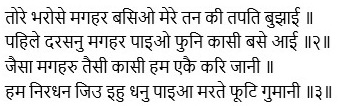
Torae bharose magahar basio mere tan kee tapat bujhaiee ||
Pahile dharasan magahar paio fun kaasee base aaiee ||2||
Hum niradhan jiau ih dhan paiaa marate fooT gumaanee ||3||
–– (SGGS, Pg. NO. 969)
Translation: (People say Maghara is a cursed land, but) relying upon You, I settled even in the cursed place of Magahara; You have put out the fire of vices from my body. First, I obtained the Blessed Vision of Your Darshan in Magahara; then, I came to dwell at Benares. ||2|| As is Magahara, so is Benares; I see them as the same. I was poor, but I have obtained this wealth of God; the proud –– (residents of Benaras who) are bursting with pride –– (because of their residency), are going to die of pride. ||3||
He concludes his composition by sharing his lofty achievement in these words:

Abb tau jai chadde si(n)ghaasan mile hai saari(n)gapaanee ||
Raam kabiraa ek bhe hai koi na sakai pachhaanee ||6||3||
–– (SGGS, Pg. No. 969)
Translation: Now, I have mounted to the throne of the God; I have met the Divine, the Sustainer of the World. The Divine and Kabir have become one. No one can tell them apart. ||6||3||
This is the ultimate achievement of oneness. From Bhagat Kabir’s writings, we see that his lasting legacy is defined by his fierce critique of religious dogma and his open promotion of direct spiritual devotion over ritualism. He urged people to look within themselves and discover the Divine through love, truth, humility, and sincere devotion.
Lasting Legacy
His lasting legacy is his profound impact on South Asian literature, a religious order, and interfaith spirituality, as under:
Writings of the Unlettered becomes field of study: Imagine that writings of this unlettered man have become a field of study. Scholars are doing PhD on his writings complete with thesis, plus publishing books on his writings. His writings are in textbooks from elementary School to university classes. Interestingly, in the many centuries since his passing away his poems have grown in number, finding expression in new languages and metaphors as they travel through various parts of India and beyond. Many anonymous poets, seekers and singers have added their own writings to his body of verse, and it has grown much like a river changing its course over time.
Inclusion in the Guru Granth Sahib: Kabir is the most prominent non-Sikh contributor (Bhagat) to Sikhism's holy scripture, which contains 229 of his hymns (Shabads) and 237 couplets (Saloks). This inclusion codified his teachings on Nirguna (formless Divine) and spiritual equality into a living religious tradition. By including his writings, the Sikh Gurus have not only embraced his contributions but also provided him with a respectable platform for spreading his message.
Kabir Panth and Festival: Kabir Panth is a religious community of his followers. No official records of number of followers exist, but Millions of followers belong to the order today. It emphasizes non-violence, truthfulness, and devotion while rejecting class, caste, and institutional religious boundaries.
Kabir Festival is an annual celebration dedicated to this mystic poet and Bhakti saint, Kabir. Through a vibrant blend of different forms of arts, they explore his philosophy into dialogue and how it applies to contemporary lives.
Radical Social Reform: A 15th-century weaver from Varanasi, Kabir used his sharp wit and blunt couplets (Saloks/Dohes) to challenge the caste system, untouchability, and clerical hypocrisy in both Hinduism and Islam. He famously argued that true spirituality relies on inner purity, not rituals like idol worship, pilgrimages, or ritual baths.
Linguistic and Poetic Impact: Kabir wrote in Sadhukkari (a vernacular blend of Hindi, Punjabi, Braj, and Persian), making complex philosophy accessible to common people. His Bijak, Sakhi Granth, and couplets remain central to South Asian folklore, music, and school curricula.
Syncretic Bridge: By rejecting rigid sectarian labels, Kabir became a timeless symbol of interfaith unity, showing how divine truth transcends formal institutional religion.
His voice remains relevant today, reminding us that the path to the Divine begins with transforming the human heart within.
Artwork by Arpana Caur
September 25, 2026
